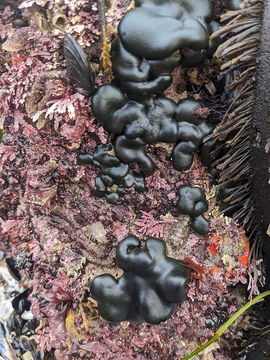
Eugonophyllum
Calcareous phylloid alga from Carboniferous to Permian.

Eugonophyllum is a genus of green algae in the family Halimedaceae, known from Carboniferous to Permian beds in North America, Europe, and east Asia. It is notable as a calcareous phylloid alga whose remains are important components of carbonate rock beds, particularly in Pennsylvanian to early Permian strata.
Quick Facts
- Taxon
- Eugonophyllum
Facts from the source article.
Lore & Background
Eugonophyllum is a phylloid alga, meaning it has leaflike photosynthesizing structures called thalli. Each thallus is a broad, undulating blade with circular to oval perforations scattered randomly across it. The blade consists of a fibrous medulla enclosed in a two-layered cortex: a thicker inner cortex of anastomosing utricles (small sacklike structures joined by openings to neighbors) and a thin outer cortex of branchlets extending outward. Reproductive organs are spherical protuberances within the inner cortex, scattered irregularly over the thallus surface.
The alga is calcareous and its remains are important components of carbonate rock beds of Pennsylvanian to early Permian age. It is particularly prominent as a carbonate producer (together with Paraepimastopora kansasensis) in rocks of Kasimovian to Gzhelian age, in regions of warm water notably close to glaciated continental areas. It grew below wave base, probably in protected shallow water, and grew to at least a few inches in height.
Reader's Guide
Eugonophyllum holds significance as a carbonate producer in Pennsylvanian to early Permian carbonate rock beds, especially during the Kasimovian to Gzhelian ages. Its remains, together with those of Paraepimastopora kansasensis, are prominent in warm-water regions near glaciated continental areas. The alga's phylloid morphology—broad, perforated blades with a two-layered cortex and reproductive structures within the inner cortex—contributes to its identification in the fossil record. Its growth below wave base in protected shallow water suggests a specific ecological niche. As a calcareous organism, its skeletal material directly contributed to carbonate sedimentation, making it a key component in understanding the paleoenvironment and sedimentology of late Paleozoic carbonate platforms. The article does not discuss extinction, modern relatives, or economic uses beyond its role as a carbonate producer.
Did You Know?
- Eugonophyllum belongs to the family Halimedaceae.
- Its thallus has circular to oval perforations scattered randomly across the blade.
The Wang et al. Reproductive Study (2025)
In 2025, the research team led by Wang published a study examining the reproductive biology of Eugonophyllum, a fossil algal organism. The investigation drew upon fossil specimens recovered from the Maping Formation, a geological unit situated in the province of Guizhou, China. These fossils date to the Gzhelian stage of the Carboniferous period, placing the organism in a specific window of late Paleozoic time. The study's focus on reproduction marks a particular analytical lens through which the fossil record of this alga is examined, rather than a broader morphological or taxonomic treatment. The publication appeared as part of the broader 2025 body of fossil plant research, which encompassed new taxa descriptions and significant discoveries across multiple plant groups. For Eugonophyllum specifically, this 2025 contribution represents the documented research attention the organism received during that year, centered on understanding how it reproduced based on the preserved evidence in the Guizhou strata.
Geological and Geographic Provenance
The Eugonophyllum fossils central to the 2025 Wang et al. study originate from a well-defined geological and geographic setting. The specimens come from the Maping Formation, a stratigraphic unit in the province of Guizhou in southwestern China. The formation is assigned to the Gzhelian stage, which represents the latest interval of the Carboniferous period. This temporal placement situates the Eugonophyllum material in the final phase of the Carboniferous, a period spanning roughly 300 to 299 million years ago. The Guizhou location places the find within a region of southwestern China that has yielded important Carboniferous fossil assemblages. The Maping Formation thus serves as the specific source horizon for the reproductive structures that Wang and colleagues examined, anchoring the organism in a particular depositional environment and time slice. No other formations or localities are mentioned in connection with the Eugonophyllum reproductive study, making this Guizhou provenance the sole documented source for the 2025 work.
Eugonophyllum Among 2025 Phycological Discoveries
The 2025 publication on Eugonophyllum reproduction sits within a broader constellation of algal and phycological research documented that year. Alongside the Wang et al. study, 2025 saw Martín-Closas and colleagues reporting the first fossil material of the charophyte genus Sycidium from the Upper Devonian of Armenia, shedding light on utricle morphology. Huang and co-workers presented evidence from molecular fossil steranes in Lower Triassic strata from both Xiakou in China and the Sverdrup Basin in Canada, pointing to reorganization of marine algal communities after the Permian–Triassic extinction. Škaloud and colleagues published genetic analyses of Mallomonas intermedia from European and North American populations, with Eocene fossils from British Columbia and the Northwest Territories being reclassified. In this context, the Eugonophyllum study contributes a Carboniferous perspective on algal reproductive biology, complementing the Devonian, Eocene, and Triassic algal research that defined the 2025 phycological literature.
Reproductive Biology as a Distinctive Research Focus
The decision by Wang and colleagues to center their 2025 investigation on the reproduction of Eugonophyllum reflects a specific research priority within fossil algal studies. Rather than describing new morphology, establishing phylogenetic relationships, or documenting geographic distribution, the study targets the reproductive structures preserved in the Gzhelian Maping Formation material from Guizhou. This focus on reproduction in a Carboniferous alga suggests that the fossil record in this formation preserves sufficient detail of reproductive anatomy to warrant dedicated analysis. The study is categorized within phycological research in the 2025 fossil plant literature, grouping it with other algal investigations that span from the Devonian to the Triassic. The reproductive angle distinguishes the Eugonophyllum work from many other 2025 paleobotanical contributions, which more commonly address taxonomy, phylogeny, or ecological context. For a fossil organism from the late Carboniferous, understanding reproduction from the preserved record offers a direct window into its biological strategy during that era.
Frequently Asked Questions
What is Eugonophyllum?
Eugonophyllum is a genus of green macroalgae classified as a calcareous phylloid alga. It belongs to the family Halimedaceae and is known exclusively from the fossil record.
What time period does Eugonophyllum span?
This genus appears in rock layers ranging from the Carboniferous through the Permian periods. It was particularly active as a carbonate-building organism during the Kasimovian to Gzhelian stages.
Where have Eugonophyllum fossils been discovered?
Fossil remains of this alga have been identified across North America, Europe, and East Asia. Its wide distribution suggests it thrived in various marine environments during the late Paleozoic.
Why does Eugonophyllum matter to geologists?
Its calcified remains form a significant portion of carbonate rock beds, especially in Pennsylvanian to early Permian strata. Because it was a major contributor to carbonate deposition, it helps geologists reconstruct ancient marine environments.
What family is Eugonophyllum part of?
Eugonophyllum is placed within the Halimedaceae family of green algae. As a phylloid alga, it built thin, blade-like calcareous structures that accumulated into substantial rock layers over millions of years.
More in Marine Green Macroalgae 1-24
Spotted an error? Know more?
Reader corrections go straight into our review queue. Suggest an edit · How this site is sourced