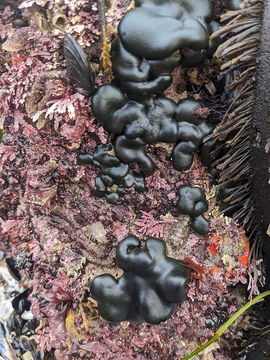
Trentepohliales
Exclusively subaerial green algae with net-like chloroplasts.

Trentepohliales is an order of green algae containing the single family Trentepohliaceae, which is a member of the Ulvophyceae. It is notable for being exclusively subaerial, with a cosmopolitan distribution, and for its unique combination of ultrastructural traits such as net-like chloroplasts without pyrenoids and cell walls with plasmodesmata.
Quick Facts
- Taxon
- Trentepohliaceae
Facts from the source article.
Lore & Background
Members of Trentepohliales consist of uniseriate filaments that are variably branched. In some genera, the filaments form small bushy tufts; in others, they grow into a pseudoparenchymatous disc. Reproduction is both asexual and sexual, with zoospores formed in a sporangiate-lateral structure attached via a suffultory cell. Their life cycle involves alternation of generations between sporophyte and gametophyte phases, which may be isomorphic or heteromorphic.
Reader's Guide
Trentepohliales are significant as one of the most common and widespread types of subaerial algae, with a cosmopolitan distribution. They are often closely associated with lichen-forming fungi and are common as phycobionts within lichens. Some genera, such as Cephaleuros and Stomatochroon, are parasites of vascular plants. The order is taxonomically well-defined, but its unique ecological and ultrastructural characters have historically made placement difficult; molecular studies have clearly placed it in Ulvophyceae. The genera are currently considered polyphyletic or paraphyletic and in need of revision.
Did You Know?
- Trentepohliales is the only order in the family Trentepohliaceae.
- They have net-like chloroplasts without pyrenoids.
Frequently Asked Questions
What is Trentepohliales?
Trentepohliales is an order in the class Ulvophyceae that houses a single family, Trentepohliaceae. It unites five genera of green algae that share a distinctive set of cellular and structural features.
Where do Trentepohliales species live?
Every member of this order is strictly subaerial, so you will never find them submerged in water. They cling to rocks, tree bark, wood, leaves, and bare soil, with the richest diversity occurring across tropical and subtropical zones worldwide.
What makes Trentepohliales structurally unique?
These algae carry net-like chloroplasts that completely lack pyrenoids, a trait combination not found in other green algal lineages. On top of that, their cell walls contain plasmodesmata, giving the group a highly distinctive ultrastructural signature.
Which genera are included in Trentepohliales?
The order encompasses exactly five genera: Cephaleuros, Phycopeltis, Printzina, Trentepohlia, and Stomatochroon. All of them sit under the single family Trentepohliaceae.
Why is Trentepohliales significant in algal biology?
It is the only order of green algae that is entirely subaerial, making it a prime model for understanding how algae adapt to life on land. Its worldwide distribution combined with its unusual chloroplast and cell-wall architecture keeps it a focal point for comparative algal research.
More in Marine Green Macroalgae 1-24
Spotted an error? Know more?
Reader corrections go straight into our review queue. Suggest an edit · How this site is sourced