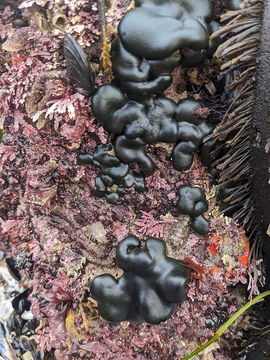
Bryopsidales
A diverse order of mostly marine green macroalgae.

Bryopsidales is an order of green algae belonging to the class Ulvophyceae. This group consists mainly of diverse marine macroalgae.
The thallus is filamentous, heavily branched, and often packed into a dense mass. It is coenocytic, meaning its cells are multinucleate, with cytoplasm enclosed in a cylindrical cell wall. No septae are present, and numerous discoid chloroplasts, nuclei, and other organelles can move freely throughout the organism. The entire organism may be a single cell; in the genus *Caulerpa*, that single cell can span several metres. In *Halimeda*, entire seabed meadows can be one individual, single-celled organism, linked by filamentous threads running through the substrate.
Reproduction usually occurs vegetatively, with small fragments growing into new individuals. Under certain conditions, sexual reproduction happens through a process called holocarpy. Nearly all the cytoplasm in the thallus turns into biflagellate gametes, which are released into the sea via papillae. After fertilisation, the zygote forms a protonema, which then develops into a new thallus.
Quick Facts
- Taxon
- Bryopsidales
Facts from the source article.
Lore & Background
The thallus of Bryopsidales is filamentous, highly branched, and may be packed into a mass. It is coenocytic, having multi-nucleate cells consisting of cytoplasm contained within a cylindrical cell wall. There are no septae, and the many discoid chloroplasts, nuclei and other organelles are free to move through the organism. The whole organism may consist of a single cell; in the genus Caulerpa, this single cell may be several metres across. In the genus Halimeda, whole seabed meadows may consist of an individual, single-celled organism connected by filamentous threads running through the substrate.
Propagation is normally vegetative from small fragments which grow into new individuals. Under certain conditions, sexual reproduction occurs in a process called holocarpy. Almost all of the cytoplasm in the thallus is converted into biflagellate gametes, which are discharged into the sea through papillae. After fertilisation, the zygote becomes a protonema and this, in turn, develops into a new thallus.
Molecular phylogenetic studies suggest relationships between extant taxa, though Chaetosiphonaceae is not included in those studies.
Reader's Guide
Bryopsidales is significant as a diverse order of mostly marine macroalgae that demonstrates extreme coenocytic organization, where a single cell can form large, complex structures. In the genus Caulerpa, a single cell may span several metres, while in Halimeda, entire seabed meadows can be a single organism connected by filamentous threads. This challenges typical notions of cellular boundaries. The order reproduces primarily through vegetative fragmentation, but under certain conditions undergoes holocarpic sexual reproduction, converting nearly all cytoplasm into biflagellate gametes. The absence of septae and the free movement of organelles within the thallus highlight its unique cellular architecture. Molecular phylogenetic studies have clarified relationships among its taxa, though Chaetosiphonaceae is not included in those analyses. Its legacy lies in exemplifying how simple cellular organization can produce large, ecologically important marine algae.
Did You Know?
- The thallus of Bryopsidales is coenocytic, with no septae, allowing organelles to move freely.
- In the genus Caulerpa, the entire organism may be a single cell several metres across.
- In Halimeda, whole seabed meadows may consist of a single, individual cell connected by filamentous threads.
- Sexual reproduction in Bryopsidales occurs via holocarpy, where almost all cytoplasm is converted into biflagellate gametes.
Taxonomic Identity & Ecological Scope
Bryopsidales is an order of green algae classified within the class Ulvophyceae. What sets this group apart is its identity as a diverse assemblage of predominantly marine macroalgae—organisms of sufficient size to be classified as macroscopic, inhabiting oceanic environments. The descriptor 'diverse' is central to understanding this order: it does not represent a narrow, uniform lineage but rather encompasses a wide range of morphological forms within the marine realm. As macroalgae, these organisms are visible without magnification and form a tangible, physical component of underwater ecosystems. Their placement within Ulvophyceae links them to a broader evolutionary lineage of green algae, yet their order-level identity reflects a shared set of structural and reproductive traits that distinguish them from other ulvophycean groups. The marine dominance of this order underscores its ecological presence in saltwater environments, where these organisms exist at a scale visible to the naked eye.
Cellular Architecture & the Coenocytic Body
The physical body of a Bryopsidales organism—the thallus—presents a striking architectural paradox. It is filamentous and highly branched, sometimes packed into dense masses, yet fundamentally it may constitute a single, undivided cell. This is the hallmark of coenocytic organization: the cytoplasm is enclosed within a cylindrical cell wall, but there are no internal septae partitioning it into discrete cells. Instead, numerous discoid chloroplasts, nuclei, and other organelles drift freely through the shared cytoplasmic volume. The consequences of this design are extraordinary in scale. In the genus Caulerpa, a single coenocytic cell can spread across several metres of substrate. In Halimeda, an entire seabed meadow may in fact be one individual organism, its vast body connected by filamentous threads threading through the sediment. What appears to be a colony or a meadow is, at the cellular level, a single multinucleate entity with no internal walls.
Reproductive Strategies
Bryopsidales organisms propagate primarily through asexual, vegetative means: small fragments break away from the parent thallus and grow into independent new individuals. This simple fragmentation strategy represents the default mode of population expansion. However, under particular environmental conditions, a more complex sexual pathway is activated, a process termed holocarpy. In holocarpy, nearly the entire cytoplasmic content of the thallus is reorganized and converted into biflagellate gametes—motile reproductive cells bearing two flagella. These gametes are then discharged into the surrounding seawater through specialized structures called papillae. Following fertilization, the resulting zygote does not immediately form a mature thallus. Instead, it first develops into a protonema, an intermediate growth stage, which subsequently matures into a full new thallus. This two-stage post-fertilization development—zygote to protonema to thallus—adds a layer of developmental complexity to what is otherwise a straightforward marine reproductive cycle.
Phylogenetic Context
Molecular phylogenetic studies have begun to illuminate the evolutionary relationships among the extant taxa within Bryopsidales. These genetic analyses provide a framework for understanding how the various lineages are related to one another, offering a view of their shared ancestry that morphological observation alone cannot supply. Notably, the family Chaetosiphonaceae falls outside the scope of these particular phylogenetic reconstructions, meaning its precise placement relative to the other bryopsidalean lineages remains a matter for further investigation. The reliance on molecular data reflects the challenges of classifying coenocytic algae, where the absence of cellular compartmentalization limits the range of structural features available for traditional taxonomic comparison. The phylogenetic picture that emerges is one of a cohesive order with internal diversification, yet the exact branching order among its constituent taxa continues to be refined as genomic and molecular tools improve.
Frequently Asked Questions
What is Bryopsidales?
Bryopsidales is an order of green macroalgae classified under the class Ulvophyceae. It encompasses a wide variety of mostly marine species that are recognized for their complex, heavily branched body forms.
What does the body structure of Bryopsidales look like?
The thallus is typically filamentous, densely branched, and often packed into tight masses. A defining feature is that it is coenocytic: the organism can be a single multinucleate cell with no internal septae, allowing nuclei and discoid chloroplasts to drift freely through one continuous cytoplasm.
Which genera are most famous within Bryopsidales?
Caulerpa and Halimeda are the two genera most commonly associated with this order. Caulerpa is noted for producing a single cell that can span several metres, while Halimeda is recognized for forming extensive meadows across the seabed.
Where do Bryopsidales organisms live?
Members of this order are predominantly marine, thriving in seawater environments. They are not generally associated with freshwater or terrestrial habitats.
What makes Bryopsidales structurally unique compared to other algae?
Rather than being built from many small, walled cells, Bryopsidales organisms are coenocytic, meaning one continuous cytoplasmic space houses numerous nuclei and freely moving organelles. This architecture allows a single 'cell' to reach extraordinary sizes, as demonstrated by metre-long Caulerpa individuals.
More in Marine Green Macroalgae 1-24
Spotted an error? Know more?
Reader corrections go straight into our review queue. Suggest an edit · How this site is sourced