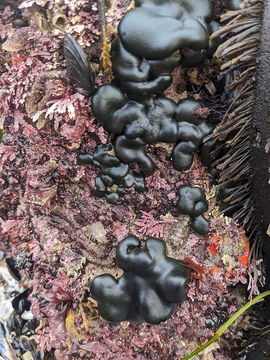
Caulerpa brachypus
Invasive green seaweed spreading beyond its native Indo-Pacific range.

Caulerpa brachypus is a species of green seaweed in the Caulerpaceae family, first described in 1860 by the Irish botanist William Henry Harvey from collections made during the North Pacific Exploring and Surveying Expedition of 1853 to 1856. Native to the Indo-Pacific region, it has spread elsewhere and is regarded as an invasive species in the United States, Martinique, and New Zealand.
Quick Facts
- Genus
- Caulerpa
- Species
- brachypus
Facts from the source article.
Lore & Background
Caulerpa brachypus is a green seaweed with a horizontal creeping stolon that sends up blade-like fronds on short rhizoids at intervals. These thalli are tongue-like or strap-like in shape, up to 5 cm long and mainly green, sometimes with yellowish margins. Where they occur together, it is difficult to distinguish this species from other members of the genus Caulerpa, especially as there is considerable variation between different populations growing in different habitats. Where conditions suit it, it can become very profuse and form dense stands.
It is native to the tropical and subtropical Indo-Pacific region, including East Africa, India, southeastern and eastern Asia, the Pacific Islands, and Western Australia. In Western Australia, it is found scattered over a large area in the Pilbara region between Exmouth and Port Hedland. It was first detected in the United States in Martin County, Florida, in 1999 and had spread to the Indian River Lagoon by 2003. It was found at Great Barrier Island in New Zealand in 2021.
Sexual reproduction is probable but asexual reproduction via fragments breaking off and re-establishing is more common. In its native surroundings, herbivorous fish keep it in check, but in Florida few fish feed on it, allowing it to flourish on off-shore reefs and reduce biodiversity. It is intolerant of bright light, growing best in shaded positions, mostly found in the 25 to 47 m depth range, and in turbid water it flourishes in shallower habitats.
Reader's Guide
Caulerpa brachypus is notable primarily for its invasive behavior outside its native Indo-Pacific range. In Florida, it has been dubbed the 'killer algae' after first being recorded in the state in 1999. By 2003 it had shown explosive growth and spread widely, with some near shore reefs in Palm Beach County becoming so overwhelmed that fish and lobsters were no longer present. During hurricanes in 2004, it was scoured from the rocky reefs and disappeared, but over the next few years it became re-established, once more forming dense stands. Its abundance on Florida's coast is thought to be linked to sewage outflows that add extra nutrients to the water. Such extensive algal cover is likely to kill corals, sponges, and other sessile invertebrates, and force more mobile organisms to move elsewhere. The species is also considered invasive in Martinique and New Zealand, where it was detected at Great Barrier Island in 2021. Its ability to spread through asexual fragmentation and its tolerance of shaded, deeper waters make it a persistent threat to native marine ecosystems.
Did You Know?
- Caulerpa brachypus was first described in 1860 by Irish botanist William Henry Harvey.
- In Florida, it has been dubbed the 'killer algae' and can overwhelm reefs, displacing fish and lobsters.
- It reproduces asexually by fragments breaking off and re-establishing elsewhere.
Taxonomy & Nomenclature
The genus name Caulerpa carries a vivid etymological story rooted in Ancient Greek: kaulos, meaning "stalk," combined with herpo, meaning "to creep," a reference to the characteristic crawling habit of the thallus across seafloor substrates. Jean Vincent Lamouroux first formally described the genus in 1809, and it remains the sole representative of the family Caulerpaceae within the order Bryopsidales, class Ulvophyceae, and phylum Chlorophyta. Modern molecular work has refined its placement: tufA gene sequencing identified Pseudochlorodesmis as a sister clade, while Cremen and colleagues proposed a revised Bryopsidales scheme positioning Caulerpaceae and Halimedaceae as sister families. Identifying species within the genus remains notoriously difficult because morphological traits show enormous variation, leading to frequent misidentification without molecular tools. By 2019, taxonomists recognized 101 accepted species, along with 40 varieties and 67 forms, underscoring just how much hidden diversity this single-celled lineage harbors.
Biology & Internal Anatomy
What makes Caulerpa brachypus truly extraordinary is its cellular architecture. Rather than being composed of many individual cells, the entire thallus is a single, multinucleate organism — a coenocytic, siphonous structure in which nuclei float freely within one continuous mass of protoplasm enclosed by a single outer cell wall. This makes members of the genus among the largest single cells known on Earth. To sustain such a vast volume, the cytoplasm must circulate continuously, a process driven by an internal network of microtubules first documented in 1967. Remarkably, when the cell is cut, the cytoplasm does not simply leak away; instead, regeneration proceeds directionally, with rhizoids regenerating at the lower surface and fronds at the upper. Inward-growing wall extensions called trabeculae thread through the central lumen, likely providing structural reinforcement, aiding nutrient diffusion to deeper cytoplasm, and influencing the diverse shapes the genus displays. The organism also synthesizes secondary metabolites — the red alkaloid caulerpin, its derivative caulerchlorin, and the amine caulerpicin — compounds linked to both its peppery flavor and its toxicity.
Morphology & Growth Forms
The external architecture of Caulerpa brachypus is both elegant and varied. A horizontal stolon creeps along the substrate, sending down rhizoids that anchor the organism firmly to the seafloor. From this stolon, upright structures called assimilators rise toward the light. Depending on the species, these assimilators may be simple and leaf-like (ligulate) or organized around a central axis called a rachis. The rachis, in turn, bears lateral branchlets known as ramuli, which come in an impressive array of shapes — terete, turbinate, clavate, peltate, falcate, or vesiculate. Their spatial arrangement adds another layer of variation: distichous (ramuli set evenly opposite one another, as in C. taxifolia), irregular (vesiculate ramuli with no clear pattern, as in C. racemosa), or verticillate (ramuli arranged in whorls, as in C. cuppresoides). This combinatorial diversity in ramuli shape and arrangement is one reason morphological identification within the genus is so challenging, and it also hints at the functional versatility of a single-cell organism.
Ecology, Distribution & Human Use
Caulerpa brachypus thrives predominantly in tropical waters, though its range can extend into temperate zones. Species richness peaks in the Caribbean, the Indo-Malay region, and southern Australia, where many lineages are endemic. The genus occupies shallow intertidal habitats and can be found at depths reaching 100 meters. Its ecological success rests on several traits: broad temperature tolerance, rapid growth, asexual reproduction through rhizoid extension and fragmentation, and the ability to draw nutrients directly from sediments via rhizoids — a competitive advantage over macroalgae that rely mainly on the water column. These same traits make some species prone to becoming invasive. On the human side, certain Caulerpa species are edible; C. lentillifera and C. racemosa, both marketed as "sea grapes," are harvested wild or cultivated across Southeast Asia, Oceania, and East Asia. Aquaculture began in the 1950s in Cebu, Philippines, and has since spread to Japan, Vietnam, Taiwan, and China. Cultivation is straightforward because fragments propagate easily, and farmers use off-bottom cages, bottom-planting, or land-based raceways. However, the genus accumulates high levels of iron and other elements, and its notable bioaccumulation rate advises against regular consumption.
Frequently Asked Questions
What is Caulerpa brachypus?
It is a green macroalga in the family Caulerpaceae, recognizable by its relatively small fronds that top out around 5 cm in length. It lives in mid-shelf waters and is most commonly encountered in the Indo-Pacific.
Where is Caulerpa brachypus native to?
Its natural home is the Indo-Pacific region. Outside that range it has spread and is now treated as an invasive green seaweed in several non-native locations.
Where has Caulerpa brachypus become invasive?
It has established itself as an invasive species in the United States, Martinique, and New Zealand. In each of those places it spreads beyond the boundaries of its original Indo-Pacific distribution.
Who first described Caulerpa brachypus and when?
The Irish botanist William Henry Harvey published the formal description in 1860. He worked from material gathered during the North Pacific Exploring and Surveying Expedition, a voyage that ran from 1853 through 1856.
At what depths does Caulerpa brachypus typically grow?
It is generally found between roughly 25 and 47 metres below the surface. That places it squarely in the mid-shelf zone, well past the shallow intertidal band but far from the deep sea.
More in Marine Green Macroalgae 1-24
Spotted an error? Know more?
Reader corrections go straight into our review queue. Suggest an edit · How this site is sourced