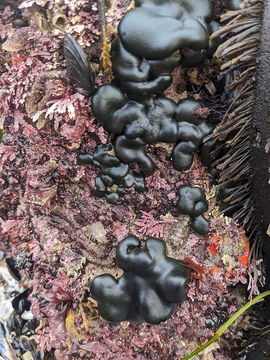
Halimeda opuntia
A calcareous green seaweed forming dense mats on reefs.

Halimeda opuntia, also called watercress alga, is a green seaweed with a hard, calcium-rich structure, belonging to the order Bryopsidales. It lives on reefs across the Indo-Pacific, the Atlantic, and the Mediterranean Sea.
This alga grows in dense, heavily branched clumps made of flat, leaf-like segments that can reach up to 25 centimeters tall. Each segment is kidney- or fan-shaped, about 8 millimeters high and 10 millimeters wide, with a clear central rib and a smooth, wavy, or lobed top edge. Wherever a segment touches the ground, root-like rhizoids sprout. The plants often pack so tightly together that they form a thick mat, making individual plants hard to pick out.
It can be found in the Indo-Pacific, Atlantic, Mediterranean, Caribbean, and near Florida and the Bahamas. It typically grows in grooves, cracks, and depressions in rock or among coral heads in moderately sheltered parts of the reef, at depths up to about 55 meters.
On degraded coral reefs where macroalgae are abundant, experiments show that coral larvae settle just as readily on this seaweed as on rubble. Larvae of the coral *Favia fragum* often settle on *Halimeda opuntia*, but because the alga is short-lived, it cannot support the coral’s long-term survival. This behavior could significantly affect coral recruitment on damaged reefs.
The alga produces secondary metabolites, including growth regulators like auxins, gibberellins, and cytokinins, as well as substances with antibacterial and antifungal properties. However, these are not currently harvested for commercial use.
Quick Facts
- Genus
- Halimeda
- Species
- opuntia
Facts from the source article.
Lore & Background
Halimeda opuntia forms thick, frequently-branched clumps of calcified, leaf-like segments up to 25 cm high. The segments are flat and kidney- or fan-shaped, up to 8 mm high and 10 mm broad, with a distinct central rib and a smooth, sinuous, or lobe-shaped upper margin. Rhizoids grow where the segments touch the substrate, and the plants are often crammed closely together forming a dense mat in which individual plants are not easily discernible.
It is found in the Indo-Pacific Ocean, the Atlantic Ocean, the Mediterranean Sea, the Caribbean Sea, and around the coasts of Florida and the Bahamas. It grows in grooves, depressions and cracks in rocks and between coral heads in moderately protected parts of the reef, at depths down to about 55 m.
Where degraded coral reefs have abundant macroalgae, experiments have shown that coral larvae of Favia fragum will settle on Halimeda opuntia in as great quantities as on rubble substrate. However, the alga was ephemeral and therefore unsuitable for long-term survival of the coral, which may have significant consequences for coral recruitment on degraded reefs. The secondary metabolites include growth regulators such as auxins, gibberellins and cytokinins, and substances with antibacterial and antifungal properties, but these are not being harvested for commercial use.
Reader's Guide
Halimeda opuntia is significant as a calcareous green seaweed that forms dense, calcified mats on reefs across multiple ocean regions, including the Indo-Pacific, Atlantic, Mediterranean, and Caribbean. Its ecological role is highlighted by experimental findings that coral larvae of Favia fragum will settle on this alga as readily as on rubble substrate on degraded reefs. However, because the alga is ephemeral, it is unsuitable for the long-term survival of the coral, a factor that may have important consequences for coral recruitment in degraded reef environments. The species also produces secondary metabolites including growth regulators (auxins, gibberellins, cytokinins) and substances with antibacterial and antifungal properties, though these are not currently harvested for commercial use. Its legacy lies in its dual role as both a habitat-forming alga and a potential ecological trap for coral larvae, underscoring the complex interactions between macroalgae and coral recovery.
Did You Know?
- Halimeda opuntia is sometimes known as the watercress alga.
- Coral larvae of Favia fragum have been observed to settle on this alga as readily as on rubble substrate.
- Its secondary metabolites include auxins, gibberellins, cytokinins, and antibacterial and antifungal substances.
Architecture of a Calcified Body
Halimeda opuntia presents one of marine biology's most striking structural designs: a thallus built from discrete, calcified segments linked by soft, non-calcified nodes. The hardening process begins remarkably quickly—aragonite, a crystalline form of calcium carbonate, starts precipitating within roughly 36 hours of tissue development. Each mature segment ends up 60 to 80 percent aragonite by volume, giving the alga a rigid, almost skeletal quality that deters most herbivorous fish and invertebrates. Beneath this mineral armor lies a complex internal architecture. The thallus is organized into siphons, which are continuous, undivided filaments of cytoplasm packed with multiple nuclei. These siphons branch in a trichotomous pattern to form peripheral utricles that press together, enclosing tiny intersiphonal cavities. It is precisely within those cavities that aragonite crystals nucleate and grow. Three distinct holdfast strategies anchor the organism to its substrate: loose trailing filaments for open-water sprawlers, dense matted roots gripping rock surfaces, and fine root-like threads threading through sand grains. This coenocytic, siphonous body plan sets Halimeda apart from other calcified green algae such as Acetabularia, which relies on cross-walled cells.
Sediment Builder and Carbon Player
In tropical reef systems, Halimeda opuntia plays a quietly monumental role in shaping the physical landscape. Its calcified tissues, once broken down, become the dominant source of coarse green-algal grains in lower-latitude sediments. In some lagoons the growth is so vigorous that the entire sediment column is composed almost exclusively of Halimeda remains, producing what researchers call Halimeda sand. Over geological timescales, this accumulation has been so extensive that certain atoll systems are built largely from this algal-derived carbonate. On the Great Barrier Reef off Queensland, Australia, the genus is responsible for distinctive circular carbonate deposits on the sheltered, leeward sides of outer shield reefs, where nutrient-rich open-ocean currents feed the beds. These represent the most extensive actively accumulating Halimeda formations known worldwide. Beyond sediment production, H. opuntia has been measured at producing up to 54.37 grams of calcium carbonate per square meter per year, underscoring its potential as a meaningful carbon sink in the ocean's budget. Yet the alga is not entirely immune to grazing; parrotfish species including Scarus rivulatus, Hipposcarus longiceps, and Chlorurus microrhinos do consume it, and hard coral canopies—particularly Acropora colonies—appear to shelter thalli from this herbivory, allowing them to grow larger than exposed individuals.
A Brief, Dramatic Life
The reproductive strategy of Halimeda opuntia is both fleeting and spectacular. Sexual reproduction, though rarely witnessed by researchers because it unfolds in under 36 hours, follows a tightly choreographed sequence. Gametangia first appear along the margins of the thallus segments. By the following day, every cell in the organism has been converted into a gametangium. These structures mature overnight and then release their gametes into the water column on the morning of the next day. After this single reproductive act, the thallus bleaches white and dies entirely—a phenomenon termed holocarpy, in which the whole organism is sacrificed to reproduction. Some populations appear to coordinate their spawning in mass events reminiscent of coral spawning, though spread over several months with small fractions of the colony reproducing each day. The overall lifespan of the genus is thought to be only a few months to a year. Asexual propagation, by contrast, is straightforward: fragments break off and reattach elsewhere, effectively cloning the parent. The full life cycle remains incompletely understood; a haploid gametophyte stage is presumed, possibly followed by a sporophyte phase, but the precise timing of meiosis has not yet been determined.
Taxonomy and the Cryptic Species Puzzle
Classifying Halimeda opuntia and its relatives has proven deceptively difficult. The genus, named by J.V. Lamouroux and nested within the order Bryopsidales and family Halimedaceae, is divided into five monophyletic sections—Halimeda, Micronesicae, Opuntia, Pseudo-opuntia, and Rhipsalis—distinguished primarily by how their medullary siphons fuse. As of 2015, Algaebase catalogued 71 species and 67 infraspecific names, yet the true diversity may be obscured by a well-documented phenomenon: morphological convergence. Halimeda is regarded as one of the best-studied examples of cryptic species pairs among marine macroalgae, where genetically distinct lineages look nearly identical under a microscope. Distribution patterns add further complexity. Several species, including H. opuntia itself, H. copiosa, H. discoidea, H. gracilis, H. simulans, and H. tuna, are found across tropical waters from the Thai-Malay Peninsula to the Florida Keys. Yet H. tuna is restricted to the Mediterranean. The genus is coenocytic, meaning each individual is a single, multi-nucleate cell without cross-walls, and in some cases an entire meadow may represent one continuous organism linked by fine threads running through the substrate.
Frequently Asked Questions
Who is Halimeda opuntia?
Halimeda opuntia, often nicknamed the watercress alga, is a calcareous green seaweed classified under the order Bryopsidales. It is a reef-dwelling species distinguished by its hard, calcium-rich body structure.
What does Halimeda opuntia look like?
It forms tightly packed, heavily branched clumps of flat, kidney- or fan-shaped segments, each roughly 8 mm tall and 10 mm wide with a visible central rib. The upper edge of every segment is smooth, wavy, or lobed, and root-like rhizoids sprout wherever a segment presses against the substrate.
Where can you find Halimeda opuntia?
This alga ranges across the Indo-Pacific, the Atlantic, the Mediterranean, the Caribbean, Florida, and the Bahamas. It typically inhabits reef environments and can be found at depths of up to about 55 meters (180 ft).
How big does Halimeda opuntia get?
A mature plant can grow up to 25 centimeters (10 inches) tall, producing dense mats of overlapping segments. Each individual segment is quite small, reaching no more than 8 millimeters in height and 10 millimeters in width.
Why is Halimeda opuntia important?
Its calcium-rich skeleton makes it a notable contributor to carbonate sediment and reef substrate in tropical marine ecosystems. The dense, heavily branched mats it forms also provide structural habitat and shelter for small reef organisms.
More in Marine Green Macroalgae 1-24
Spotted an error? Know more?
Reader corrections go straight into our review queue. Suggest an edit · How this site is sourced