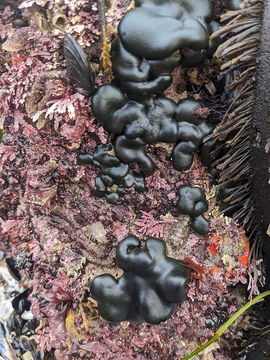
Bryopsis
Siphonous green alga with antitumor potential and ecological significance.

Bryopsis, commonly called hair algae, is a genus of marine green algae belonging to the family Bryopsidaceae. These algae are macroscopic and siphonous, meaning their bodies consist of single, tubular filaments without internal cross-walls. They form dense tufts that can reach up to 40 centimeters in height. Each cell is a single, erect thallus, often branched into small, feather-like structures called pinnules. Since the genus was first described in 1809, around 60 species have been identified. Much of Bryopsis’s ecological success comes from its relationship with endophytic bacteria that live inside its cytoplasm.
In aquariums, Bryopsis species are considered pests, and they are also linked to green tides caused by macroalgal blooms. However, the genus has unique chemical properties, most notably Kahalalide F (KF), a depsipeptide being studied for its potential to fight human cancer cells. KF also plays an important ecological role by protecting the algae from being eaten by herbivores. Removing algal blooms to extract KF could be a practical way to both control Bryopsis during green tides and reduce the cost of producing KF for clinical trials.
**Morphology and cell biology**
Bryopsis is a filamentous green alga that forms dense tufts 2 to 40 centimeters tall. Its morphology is simple, non-calcified, and siphonous—made of multinucleate filaments with no cross-walls. The axes are erect and uniaxial, and the fronds are feather-like, extending from prostrate axes. Each organism is a single tubular cell with a large central vacuole surrounded by a layer of protoplasm. Nuclei and chloroplasts line the cell wall inside the thallus. If the protoplasm is extruded, it can survive without a cell membrane for several minutes before regenerating into a mature individual. The thallus is usually erect and appears in two forms corresponding to life cycle stages: the macrothallus (haploid) and microthallus (diploid). The macrothallus grows indefinitely, while the microthallus has a fixed size. Frond shapes vary among species, from deltoid to lanceolate, and pinnules are arranged radially, distichously, or secundly.
Research has linked the cell wall structure to the shape of Bryopsis cells. The walls are tough but flexible, composed mainly of mannan, cellulose, and xylan.
Quick Facts
- Taxon
- Bryopsis
Facts from the source article.
Lore & Background
Bryopsis was first discovered in 1809. It consists of single tubular filaments that form dense tufts up to 40 cm tall. The thallus is erect, often branched into pinnules, and lacks cross walls, making it siphonous and multinucleate. Two morphologies exist: the haploid macrothallus and the diploid microthallus. The cell wall contains mannan, cellulose, and xylan. The chloroplast is the largest organelle and shows high autonomy, aiding in protoplast regeneration and photoprotection through fast repair of photosystem II. Nuclear volume is not related to nuclear DNA content in many species. The life cycle is highly variable, with macrothalli producing gametes or directly forming microthalli at frond tips, allowing diploidization without syngamy. Stephanokontic zoospores occur in many species, but some lack them. Meiosis timing is poorly understood.
Reader's Guide
Bryopsis is ecologically significant as a primary producer and refuge for marine organisms, but it is also a pest in aquariums and contributes to green tides via macroalgal blooms. Its production of Kahalalide F (KF) is notable for both protecting the alga from herbivory and for being studied as an antitumor agent in human cancer cells. The article suggests that removing algal blooms for KF extraction could help eradicate Bryopsis from green tides while reducing the economic burden of producing KF for clinical trials. The genus thrives in eutrophic waters and is widely distributed in tropical, subtropical, and temperate coastal regions, with high species density in places like Singapore and the east coast of the United States and the Caribbean. Climate warming and pollution are thought to contribute to its increased presence. Some species may be invasive, and they may function as bioindicators. Herbivory is a key factor influencing mortality, and chemically mediated interactions like KF production provide defense, though Sacoglossans are an exception.
Did You Know?
- Bryopsis can form dense tufts up to 40 cm in height.
- It produces Kahalalide F (KF), a depsipeptide studied for antitumor properties.
- The genus has approximately 60 identified species since its discovery in 1809.
Architecture of a Single Cell
Bryopsis represents one of the most remarkable examples of cellular architecture in the plant kingdom. Rather than being composed of many small cells stacked together, each organism is essentially one enormous, unbroken tubular cell—a siphonous, coenocytic structure with no cross-walls dividing it into compartments. Inside this single cell, a large central vacuole is encircled by a thin outer layer of protoplasm, while nuclei and chloroplasts line the inner surface of the cell wall. The cell wall itself is a tough yet flexible composite of mannan, cellulose, and xylan, and its growth mechanism is unusual: new material is deposited on the inner surface from transverse microfibrils, with apical development driving both lateral and longitudinal expansion. Perhaps most astonishing, if the protoplasm is extruded from the cell, it can survive without a membrane for several minutes before regenerating into a fully functional unit. This resilience, combined with the chloroplast's remarkable autonomy—its ability to photosynthesize and even lodge in other cells—makes Bryopsis a subject of intense cell-biological fascination.
A Life Cycle That Defies Convention
Among green algae, few genera display the reproductive flexibility of Bryopsis. Its life history alternates between two visually distinct phases: an erect, macroscopic macrothallus (haploid) and a smaller, branched microthallus (diploid). What makes this genus truly extraordinary is that the transition from haploid to diploid does not always require the conventional fusion of gametes. In some cases, microthalli develop directly at the tips of macrothallus fronds, in a specialized region where both haploid and diploid nuclei coexist, though the precise mechanism of diploidization remains poorly understood. This shortcut bypasses the need for a mating partner, allowing new diploid individuals to appear relatively quickly, though it comes at the cost of reduced genetic exchange. Macrothalli, in turn, can arise directly from microthalli or through stephanokontic zoospores—flagellated cells that settle on a substrate and grow into new gametophytes. The exact life-history pattern varies not only between species but even among individuals within a single species, making Bryopsis arguably the most reproductively diverse genus in the green algae.
Ecological Success and the Green Tide Problem
Bryopsis occupies a paradoxical position in marine ecology. On one hand, its ecological success is partly explained by symbiotic relationships with endophytic bacteria that live within the cytoplasm of its cells, likely contributing to its competitive edge in coastal habitats. On the other hand, this same success has made the genus a persistent nuisance. In aquariums, it is a well-known pest that can overgrow tanks, and in the wild, dense macroalgal blooms of Bryopsis are a primary driver of so-called green tides—events in which vast mats of algae smother seafloor habitats and disrupt local ecosystems. The algae form dense tufts reaching up to 40 centimeters in height, and their siphonous morphology, combined with light-harvesting modulation strategies and the ability of surface filaments to discriminate their exposure from underlayer filaments, gives them a significant advantage on intertidal shores. Yet this very abundance creates an economic and ecological burden, particularly for coastal communities and the aquarium trade, while simultaneously presenting an opportunity that researchers are now exploring.
From Nuisance Bloom to Cancer Research
The most striking twist in Bryopsis's story is that the very compound making it a formidable alga is also a potential weapon against human disease. The genus produces Kahalalide F, a depsipeptide that serves a dual purpose in nature: it deters herbivores from consuming the algae, and in the laboratory it has demonstrated antitumor activity against human cancer cells. Researchers are now investigating whether the practical removal of Bryopsis blooms during green tide events could simultaneously address two problems—eradicating the ecological nuisance and supplying a steady source of KF for experimental production aimed at clinical trials. This approach would reduce the economic burden of synthesizing the compound in the lab while turning a destructive algal bloom into a biomedical resource. The ecological significance of KF in protecting the algae from grazing underscores how a molecule evolved for one purpose in the ocean may find an entirely new role in the clinic, bridging marine ecology and oncology in a way that was unimaginable when the genus was first described in 1809.
Frequently Asked Questions
What is Bryopsis?
Bryopsis is a genus of marine green macroalgae in the family Bryopsidaceae, widely recognized by aquarists and ecologists as "hair algae." It was first formally described in 1809 and is defined by its macroscopic, siphonous body made of single tubular filaments.
How big can Bryopsis grow?
Dense tufts of Bryopsis typically range from about 2 centimeters up to a maximum of roughly 40 centimeters in height. The filaments branch into small, feather-like pinnules that give the algae its characteristic tufted appearance.
What makes Bryopsis's cell structure unique?
Bryopsis is siphonous, so each filament is essentially one enormous cell with no internal cross-walls separating it into smaller units. Its macrothallus nucleus measures approximately 25 micrometers in diameter, while the primary microthallus nucleus can reach up to 60 micrometers.
How many Bryopsis species have been identified?
Since the genus was originally described in 1809, roughly 60 distinct species have been catalogued. This places Bryopsis as a moderately diverse genus within the broader group of green macroalgae.
Why is Bryopsis ecologically and scientifically significant?
A key driver of Bryopsis's success in marine habitats is its symbiotic partnership with endophytic bacteria that aid its growth. It also draws biomedical attention because of its demonstrated antitumor potential, making it a subject of ongoing research beyond ecology.
More in Marine Green Macroalgae 1-24
Spotted an error? Know more?
Reader corrections go straight into our review queue. Suggest an edit · How this site is sourced