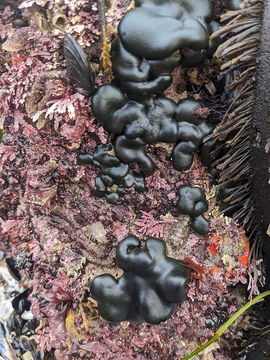
Halimeda fragilis
A calcified green macroalga in the genus Halimeda.

Halimeda fragilis is a species of green macroalgae in the genus Halimeda, which belongs to the order Bryopsidales and family Halimedaceae. Like all members of the genus, its thallus is composed of calcified green segments, with calcium carbonate deposited as aragonite, making it inedible to most herbivores. The genus is notable for being one of the best studied examples of cryptic species pairs due to morphological convergence within marine macroalgae.
Quick Facts
- Taxon
- Halimeda
- Type Species
- Halimeda tuna
- Type Species Authority
- (J. Ellis & Solander) J.V. Lamouroux, 1816
Facts from the source article.
Lore & Background
Halimeda fragilis, as a member of the genus Halimeda, shares the characteristic of being coenocytic and siphonous, meaning its cells are not divided by cross walls but form a continuous filament. The thallus is distinctly segmented, with non-calcified nodes separating the calcified segments. Calcium carbonate is deposited in the intersiphonal spaces of each segment, where aragonite precipitates. The genus has three types of holdfasts: sprawler, rock-grower, and sand-grower, which determine its attachment to different substrates.
Reader's Guide
Halimeda fragilis, like other Halimeda species, contributes to reef building as a large producer of carbon sediments on reefs, generating a wide range of sediment sizes from coarse particles to silt and clay. The genus has been found to have good potential as a carbon sink and can play an important role in regulating the ocean's carbon budget. Some species produce up to 54.37 g CaCO3 m−1 yr−1. Halimeda beds are responsible for distinctive circular deposits in various parts of the Great Barrier Reef, and are the most extensive, actively accumulating Halimeda beds in the world. The genus also forms calcareous 'Halimeda sand' in tropical lagoons, and some tropical reef systems consist largely of this sand accumulated over the aeons. Overall, Halimeda represents the most common green algae large grains in the sediment of the lower latitudes.
Did You Know?
- Calcium carbonate deposition in Halimeda begins as early as 36 hours.
- Halimeda beds in the Great Barrier Reef are the most extensive, actively accumulating Halimeda beds in the world.
- Some species of Halimeda reproduce synchronously in mass spawning events similar to corals.
Segmented Architecture and the Mechanics of Calcification
The thallus of Halimeda presents a strikingly segmented body plan, with each segment composed of 60 to 80 percent aragonite. This mineralization is not uniform: calcium carbonate precipitates specifically within the intersiphonal spaces enclosed by peripheral utricles, while the nodes separating segments remain entirely non-calcified. The internal architecture relies on siphons that branch trichotomously into medullary filaments, all wrapped in a cortex. What makes Halimeda structurally unusual among green seaweeds is its coenocytic, siphonous organization—cells are not partitioned by cross walls but instead form a continuous filament. This distinguishes it from other calcified genera like Acetabularia. The genus also displays three distinct holdfast strategies: a "sprawler" type with loose terminal filaments, a "rock-grower" type with matted branched filaments gripping hard surfaces, and a "sand-grower" type whose filaments anchor into fine particles, creating a root-like structure. Calcification can begin as early as 36 hours after the relevant developmental stage.
Reef Sediment, Atoll Building, and Carbon Cycling
Halimeda plays a disproportionately large role in shaping tropical reef landscapes. In the Great Barrier Reef off Queensland, Australia, the alga is responsible for distinctive circular sediment deposits on the western, lee-facing sides of outer shield reefs, where nutrient-rich open-ocean currents allow the beds to flourish. These represent the most extensive actively accumulating Halimeda beds known worldwide. In tropical lagoons, vigorous growth can produce sediment composed entirely of the alga's calcified remains, forming what is termed Halimeda sand. Over geological time, this material has built up to constitute the bulk of some atoll systems. The genus generates sediment across a wide particle-size range, from coarse grains down to silt and clay, and is the most common source of large green-algal grains in lower-latitude sediments. Beyond sediment production, Halimeda functions as a meaningful carbon sink. Species such as H. opuntia can produce up to 54.37 grams of calcium carbonate per square meter per year, contributing to the regulation of the ocean's carbon budget.
Holocarpy, Mass Spawning, and a Brief Life Span
The reproductive biology of Halimeda is both rapid and dramatic. Sexual reproduction, though rarely observed, unfolds in a compressed 36-hour window. Gametangia first appear along the segment edges of the thallus, and by the following day the entire thallus has been converted into gametangial tissue. After an overnight maturation period, gametes are released the next morning. The cost is total: the thallus is left white and dies in a phenomenon called holocarpy, in which the whole organism perishes after a single reproductive event. Some species appear to coordinate their spawning in mass events reminiscent of coral spawning, though spread over several months with small fractions of the population releasing gametes each day. Because the life span of the genus is estimated at only a few months to a year, this all-or-nothing reproductive strategy makes ecological sense. Asexual reproduction supplements the cycle through vegetative fragmentation and dispersal, allowing colonies to spread across substrates. The full life cycle remains only partially understood, with the timing of meiosis and the relative roles of haploid and diploid phases still uncertain.
Cryptic Diversity and Taxonomic Complexity
Despite its recognizable segmented appearance, Halimeda harbors a surprising depth of hidden diversity. The genus is regarded as one of the best-studied examples of cryptic species pairs in marine macroalgae, a status arising from morphological convergence—distinct lineages evolving nearly identical external forms. As of 2015, Algaebase listed 71 species and 67 infraspecific names, yet the true number of genetically distinct lineages may be higher. Taxonomically, the genus sits within the family Halimedaceae and order Bryopsidales, and is divided into five monophyletic sections—Halimeda, Micronesicae, Opuntia, Pseudo-opuntia, and Rhipsalis—distinguished by differences in how medullary siphons fuse. Halimeda tuna, the Mediterranean-restricted holotype, anchors the genus name. Distribution patterns add another layer of complexity: several species, including H. copiosa, H. discoidea, H. gracilis, H. opuntia, H. simulans, and H. tuna, are found globally, while others remain geographically constrained. This combination of morphological similarity, global range, and hidden genetic structure makes Halimeda a persistent challenge and a rich subject for evolutionary marine biology.
Frequently Asked Questions
What is Halimeda fragilis?
Halimeda fragilis is a species of green macroalga in the genus Halimeda, placed in the family Halimedaceae and the order Bryopsidales. It is one of 71 recognized species (plus 67 infraspecific names) catalogued under that genus on Algaebase as of 2015.
What makes Halimeda fragilis's body structure so distinctive?
Its thallus is built from discrete green segments that are heavily mineralized with calcium carbonate in the aragonite crystal form, accounting for roughly 60 to 80 percent of each segment's mass. Remarkably, this calcification can kick in as early as 36 hours after a new segment begins forming.
Why can't most marine herbivores graze on Halimeda fragilis?
The dense aragonite deposits in every segment make the alga effectively inedible to the vast majority of herbivorous marine animals. This hard, calcified architecture serves as a built-in anti-grazing defense that sets it apart from softer green seaweeds.
Where does Halimeda fragilis sit in the broader taxonomic tree?
It belongs to the genus Halimeda, which is nested in the family Halimedaceae under the order Bryopsidales. The genus as a whole is one of the more species-rich lineages in the Bryopsidales, with over seventy described species and numerous infraspecific taxa.
Why do researchers love studying the genus Halimeda?
Halimeda is widely regarded as one of the best-documented examples of cryptic species pairs in marine macroalgae, because morphological convergence causes unrelated or distantly related lineages to look nearly identical. This makes species like H. fragilis a key test case for figuring out how true species boundaries operate when external appearance is misleading.
More in Marine Green Macroalgae 1-24
Spotted an error? Know more?
Reader corrections go straight into our review queue. Suggest an edit · How this site is sourced