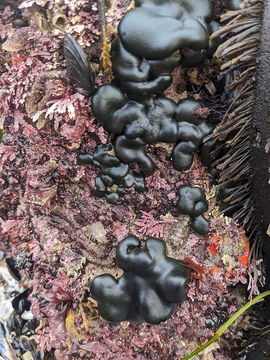
Caulerpa
A genus of single-celled, multinucleate green seaweeds.

Caulerpa is a genus of green seaweed belonging to the family Caulerpaceae. What makes it unusual is that each organism is a single cell containing many nuclei—a structure described as coenocytic or siphonous—which places it among the largest single cells on Earth. Its name comes from the Ancient Greek words *kaulos* ("stalk") and *herpo* ("to creep"), a reference to the way its thallus crawls along the substrate.
First formally described in 1809 by Jean Vincent Lamouroux, Caulerpa is the sole genus in the family Caulerpaceae, which sits within the order Bryopsidales, class Ulvophyceae, and phylum Chlorophyta. Genetic analysis of the *tufA* gene has shown that the genus *Pseudochlorodesmis* is a sister clade to Caulerpa. A later classification scheme proposed by Cremen and colleagues placed Caulerpaceae and Halimedaceae as sister families within Bryopsidales. Identifying species by appearance alone is often unreliable because traits vary widely, so many species are misidentified without molecular testing. As of 2019, there were 101 accepted species, along with 40 varieties and 67 forms.
To support their enormous cell size, Caulerpa species keep their cytoplasm in constant motion, driven by a network of microtubules—a behavior documented since 1967. When the cell is cut, the cytoplasm does not leak out. Regeneration is directional: rhizoids grow from the bottom and fronds from the top. The genus produces several secondary metabolites, including the red pigment alkaloid caulerpin, its derivative caulerchlorin, and the amine mixture caulerpicin, which are thought to be responsible for its toxicity and peppery taste.
Externally, Caulerpa takes many forms. It has a stolon with downward-growing rhizoids that anchor it, and upright fronds called assimilators. These assimilators can be leaf-like, as in *Caulerpa prolifera*, or have a central axis called a rachis. The rachis may bear lateral branchlets known as ramuli, which come in various shapes (terete, turbinate, clavate, peltate, falcate, vesiculate) and arrangements: distichous (evenly opposite, as in *Caulerpa taxifolia*), irregular (no clear pattern, as in *Caulerpa racemosa*), or verticillate (whorled, as in *Caulerpa cuppresoides*).
Internally, Caulerpa is coenocytic, meaning its thallus is multinucleate, and siphonous, meaning the thallus and nuclei are not separated by cell walls.
Quick Facts
- Taxon
- Caulerpa
- Type Species
- Caulerpa prolifera
- Type Species Authority
- (Forsskål) J.V. Lamouroux, 1809
Facts from the source article.
Lore & Background
Caulerpa was first described by Jean Vincent Lamouroux in 1809 and is the only genus under the family Caulerpaceae, from the order Bryopsidales, class Ulvophyceae, and phylum Chlorophyta. Through the use of tufA gene sequencing, it was revealed that Pseudochlorodesmis F. Børgesen was a sister clade of Caulerpa. Cremen et al. proposed a new classification scheme in Bryopsidales, wherein Caulerpaceae and Halimedaceae were described as sister families. Species discrimination via morphology-based identification is often hampered by the high degree of variation among traits, so several species are often misidentified without the use of molecular analyses. As of 2019, there are 101 accepted species, with 40 varieties and 67 forms.
The genus Caulerpa exhibits several different growth forms. They possess a stolon with rhizoids which grow downward, anchoring the plant to the substrate. The stolons support upright fronds or leaves known as assimilators. The structure of the assimilator may be ligulate (leaf-like, e.g. Caulerpa prolifera), or they may have a central axis known as a rachis. The rachis may have lateral branchlets known as ramuli which themselves come in different forms (terete, turbinate, clavate, peltate, falcate, vesiculate) and arrangements: distichous, irregular, or verticillate. Caulerpa is coenocytic, meaning it has a multinucleate thallus organization, and siphonous, meaning the thallus and the nuclei are not separated by cell walls. The genus also possesses trabeculae, inward growing cell wall extensions that pass through the central lumen of siphons, hypothesized to provide structural support, facilitate diffusion, and possibly help determine cell shape.
Reader's Guide
Caulerpa is notable for its unique cellular structure as one of the largest single cells in the world, supported by constant cytoplasmic circulation via a network of microtubules. The genus produces secondary metabolites such as caulerpin, caulerchlorin, and caulerpicin, which are thought to be related to its toxicity and peppery taste. Caulerpa is mostly found in tropical regions, with highest diversity in the Caribbean, Indo-Malay region, and southern Australia, where a majority of species are endemic. The genus is typically found in shallow intertidal zones and can reach depths of 100 meters. Some species, such as Caulerpa taxifolia, have become invasive in the Mediterranean Sea, Australia, and southern California, partly due to their ability to thrive in temperate waters and freedom from natural predators. Caulerpa species are also cultivated for food, particularly Caulerpa lentillifera and Caulerpa racemosa (both called 'sea grapes'), with cultivation beginning in the 1950s in Cebu, Philippines. The genus has uses in bioremediation, as fertilizer, and in health and wellness, with anti-oxidant compounds studied for treating diseases such as cancer and cardiovascular disorders.
Did You Know?
- Caulerpa consists of only one cell with many nuclei, making it among the biggest single cells in the world.
- The name Caulerpa means 'stem (that) creeps' from Ancient Greek kaulos ('stalk') and herpo ('to creep').
- Caulerpa taxifolia has become an invasive species in the Mediterranean Sea, Australia, and southern California.
- The two most commonly eaten species are Caulerpa lentillifera and Caulerpa racemosa, both called 'sea grapes'.
Biology & Genomic Uniqueness
Caulerpa lentillifera defies the typical image of a plant. Rather than being composed of countless individual cells, this green algae is a siphonous macroalgae — essentially one enormous cell housing multiple nuclei, stretching up to thirty centimeters in length. Where other seaweeds develop leaf-like structures, sea grape instead forms small, bubble-like vesicles that pop between the teeth, releasing a briny, umami-rich flavor that diners have likened to the taste of the ocean itself. In January 2025, researchers at the University of Amsterdam published the organism's 34-megabase genome, though it has not yet been assembled into discrete chromosomes. Perhaps the most striking genomic finding is that C. lentillifera possesses only a single Receptor-like kinase, a protein family that typically constitutes the largest class of signal-transduction components in the plant kingdom. This unusual scarcity hints at a radically different cellular communication strategy compared to land plants or other algae.
From Accidental Ponds to Global Aquaculture
For centuries, communities along the Asia-Pacific coast simply gathered sea grape from the wild. The shift toward deliberate farming began in the 1950s on Cebu Island in the Philippines, when C. lentillifera was accidentally introduced into local fish ponds and thrived. What started as an unplanned ecological event became a livelihood: today roughly four hundred hectares of ponds on Cebu yield between twelve and fifteen tons of fresh seaweed annually. Growers typically harvest two months after initial planting and then return every two weeks, adjusting to the algae's growth rate. Japan followed suit in 1986, cultivating the species in tanks within the warmer coastal waters of Okinawa. From these two pioneering sites, aquaculture operations expanded to Vietnam, Taiwan, and the Chinese provinces of Fujian and Hainan. While most production still serves domestic markets, a steady stream is exported to Japan, where demand remains strong. The Philippines and Japan together continue to account for the bulk of global consumption.
A Salad That Travels: Culinary Traditions Across the Pacific
Sea grape is almost exclusively consumed raw, either on its own or tossed into salads, prized for its soft, succulent texture and a flavor often described as tasting 'like the ocean.' The algae is also notably rich in iodine, adding a nutritional dimension to its culinary appeal. In the Philippines, it goes by the names latô or arosep. After a thorough rinse in clean water, it is most commonly served in ensaladang latô — a simple salad of chopped raw shallots and fresh tomatoes, dressed with a tangy blend of fish sauce or bagoóng (fermented fish paste) and vinegar. In Okinawa, Japan, the seaweed is called umi-budō, literally 'sea grapes,' or kubiretsuta. There it appears dipped in ponzu, rolled into sushi, scattered over salads, or eaten plain. Vietnam knows it as rong nho, Korea as bada podo, and the islands of Bali as bulung. Each name captures the same essential image: tiny green grapes drawn from the sea.
Migration, Identity, and the Coastal Table
The spread of sea grape across the Asia-Pacific is inseparable from the movement of people. In the Malaysian state of Sabah, the seaweed is known as latok — a spelling that traces directly to the migrations of the Bajau peoples, who carried the tradition from the Philippines into Borneo's coastal communities. Further south, Malay-speaking communities in the Riau Archipelago and Singapore cherish it under the name latoh, a testament to centuries of shared maritime food culture across the straits. Yet this connection is not static. In Singapore, the coastal populations who once relied on wild-harvested sea grape were gradually displaced inland during the late twentieth century, severing a direct link between the people and the reef. Meanwhile, in the Philippines, the practice of gathering C. lentillifera from the wild persists alongside the pond-based aquaculture that began on Cebu. The seaweed thus occupies a unique cultural space: part wild forage, part cultivated crop, and always a marker of coastal identity that travels with the communities who name it.
Frequently Asked Questions
What is Caulerpa?
Caulerpa is a genus of green seaweed that belongs to the family Caulerpaceae. What sets it apart is that each individual organism is technically just one giant cell packed with multiple nuclei, making it one of the largest single cells known on the planet.
What makes Caulerpa so unusual compared to other algae?
Unlike most algae that are built from many separate cells, a single Caulerpa organism is a coenocytic (siphonous) structure—one continuous cell housing hundreds or thousands of nuclei. This multinucleate, single-cell design lets it spread into sprawling mats while remaining, biologically speaking, just one cell.
Where does the name 'Caulerpa' come from?
The name blends two Ancient Greek words: kaulos, meaning 'stalk,' and herpo, meaning 'to creep.' Together they capture the way the thallus of this seaweed slowly crawls and spreads across the seafloor substrate.
How many Caulerpa species exist, and how deep can they live?
As of 2019, 101 accepted species have been recognized, along with 40 varieties and 67 additional forms. These seaweeds can be found at depths reaching up to 100 meters.
Who first described Caulerpa and when?
The genus was formally described in 1809 by the French naturalist Jean Vincent Lamouroux. It stands as the sole genus within the family Caulerpaceae, which is nested in the order Bryopsidales, class Ulvophyceae.
More in Marine Green Macroalgae 1-24
Spotted an error? Know more?
Reader corrections go straight into our review queue. Suggest an edit · How this site is sourced