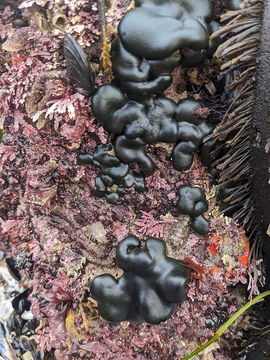
Udotea flabellum
A green macroalgae with antimicrobial and cancer research potential.

Udotea flabellum is a green macroalga that photosynthesizes. It grows in shallow waters off Florida and Belize, where it can be found on sandy bottoms, among seagrasses, and on coral reefs. This alga is known to have antimicrobial effects and is being investigated for potential use in cancer therapies.
The alga attaches to sand or mud using root-like structures called rhizoids, which form a holdfast. It lacks true stems, leaves, roots, and a vascular system, but it does have a stem-like stipe. Its body, or thallus, grows in a fan shape—earning it the nickname "mermaid's fan algae"—and is often lobed, thick, leathery, and moderately calcified. The stipe is also often calcified.
*Udotea flabellum* is found in tropical and subtropical waters across North America, the Atlantic islands, Mexico, the Caribbean, South America, the Indian Ocean, Africa, Australia, New Zealand, and Asia. It grows in coral reefs, sandy coastlines, and seagrass beds, at depths up to 23 meters. When the alga dies, its calcified thallus and stipe break down, enriching sediment nutrients and contributing to sediment production, which helps reefs continue growing. As a photosynthetic organism, it is a base of reef food webs, producing organic compounds from carbon dioxide and serving as food for marine herbivores.
In one lab study, an extract of *U. flabellum* was the most effective among several tropical green seaweeds tested at increasing plasma coagulation time. Another experiment found that an ethanol extract showed modest antimicrobial activity against *Staphylococcus aureus* and *Candida albicans*. Researchers isolated hydrates of a new compound, named udoteatrial, from the extract, which they believe is responsible for the antimicrobial effect.
Quick Facts
- Genus
- Udotea
- Species
- flabellum
Facts from the source article.
Lore & Background
Udotea flabellum attaches to sand or mud using rhizoids, root-like structures that form a holdfast. It lacks stems, leaves, roots, and a vascular system, but possesses a stem-like stipe. The thallus grows in a fan shape, often lobed, with thick, leathery, moderately calcified lobes; the stipe is also often calcified. This species is found in tropical to subtropical locations worldwide, including coral reefs, sandy coastlines, and sea grass beds, at depths up to 23 meters. When it dies, its calcified thallus and stipe improve sediment nutrients and contribute to sediment production, aiding reef growth. As a photosynthetic organism, it contributes to primary production and serves as a food source for marine herbivores.
Reader's Guide
Udotea flabellum holds significance in both ecological and biomedical contexts. Ecologically, its calcified remains enhance sediment nutrients and production, supporting coral reef growth, and it forms a base of reef food webs through primary production. In research, an in vitro study found that an extract of U. flabellum was the most effective among several tropical green seaweeds tested at increasing plasma coagulation time. Another in vitro experiment showed that an ethanol extract exhibited modest antimicrobial activity against Staphylococcus aureus and Candida albicans; researchers isolated hydrates of a novel compound, udoteatrial, believed responsible for this activity. Additionally, the species is being used in cancer treatment studies, though specific findings are not detailed in the source.
Did You Know?
- Udotea flabellum is nicknamed mermaid's fan algae due to its fan-shaped thallus.
- An extract of this alga increased plasma coagulation time in an in vitro study.
- The compound udoteatrial was isolated from U. flabellum and linked to antimicrobial activity.
- Its calcified thallus and stipe contribute to sediment production after death.
More in Marine Green Macroalgae 1-24
Spotted an error? Know more?
Reader corrections go straight into our review queue. Suggest an edit · How this site is sourced