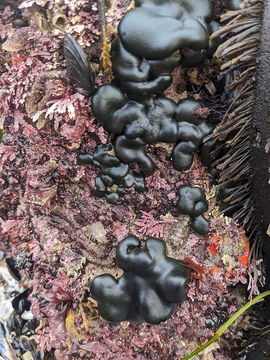
Trentepohliaceae
Exclusively subaerial green algae with net-like chloroplasts and worldwide distribution.

Trentepohliaceae are a family of green algae, and they make up the entire order Trentepohliales within the class Ulvophyceae. Their key features include net-like chloroplasts that lack pyrenoids, cell walls containing plasmodesmata, and cell division that involves forming a phragmoplast. These algae live exclusively in subaerial environments and are found worldwide.
Most members grow as branched, single-row filaments. In some genera, these filaments form small, bushy tufts, while in others they pack together into a flat, disc-like pseudoparenchyma. Reproduction can be either asexual or sexual. Asexual zoospores develop inside a sporangium attached to a highly modified branch called a suffultory cell. The life cycle alternates between a sporophyte and a gametophyte generation; these two phases may look identical (isomorphic) or different (heteromorphic).
Ecology Trentepohliaceae are strictly subaerial and rank among the most common and widespread algae of this type. They occur across the globe but are most diverse in tropical and subtropical regions. They grow on many surfaces, including rocks, tree bark, wood, leaves, and occasionally bare soil. Two genera, *Cephaleuros* and *Stomatochroon*, are parasites that live inside plant tissue. Some species, especially in *Trentepohlia*, tolerate desiccation well and adapt to a broad range of light and temperature conditions, as shown by studies of alpine and coastal populations. These algae often associate closely with lichen-forming fungi and are frequently found as the photosynthetic partner (phycobiont) in lichens.
Taxonomy The family generally includes five genera: *Cephaleuros* (a parasite of vascular plants, growing inside leaves or other tissues), *Phycopeltis* (an epiphyte on leaves, forming flat, rounded discs), *Printzina* (similar to *Trentepohlia* but differing in zoosporangia and prostrate filament shape, mainly in shaded spots), *Trentepohlia* (erect, branched filaments from a prostrate base, on bark, rocks, and soil), and *Stomatochroon* (a parasite inside leaf substomatal chambers, rarely reported). AlgaeBase lists additional genera like *Friedaea*, but their status is uncertain.
Quick Facts
- Taxon
- Trentepohliaceae
Facts from the source article.
Lore & Background
Members of Trentepohliaceae typically consist of uniseriate filaments that are variably branched. In some genera, the filaments produce small, bushy tufts; in others, they grow into a pseudoparenchymatous disc. Reproduction is both asexual and sexual, with zoospores formed in a sporangiate-lateral structure attached via a modified branch called a suffultory cell. Their life cycle involves alternation of generations between sporophyte and gametophyte phases, which may be isomorphic or heteromorphic.
Ecology: Trentepohliaceae are exclusively subaerial and among the most common and widespread subaerial algae. They grow on a wide range of substrates including rocks, tree barks, wood, leaves, and bare soil. Some genera, such as Cephaleuros and Stomatochroon, are parasites that grow within plant tissue. Species like Trentepohlia show remarkable desiccation tolerance and adaptability to varied light and temperature conditions. They are often closely associated with lichen-forming fungi and are common as phycobionts within lichens.
Taxonomy: The family includes five generally recognized genera: Cephaleuros, Phycopeltis, Printzina, Trentepohlia, and Stomatochroon. AlgaeBase lists additional genera of uncertain status, such as Friedaea. The family is taxonomically well-defined, but its unique ecological and ultrastructural characters have made placement difficult; previous classifications placed it in Chlorophyceae, Ulvophyceae, or its own class Trentepohliophyceae. Molecular phylogenetic studies have clearly established its place in Ulvophyceae. The genera are currently considered polyphyletic or paraphyletic and in need of revision; for example, some recent sources do not recognize Printzina.
Reader's Guide
Trentepohliaceae hold significance as the only family in the order Trentepohliales and as a member of the Ulvophyceae. Their exclusively subaerial habitat distinguishes them from most green algae, and they are among the most common and widespread subaerial algae globally, with greatest diversity in the tropics and subtropics. The family's unique combination of traits—net-like chloroplasts without pyrenoids, cell walls with plasmodesmata, and cytokinesis by phragmoplast—has historically made its classification challenging, with placements varying among Chlorophyceae, Ulvophyceae, and even its own class. Molecular phylogenetic studies have resolved its position within Ulvophyceae. Ecologically, they are notable for their desiccation tolerance and adaptability, and for their role as phycobionts in lichens. Some genera are parasites of vascular plants, growing within leaves or substomatal chambers. The taxonomy remains under revision, as current genera are polyphyletic or paraphyletic, and some genera like Printzina are not universally recognized. This ongoing revision reflects the family's complex evolutionary history and the need for further study.
Did You Know?
- They are exclusively subaerial algae, growing on rocks, tree barks, wood, leaves, and bare soil.
- Their cell walls contain plasmodesmata and they undergo cytokinesis by phragmoplast production.
More in Marine Green Macroalgae 1-24
Spotted an error? Know more?
Reader corrections go straight into our review queue. Suggest an edit · How this site is sourced