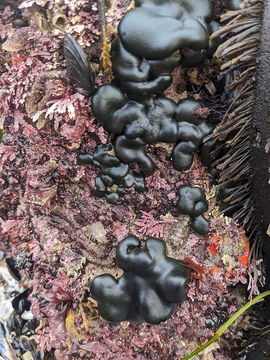
Trentepohlia (alga)
Orange filamentous green alga living on land and in lichens.

Trentepohlia is a genus of filamentous chlorophyte green algae in the family Trentepohliaceae. It is notable for living free on terrestrial supports such as tree trunks and wet rocks or symbiotically in lichens, and for its strong orange color caused by large quantities of carotenoid pigments that mask the green of chlorophyll.
Quick Facts
- Taxon
- Trentepohlia (alga)
- Type Species
- Trentepohlia aurea
- Type Species Authority
- (L.) C.Martius
Facts from the source article.
Lore & Background
Organisms belonging to the genus Trentepohlia were first described by Linnaeus in 1759, who named his species Byssus aureus (currently known as Trentepohlia aurea). The genus was circumscribed by Carl Friedrich Philipp von Martius in 1817. The genus name honors Johann Friedrich Trentepohl, a German clergyman and botanist who worked as a lecturer and pastor in the Wesermarsch region. Martius' name was conserved over earlier names published by Albrecht Wilhelm Roth in 1794 and 1800.
Trentepohlia consists of branched filaments of cells occurring in two systems: a prostrate and an erect system, both variously branched. Cells are cylindrical, barrel-shaped or spherical, with multiple discoid chloroplasts or a single band-shaped chloroplast that lacks pyrenoids. The chloroplast is typically obscured by carotenoid pigments, giving the cells an orange or red color. The life cycle is poorly known but includes both asexual reproduction via quadriflagellate zoospores and sexual reproduction via biflagellate gametes. It is generally hypothesized to undergo an alternation of generations between haploid gametophytes and diploid sporophytes, though biflagellate gametes have been reported to germinate without fusing.
Trentepohlia is a subaerial alga commonly found in humid climates on moist rocks, wood, tree trunks, and leaves. It forms orange, felt-like growths that can obscure posts and inscriptions, creating an economic nuisance. Trentepohlia abietina has been reported growing on spiders in Queensland, Australia. The genus forms close associations with fungal hyphae and can form protolichens; it is a widespread true phycobiont in lichens such as the 'secret writing' crustose lichen genera Graphis, Graphina, Gyalecta and Opegrapha.
Reader's Guide
Trentepohlia holds significance as a widespread phycobiont in lichens, particularly in crustose lichen genera like Graphis and Opegrapha. Its orange coloration, due to carotenoid pigments masking chlorophyll, makes it easily distinguishable in its subaerial habitats. The genus is economically notable because its felt-like growths often obscure posts and inscriptions, requiring painting over. Ecologically, Trentepohlia is mostly diverse in tropical and subtropical areas but also occurs in temperate regions including Britain and Ireland. With global warming, European lichens containing Trentepohlia as phycobionts have increased in recent decades. The genus contains about 40 species, but its taxonomy is in need of revision because morphology is highly variable and environment-dependent, the genus is known to be polyphyletic, and individuals may be intermediate in morphology. The life cycle remains poorly understood, with uncertainty about whether biflagellate gametes can germinate without sexual fusion. This combination of ecological, economic, and taxonomic challenges makes Trentepohlia a genus of ongoing scientific interest.
Did You Know?
- Trentepohlia was first described by Linnaeus in 1759 as Byssus aureus.
- European lichens with Trentepohlia as phycobionts have increased in recent decades due to global warming.
More in Marine Green Macroalgae 1-24
Spotted an error? Know more?
Reader corrections go straight into our review queue. Suggest an edit · How this site is sourced