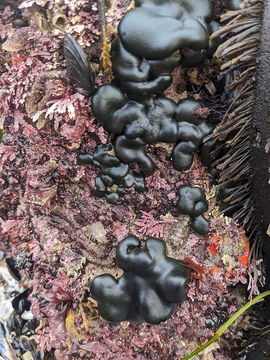
Rhipiliopsis
A pantropical green algal genus with the deepest fleshy upright record.

Rhipiliopsis is a genus of green algae belonging to the family Rhipiliaceae. It is also known by the synonym *Johnson-sea-linkia*. This genus is particularly notable for containing the deepest recorded fleshy upright alga, *Rhipiliopsis profunda*, which attaches to bedrock at depths reaching 210 meters.
In terms of morphology, the thallus ranges in height from less than 5 mm to over 7 cm and is non-calcified. A prostrate rhizome or digitate structures within the substrate give rise to the blade and stalk. The fronds can be one or several cell layers thick, shaped irregularly lanceolate or regularly to excentrically peltate, with siphons that branch dichotomously and are generally constricted equally above each fork. A somewhat differentiated cortex appears on both upper and lower frond surfaces, and scattered spines occur on blade siphons in the two thickest-bladed species. Stalks may be monosiphonous (single-tubed) or multisiphonous; monosiphonous stalks are either smooth or covered with spinous processes. The siphons cohere at scattered points via circular rings of wall thickening at the tips of lateral papillae or shortened blade-siphon dichotomies. Cells are heteroplastic (except possibly in *Johnson-Sea-Linkia*), containing ovoid chloroplasts and larger, kidney-shaped amyloplasts. Additional descriptions note that *Rhipiliopsis* is much smaller and more delicate than *Rhipilia* species, with papillae less developed than the tenacula of *Rhipilia* but still giving the blade a cohesive, net-like appearance. The genus is characterized by a mono- or multisiphonous stipe and a mono- or pluristromatic blade that may be flabellate, peltate, or cyathiform.
Distribution is predominantly tropical, with most species known only from their type localities and limited ranges. A pantropical distribution has been confirmed, but no species appears cosmopolitan; instead, they have restricted ranges. Recorded collections come from the western and southwestern Pacific Ocean, Australia, and the Philippines. Two species, *R. peltata* and *R. robusta*, are endemic to the temperate coasts of southern Australia.
Ecologically, the genus commonly grows in low intertidal to shallow subtidal rocky habitats on wave-exposed temperate shores. Its vertical range extends from the low intertidal zone down to 153 meters, with the deepest record being *R. profunda* at 210 meters.
Quick Facts
- Taxon
- Rhipiliopsis
- Type Species
- Rhipiliopsis peltata
Facts from the source article.
Lore & Background
According to Algaebase as described by Kraft (1986), the thallus height ranges from less than 5 mm to above 7 cm, non-calcified, with a prostrate rhizome or digitate processes giving rise to the blade and stalk system. Fronds are monostromatic or polystromatic, irregularly lanceolate or regularly to excentrically peltate, with siphons dichotomously branched and generally equally constricted above dichotomy. A somewhat differentiated cortex was observed on upper and lower surfaces of fronds, and scattered spines occur on blade siphons for the two species with thickest blade. Stalks can be monosiphonous or multisiphonous; monosiphonous stalks are smooth or variously covered with spinous processes. Constituent siphons cohere at scattered points by circular rings of wall thickening at tips of lateral papillae or foreshortened blade-siphon dichotomies. Heteroplastic, except possibly for Johnson-Sea-Linkia, with ovoid chloroplasts and larger reniform amyloplasts.
Additional description by Lagourgue and Payri notes that Rhipiliopsis is much smaller and more delicate than Rhipilia species, with papillae less developed than the tenacula of Rhipilia but giving a cohesive, net-like appearance to the blade. Species are characterized by a mono- or multisiphonous stipe and a mono- or pluristromatic blade (flabellate, peltate, or cyathiform). Distribution is predominantly tropical, with most species known only from type and limited ranges; none of the species studied by Lagourgue and Payri appeared cosmopolitan. Recorded collections occur in the western and southwestern Pacific Ocean, Australia, and the Philippines, with two species endemic to temperate coasts of southern Australia.
Reader's Guide
Rhipiliopsis is significant primarily for its ecological record as the deepest occurring fleshy upright alga, with Rhipiliopsis profunda attached to bedrock at 210 m. The genus grows commonly in low intertidal to shallow subtidal rocky habitats on wave-exposed temperate areas, with vertical growth from the low intertidal to 153 m. Its morphology is distinct from the related Rhipilia in being smaller, more delicate, and with less developed papillae that nonetheless create a cohesive net-like blade. The genus is heteroplastic, with ovoid chloroplasts and larger reniform amyloplasts, though Johnson-Sea-Linkia may be an exception. Reproduction is unreported in all but the type species, which bears single ovoid to pyriform, stalked zooidangia laterally on medullary siphons. No cultivation, harvesting, or utilization data exist, and the biological activities of Rhipiliopsis remain unexplored compared to other green seaweeds like Ulva and Caulerpa. Its legacy lies in its extreme depth tolerance and restricted pantropical distribution, with most species known only from type localities.
Did You Know?
- Rhipiliopsis profunda is the deepest occurring fleshy upright alga, found attached to bedrock at 210 m.
- Johnson-sea-linkia is a synonym of Rhipiliopsis.
- Reproduction has been reported only in the type species, with single ovoid to pyriform, stalked zooidangia.
More in Marine Green Macroalgae 1-24
Spotted an error? Know more?
Reader corrections go straight into our review queue. Suggest an edit · How this site is sourced