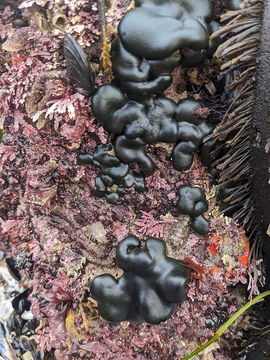
Monostroma
Monostroma is the most widely cultivated genus among green seaweeds.

Monostroma is a genus of marine green algae, or seaweed, belonging to the family Monostromataceae. True to its name, the algae in this genus have a single cell layer, making them monostromatic. It is the most widely cultivated genus among green seaweeds, with commercial farming in East Asia and South America for food products like "hitoegusa-nori" and "aonori."
Classification of species within Monostroma is difficult and lacks agreement among taxonomists. The genus is sometimes called "Gayralia," but the two are considered the same group. Several monostromatic species have been moved out of this genus, including those in *Kornmannia*, *Ulvopsis*, and *Capsosiphon*. A working classification and a field identification key are available.
Genetically, the largest phylogeographic study of this genus, conducted in southwestern Japan, found evidence of sympatric speciation within a panmictic population—the first such report in algae.
In terms of ecophysiology, cultivation, and life cycle, numerous peer-reviewed studies exist. Natural and cultivated sexually reproducing samples, along with an asexually reproducing ecotype discovered in Tosa Bay, Japan, are all the same species. Seasonal changes in thallus length vary by habitat and repeat yearly. Thalli appear and decay earlier in high-salinity areas, suggesting salinity influences either sporophyte maturation or gametophyte senescence. Life cycle, thallus development, and genetic analyses place this genus in the order Ulotrichales. The type of life cycle is not a reliable trait for defining species within Monostromataceae.
For reproduction and sex ratio, gametes form in scattered patches near the thallus tip and are released synchronously in a linear pattern from the back, as the gametangial sheath splits, causing the thallus to break apart. The overall primary sex ratio is roughly 1:1, likely due to Fisherian selection.
Culinarily, in Korea, edible species like *Monostroma nitidum* are called *parae* and eaten as a *namul* vegetable. In Japan, dried *Monostroma kuroshiense* is known as *aonori* and used to season dishes such as *takoyaki* and *okonomiyaki*. In Okinawa, it is used in a soup called *āsa nu ushiru*.
Quick Facts
- Taxon
- Monostroma
Facts from the source article.
Lore & Background
Species-level classification within Monostroma is quite problematic and no consensus exists among algal taxonomists. The genus is oftentimes referred to as 'Gayralia', however Gayralia and Monostroma are congeneric. A number of monostromatic algal species have been removed from this genus, including Kornmannia, Ulvopsis and Capsosiphon. A taxonomic field-identification dichotomous key is available. The largest phylogeographic assessment of this genus yet conducted in SW Japan revealed the existence of sympatric speciation in a panmictic population, the first report of sympatric speciation in algae. Natural and cultivated sexually reproducing environmental samples, as well as sexually reproducing and serendipitously discovered asexually reproducing ecotypes from Tosa Bay, Japan are conspecific. Patterns of seasonal fluctuations in thallus lengths were habitat specific and recur annually; both appearance and decay of thalli were earlier at high saline habitats, suggesting that salinity positively influences either maturation of sporophytes or senescence of gametophytes. Results from life cycle, thallus ontogeny, gametangial ontogeny and phylogenetic analyses suggest that this algal genus is evolutionarily affiliated in the order Ulotrichales. The type of life cycle is not a valid diagnostic character for species circumscription in Monostromataceae. Gametogenesis occurs in discontinuous patches along the frontal apex, and gametes release synchronously in a posterior faced linear fashion by dehiscence of the gametangial sheath, leading to thallic disintegration. The overall primary sex ratio is about 1:1, likely reflecting Fisherian selection.
Reader's Guide
Monostroma is notable as the most widely cultivated genus among green seaweeds, with commercial cultivation in East Asia and South America for edible products such as hitoegusa-nori and aonori. In Korea, edible Monostroma species such as Monostroma nitidum are called parae and eaten as a namul vegetable. In Japan, dried Monostroma kuroshiense called aonori is used to season dishes such as takoyaki and okonomiyaki, and in Okinawa it is used in a soup called āsa nu ushiru. Beyond culinary use, Monostroma oligosaccharides with degree of polymerization 6 prepared by agarase digestion from Monostroma nitidum polysaccharides have been shown to be an effective prophylactic agent during in vitro and in vivo tests against Japanese encephalitis viral infection. The sulfated oligosaccharides from Monostroma seem to be promising candidates for further development as antiviral agents. The genus also holds scientific significance as the site of the first report of sympatric speciation in algae, discovered in a phylogeographic assessment in SW Japan. However, species-level classification remains problematic with no consensus among algal taxonomists, and the genus is often referred to as Gayralia, with which it is congeneric.
Did You Know?
- Monostroma oligosaccharides have shown prophylactic activity against Japanese encephalitis viral infection in in vitro and in vivo tests.
- The first report of sympatric speciation in algae was found in a phylogeographic assessment of Monostroma in SW Japan.
More in Marine Green Macroalgae 1-24
Spotted an error? Know more?
Reader corrections go straight into our review queue. Suggest an edit · How this site is sourced