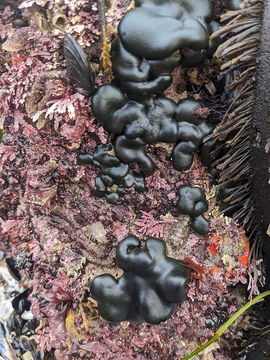
Codium
A genus of edible green macroalgae with diverse thallus forms.

Codium is a genus of edible green seaweed belonging to the order Bryopsidales, and it is the largest genus in the algal family Codiaceae. Currently, the genus includes about 143 confirmed species, with four additional members whose status is unresolved. The name *Codium* comes from a Greek word that describes the soft feel of its thallus.
A leading authority on the taxonomy of this genus was Paul Claude Silva, a researcher at the University of California, Berkeley. Silva identified and described 36 species within *Codium*, and in recognition of his contributions, the species *C. silvae* was named after him.
Taxonomically, the genus has a complicated history. The original type species, *C. tomentosum*, along with several related dichotomously branching species, were described by Stackhouse without proper holotype specimens. This led to frequent misidentifications. P.C. Silva later resolved the confusion by clearly defining *C. tomentosum*, *C. fragile*, and *C. vermilara*, and establishing neotypes for each.
In terms of structure, *Codium* is coenocytic and siphonous, like other members of the Bryopsidales. Its spongy thallus is made of a single, multinucleate, branched tubular cell called a siphon, which ends in a swollen tip known as a utricle. The siphons intertwine to form a mesh-like central region (the medulla), while the utricles form a green to dark-green outer layer (the cortex). The thallus takes several forms: mat-forming (encrusting a substrate with medullary filaments), spherical (forming a ball attached by rhizoidal filaments), or erect and dichotomously branched. The utricles themselves also vary, mainly in the thickness of their apical walls and the shape of their tips. Like many seaweeds, *Codium* species show considerable morphological plasticity, which has made identification based on shape alone difficult.
*Codium* is found naturally from tropical to temperate latitudes but is absent from the polar regions. It lives in both intertidal and subtidal zones. Its life history is diplontic, typical of ulvophycean seaweeds, where the dominant diploid thallus produces male and female gametes.
In Ireland, six species are recorded, two of which are very rare. *Codium adhaerens* has been found at a few sites on the west coast and on Tory Island in County Donegal; it was also recorded in Church Bay, County Antrim, in 1837 but not since.
Quick Facts
- Taxon
- Codium
- Type Species
- Codium tomentosum
- Type Species Authority
- Stackhouse, 1797
Facts from the source article.
Lore & Background
The genus Codium is coenocytic and siphonous, with a spongy thallus composed of a single, multinucleated, branched tubular cell called a siphon, which ends in a swollen utricle. The siphons intertwine to form the medulla, while the utricles form the green to dark-green cortex. Thallus forms include mat-forming, spherical, and erect dichotomously branched types. Utricles vary in apical wall thickness and apex shape. Morphological plasticity has challenged taxonomy.
Taxonomically, Stackhouse failed to provide holotype specimens for C. tomentosum and some congeners, leading to misidentifications. Paul Claude Silva resolved this by delineating C. tomentosum, C. fragile, and C. vermilara and establishing neotypes for each. Silva described 36 species for the genus, and C. silvae was named in his honor.
Codium has a latitudinal range from tropical to temperate areas but is absent from frigid polar regions. In Ireland, C. adhaerens and C. bursa are very rare. Worldwide, many species are listed from Australia, New Zealand, California, South Africa, and other regions. The species C. fragile subsp. tomentosoides, known as 'oyster thief', has invaded Europe and the USA from Japan via marine traffic, causing biodiversity and aquacultural losses.
Reader's Guide
Codium is notable as the largest genus in the algal family Codiaceae, with about 143 confirmed species. Its taxonomy was significantly advanced by Paul Claude Silva, who resolved historical misidentifications by establishing neotypes for key species. The genus exhibits a diplontic life history, with the dominant diploid thallus producing gametes through meiosis, and it can also spread via fragmentation. Ecologically, Codium inhabits intertidal to subtidal zones. Its economic importance is highlighted by South Korea, the leading consumer and producer of farmed Codium (cheonggak), which produced about 4000 metric tons fresh weight in 2017 valued at 2 million US dollars. Farming involves seeding rope lines with utricles and medullary filaments for open-sea grow-out. Chemically, Codium contains polysaccharides, glycoproteins, and other compounds with immunostimulatory, anticoagulant, anticancer, anti-inflammatory, antibacterial, antifungal, and antiviral bioactivities. It is used fresh or dry, typically cooked with soy sauce and vinegar or mixed with kimchi. The genus also includes invasive species like C. fragile subsp. tomentosoides, which has spread from Japan to Europe and the USA, causing ecological and aquacultural damage.
Did You Know?
- The genus name Codium comes from a Greek word for the soft texture of its thallus.
- Paul Claude Silva described 36 species of Codium, and the species C. silvae was named after him.
- Codium fragile subsp. tomentosoides, called 'oyster thief', invaded Europe and the USA from Japan via marine traffic.
- South Korea produced about 4000 metric tons of farmed Codium in 2017, valued at 2 million US dollars.
More in Marine Green Macroalgae 1-24
Spotted an error? Know more?
Reader corrections go straight into our review queue. Suggest an edit · How this site is sourced