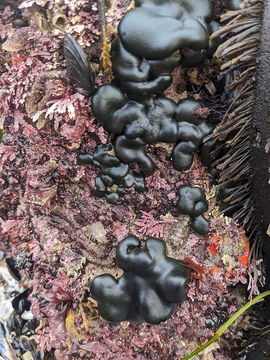
Codium setchellii
Eastern Pacific green felt alga, a long-lived single-celled cushion.

Codium setchellii, commonly known as green felt algae, is a species of marine green macroalgae found in the Eastern Pacific from Alaska to Baja California. It is notable for its unusual morphology as a single, multinucleate cell that forms a bulbous, gently wrinkled cushion, and for its long lifespan relative to other green algae.
Quick Facts
- Genus
- Codium
- Species
- setchellii
Facts from the source article.
Lore & Background
Codium setchellii was described in 1919 by N.L. Gardner, with the holotype collected in 1897 by Mrs. J.M. Weeks, a prolific amateur phycologist, in Pacific Grove, California. The species epithet honors William Albert Setchell, a colleague of Gardner who also worked on Codium. The alga appears as a green to greenish-black, glossy or velvet-like cushion, tightly fused to rock surfaces, and resembles Codium convolutum (restricted to the Southwest Pacific) and Codium ritteri (overlapping in Alaskan and British Columbian waters), though C. setchellii has a smoother surface. It occupies mid intertidal to upper subtidal zones, preferring moist, shady microhabitats such as crevices and north-facing rock faces, and cannot withstand harsh sun or drying conditions.
Reader's Guide
Codium setchellii is significant as an uncommon but ecologically specialized species in the Eastern Pacific. Its relative rarity is attributed to specific microhabitat requirements and efficient herbivory, particularly by the sea slug Placida dendritica, which can amass groups of 70–90 individuals per thallus, and the snail Lacuna marmorata. A transplantation study showed that sand presence is necessary for growth, as sand burial or scouring deters grazers that would otherwise eliminate this slow-growing alga. Despite its slow growth, it can overgrow and smother other rock-adherent organisms. The species is unusually long-lived for green algae, surviving several years if it reaches 4 cm in diameter. Its life cycle is likely a simple diplontic sexual one, with reproduction mainly in winter (November to December); it is dioecious, with male and female gametangia on separate individuals. No parthenogenesis or asexual reproduction via fragmentation has been observed. The alga also hosts numerous epiphytic red and brown algae.
Did You Know?
- Each individual Codium setchellii is a single enormous cell packed with multiple nuclei.
- The species is eaten by the sea slug Placida dendritica, which sequesters chloroplasts from the alga for camouflage.
- Codium setchellii can live for several years if it reaches a diameter of 4 cm or more.
- The holotype was collected in 1897 by Mrs. J.M. Weeks, a highly knowledgeable amateur phycologist.
More in Marine Green Macroalgae 1-24
Spotted an error? Know more?
Reader corrections go straight into our review queue. Suggest an edit · How this site is sourced