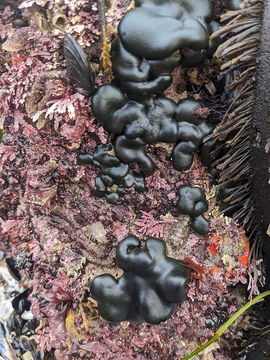
Cephaleuros
Parasitic green algae causing red rust spots on tropical plants.

Cephaleuros is a genus of thalloid green algae with about 14 species, commonly called red rust. These algae are parasites that live inside vascular plants, mostly in subtropical and tropical regions.
The algae produce velvet-like spots up to 10 mm or more across. These spots consist of a prostrate thallus (either filamentous or pseudoparenchymatous) and an erect system of branching filaments. Cephaleuros grows beneath the host plant’s cuticle or epidermis. Its filaments branch dichotomously or pinnately, forming roughly circular thalli. Each cell has a single nucleus and an irregularly reticulate, parietal chloroplast without pyrenoids. Carotenoid pigments often accumulate in the cytoplasm, giving the thallus an orange-red color.
Cephaleuros is easily mistaken for non-algal organisms because its fuzzy reddish spots resemble rust disease. To identify species, the key traits are thallus growth habit (filamentous or pseudoparenchymatous, and location within host cells), the shape of reproductive structures, and the type of lesions produced (distinctive for a few species). Chromosome counts can also help.
Reproduction is both asexual and sexual. Asexually, zoospores form in zoosporangia on fertile branches. These branches have an enlarged “head cell” and multiple “sporangiate laterals,” each made of a short suffultory cell and a round, enlarged zoosporangium. Each zoosporangium produces 8 to 64 zoospores, which have four equal flagella and are released when the sporangium gets wet. Sexual reproduction is isogamous. Gametangia develop from lateral and terminal thallus cells, producing 8 to 64 biflagellate gametes that are slightly smaller than zoospores. The gametes fuse outside the gametangia if moisture is sufficient; otherwise, they fuse inside. The resulting zygotes reportedly develop into dwarf sporophytes that produce spores through meiosis, but this heteromorphic alternation of generations is not fully documented and may vary among species.
The only known fossil record of Cephaleuros is *Pelicothallos villosus*, originally thought to be a fungus but now recognized as a form of Cephaleuros. It was found inside the cuticle of Myrtaceae leaves from a Middle Eocene deposit in the Claiborne Formation, Tennessee.
Cephaleuros parasitizes angiosperms and, less often, gymnosperms.
Quick Facts
- Taxon
- Cephaleuros
- Type Species
- Cephaleuros virescens
- Type Species Authority
- Kunze ex E.M.Fries
Facts from the source article.
Lore & Background
Cephaleuros forms velvet-like spots up to 10 mm or more in diameter, consisting of a filamentous or pseudoparenchymatous prostrate thallus and an erect system of branching filaments. The organism grows below the cuticle or epidermis of the host plant. Cells contain a single nucleus and an irregularly reticulate, parietal chloroplast with no pyrenoids; accumulations of carotenoid pigments give the thallus an orange-red color.
Cephaleuros reproduces both asexually and sexually. Asexual reproduction occurs via zoospores formed on zoosporangia on fertile branches, which include an enlarged head cell and sporangiate laterals. Zoosporangia produce 8 to 64 zoospores with four equal flagella, released when wet. Sexual reproduction is isogamous, with gametangia developing from lateral and terminal thallus cells; gametes are biflagellate and fuse outside or inside the gametangia depending on moisture. The resulting zygotes reportedly develop into dwarf sporophytes that produce spores through meiosis, though this heteromorphic alternation of generations is not fully documented.
Cephaleuros has been recorded from the fossil record once, as Pelicothallos villosus, originally thought to be a fungus, found within the cuticle of Myrtaceae leaves in a Middle Eocene deposit in the Claiborne Formation, Tennessee.
Reader's Guide
Cephaleuros is significant as a parasitic alga on angiosperms and, to a lesser extent, gymnosperms, causing damage to economically important tropical and subtropical plants such as tea, coffee, mango, and guava. The damage includes algal leaf spot, killing new shoots, or disfiguring fruit. Spores germinate on plants in the rainy season, though how Cephaleuros enters its host plants remains unclear. Members of the genus may also grow with a fungus to form a lichen that does not damage plants; in some cases, fungi surround the algae and extract water and nutrients, acting as hyperparasites. Most species grow between the cuticle and epidermis, but a few intercellular species cause more damage. Identification is often confused with non-algal taxa because the fuzzy reddish spots resemble rust disease. Species identification relies on thallus growth habit, morphology of reproductive structures, lesion types, and chromosome counts. The genus includes 14 recognized species, such as Cephaleuros virescens and Cephaleuros parasiticus.
Did You Know?
- Cephaleuros is commonly called red rust due to its fuzzy reddish spots that resemble rust disease.
- Its zoospores have four equal flagella, while its gametes are biflagellate and somewhat smaller.
- The only fossil record of Cephaleuros is Pelicothallos villosus from a Middle Eocene deposit in Tennessee.
- Some Cephaleuros species grow intercellularly and cause more damage to host plants than those growing between cuticle and epidermis.
More in Marine Green Macroalgae 1-24
Spotted an error? Know more?
Reader corrections go straight into our review queue. Suggest an edit · How this site is sourced