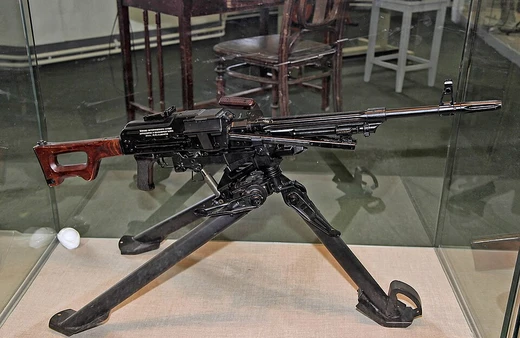
ZB-60
Czechoslovak heavy machine gun adapted for German and British service.

The ZB-60 was a heavy machine gun designed by Zbrojovka Brno in Czechoslovakia during the 1930s. Originally conceived as a 20mm anti-tank gun, it was later adapted to fire the 15×104mm Škoda round, becoming a large-caliber heavy machine gun. Though not adopted by the Czechoslovak military, it saw service with Nazi Germany and other nations, and its design influenced the British 15 mm Besa machine gun.
Quick Facts
- Origin
- Czechoslovakia
- Is Ranged
- yes
- Service
- 1938–1944
- Wars
- World War II
- Designer
- Zbrojovka Brno
- Design Date
- 1933–1937
- Manufacturer
- Zbrojovka Vsetín · de · Zbrojovka Vsetín
- Length
- 2050 mm
- Part Length
- 1460 mm
- Cartridge
- 15×104mm Brno · ru · 15 × 104 мм Брно
- Caliber
- 15 mm
- Action
- Gas operated, open bolt
Facts from the source article.
Lore & Background
Design efforts for the ZB-60 began in the early 1930s as a 20mm automatic gun intended for anti-tank use. In 1933, the design was altered to use the 15×104mm Škoda round, transforming it into a large-caliber heavy machine gun. By 1934, the Czechoslovak military tested the ZB-60 but declined to adopt it due to accuracy concerns and excessive recoil, even given its weight. For several years, it was considered for use as a fortification gun, where stronger mounts could manage the recoil, but it was eventually dropped from fortification concepts.
After the German occupation of Czechoslovakia in March 1939, Nazi Germany acquired a number of ZB-60s and took them into Wehrmacht service as the 15 mm 39(t). Under German occupation, new guns were produced for the Wehrmacht and Kriegsmarine. Following the Invasion of Yugoslavia, former Yugoslav guns were designated as the 15 mm 490(j). The Germans employed the ZB-60 as an anti-aircraft gun during World War II.
The British acquired a license for the ZB-60 and later developed their 15 mm Besa machine gun from it for service on armored fighting vehicles. A batch was also sold to Iran, and in 1937 Yugoslavia adopted the gun as the Mitraljez 15 mm M.38.
Reader's Guide
The ZB-60's significance lies in its role as a transitional design between anti-tank cannon and heavy machine gun, and its subsequent adoption by multiple nations. Though rejected by its own military, the gun found a second life under German occupation, where it was produced and used as an anti-aircraft weapon by both the Wehrmacht and Kriegsmarine. Its capture and use by Germany, along with its sale to Iran and adoption by Yugoslavia, demonstrate its spread across different theaters of World War II.
Perhaps its most lasting legacy is its influence on British armored vehicle armament. The British license for the ZB-60 led directly to the development of the 15 mm Besa machine gun, which saw extensive service in British tanks and other armored fighting vehicles. This lineage connects the ZB-60 to a broader family of weapons that served throughout the war. The gun's design, though flawed in its original form, proved adaptable enough to be repurposed for different roles and users, making it a notable example of interwar Czechoslovak arms development that outlived the state that created it.
Did You Know?
- The ZB-60 was originally designed as a 20mm anti-tank gun before being rechambered for the 15×104mm Škoda round.
- The Czechoslovak military rejected the ZB-60 due to accuracy concerns and excessive recoil.
- Nazi Germany used captured and newly produced ZB-60s as anti-aircraft guns under the designation 15 mm 39(t).
- The British developed their 15 mm Besa machine gun from a licensed version of the ZB-60.
More in Machine Guns, Part 4 1-24
Spotted an error? Know more?
Reader corrections go straight into our review queue. Suggest an edit · How this site is sourced