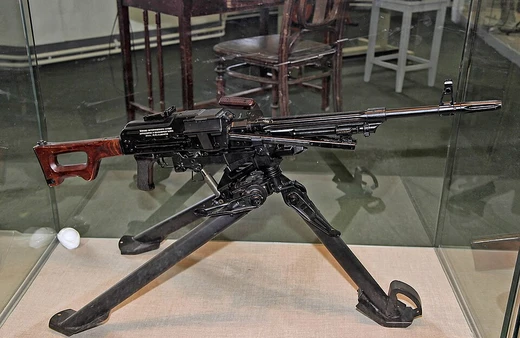
Heavy machine gun
A class of machine guns too heavy to be man-portable.

Gary Todd from Xinzheng, China · CC0
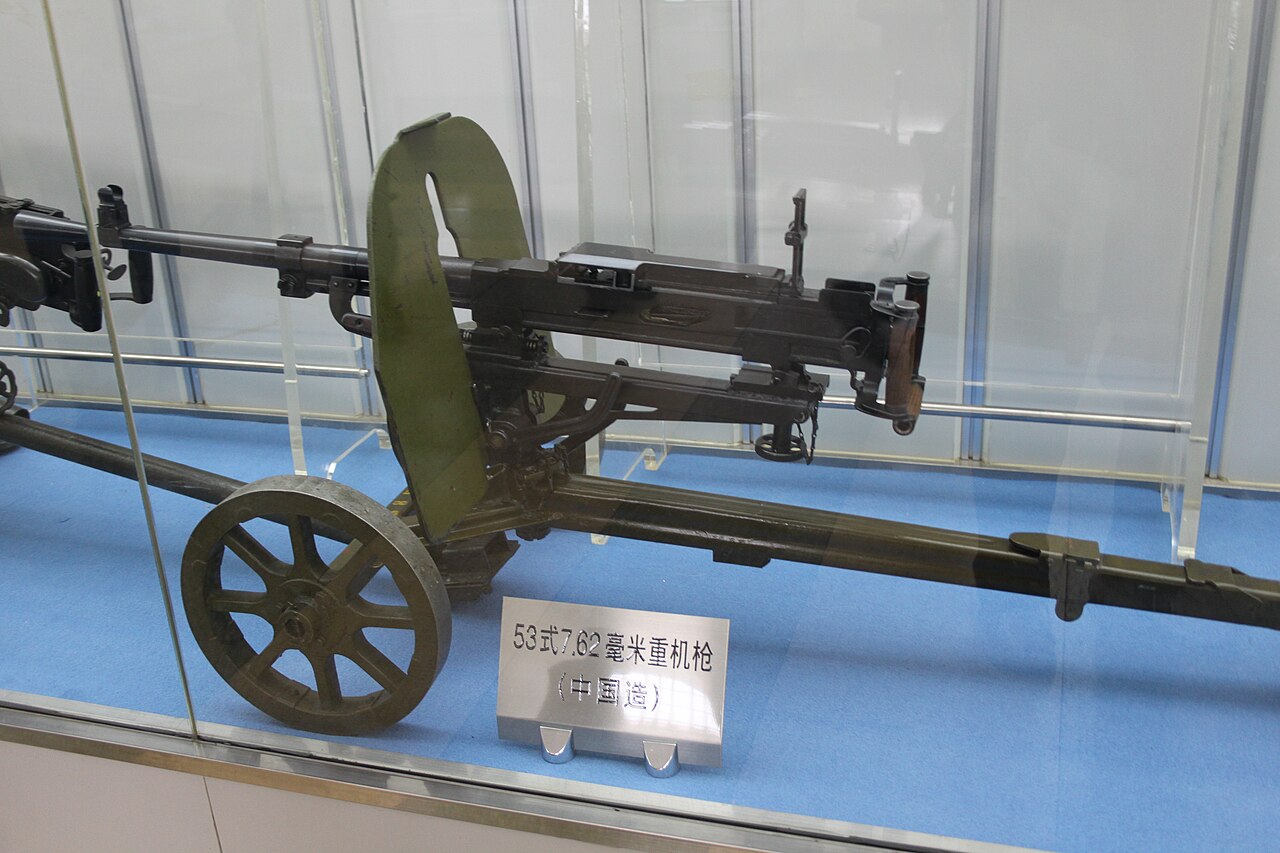
A heavy machine gun (HMG) is a class of firearm that is substantially larger and heavier than light, medium, or general-purpose machine guns. Because of its weight, an HMG cannot be carried by a single person; it must be mounted on a vehicle, tripod, or other platform to be stable and tactically useful. It delivers greater firepower and typically requires a crew of several people to operate and maintain.
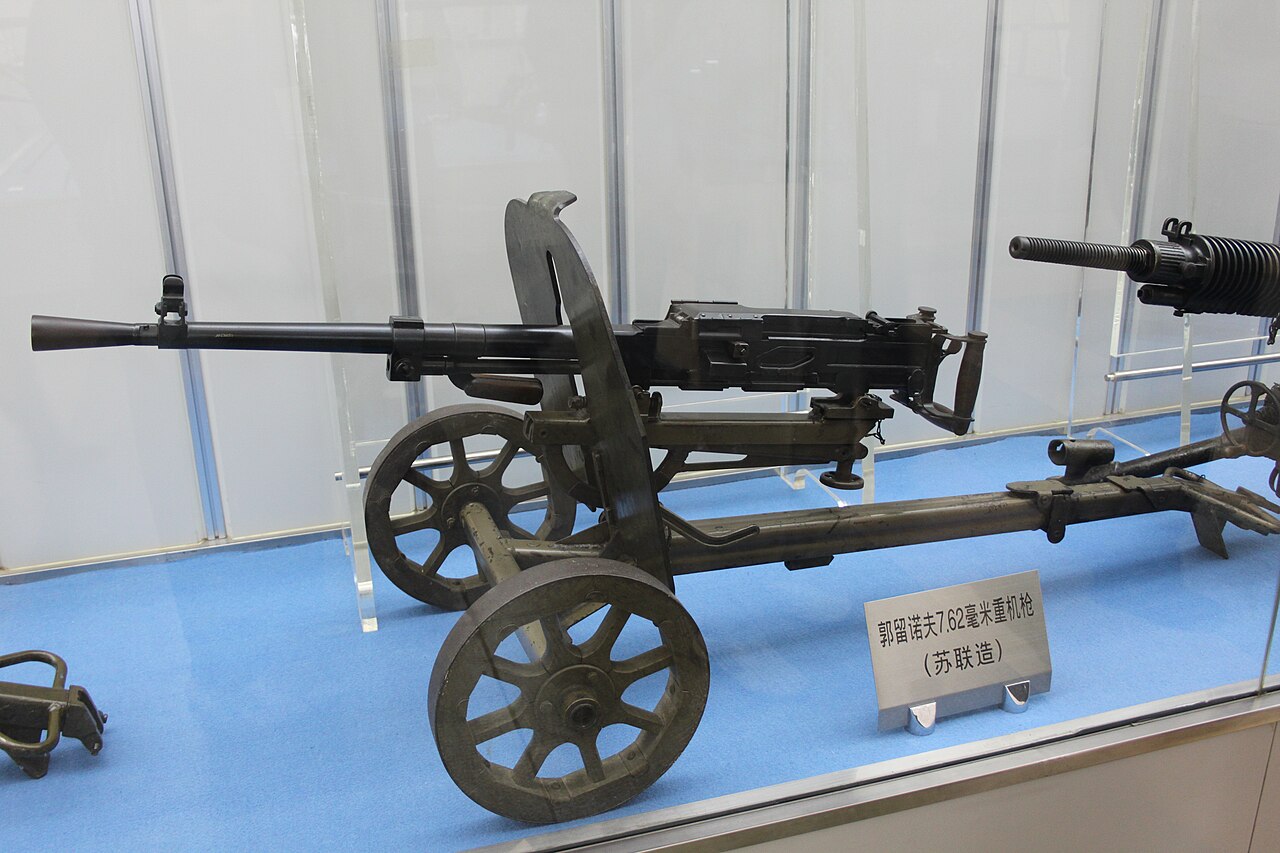
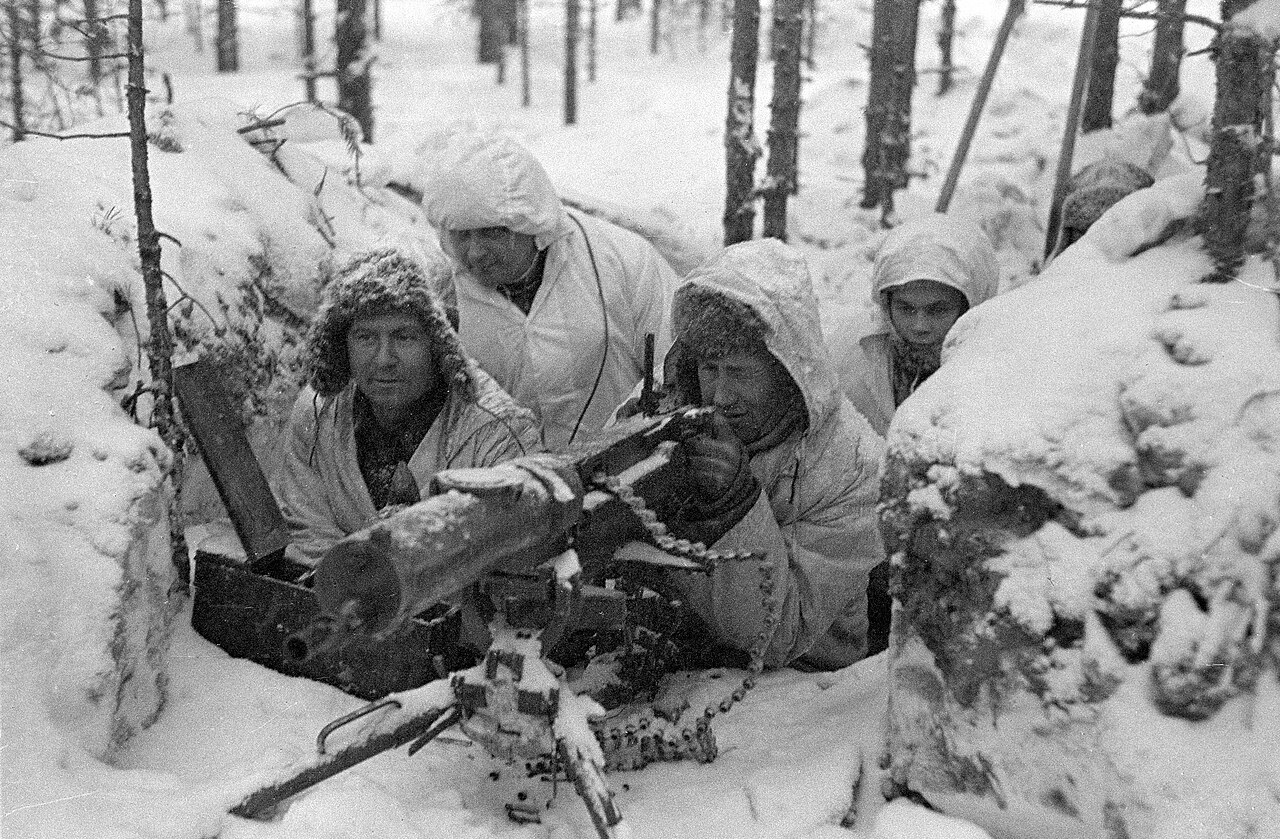
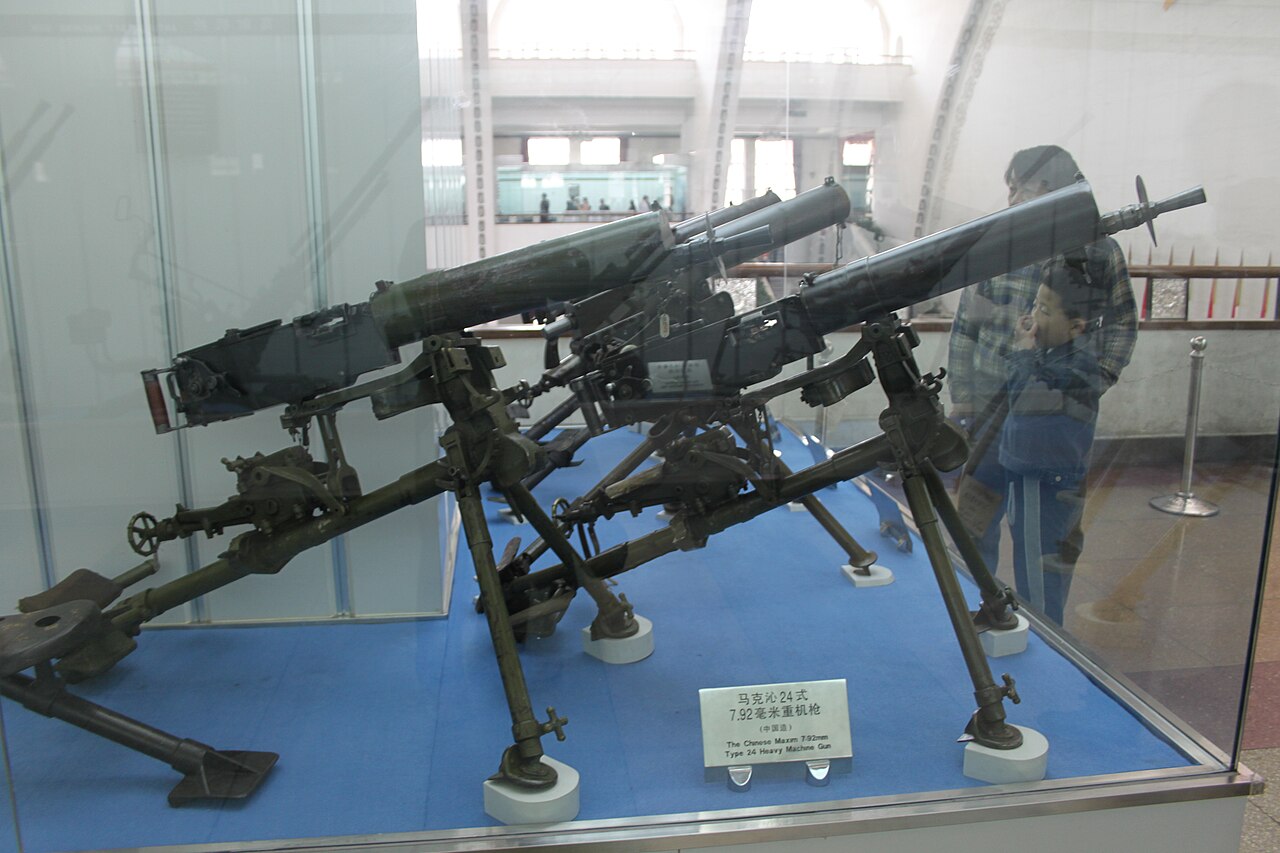
Two distinct classes of weapons fall under the HMG label. The historical definition covers machine guns that fire standard full-power rifle cartridges—such as the 7.92×57mm Mauser, .303 British, or 7.62×54mmR—but are considered “heavy” due to their bulk and cumbersome nature. These weapons, exemplified by the Maxim gun and the M1917 Browning, used heavy construction, elaborate mounts, and water-cooling systems to sustain long-range automatic fire with high accuracy. Their weight made them impractical for infantry to move on foot, and they required a crew to operate. The term “heavy” in this context referred to the weapon’s size and ability to sustain fire, not the caliber of its cartridge.
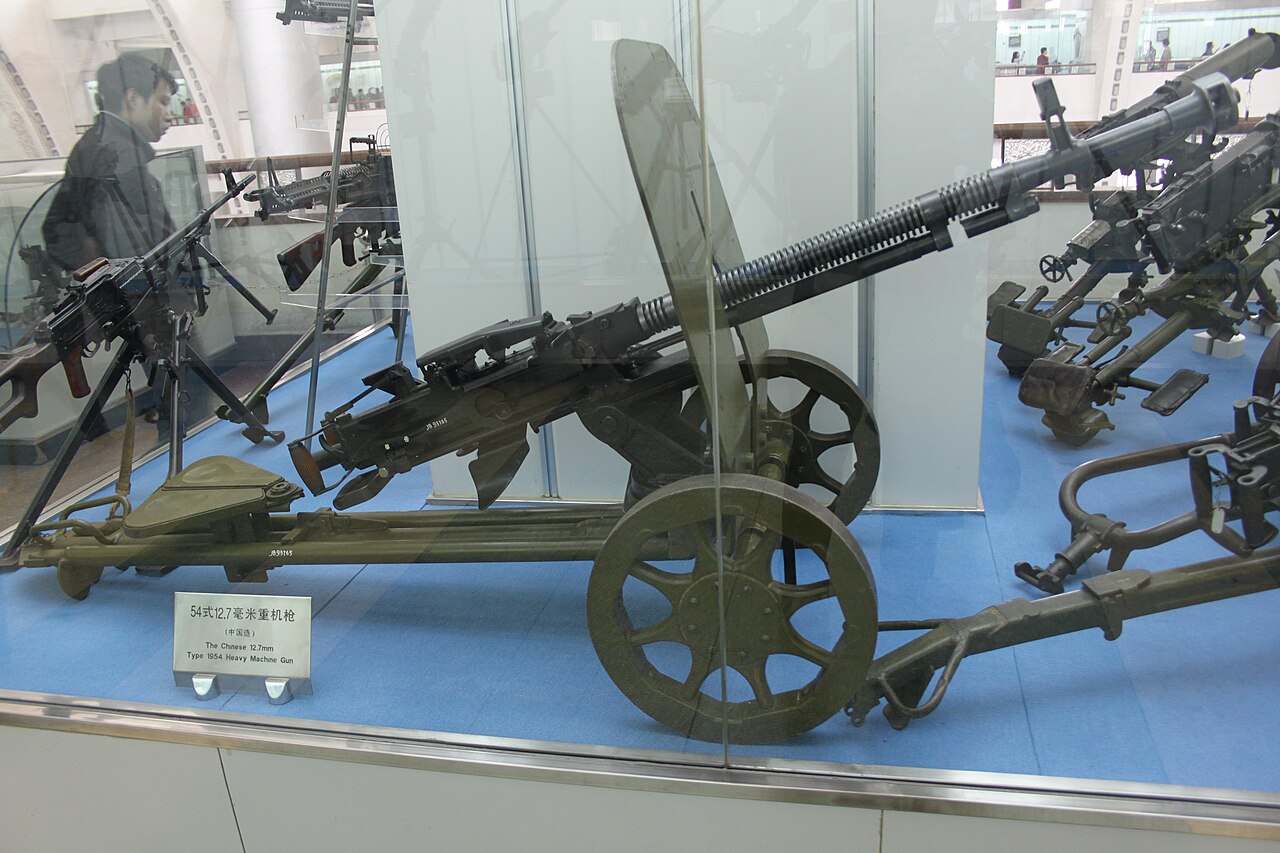
The modern definition refers to “heavy caliber” machine guns, a concept pioneered by the German Empire’s MG 18 TuF, a Maxim derivative chambered in 13.2×92mmSR that appeared near the end of World War I. These weapons are designed to provide greater effective range, penetration, and stopping power against vehicles, aircraft, and light fortifications—capabilities beyond those of full-power rifle cartridges used in medium or general-purpose machine guns, and far beyond the intermediate cartridges used in assault rifles and light machine guns. They also produce more felt recoil than lighter machine guns. Common modern HMG rounds include the 12.7×99mm, 12.7×108mm, and 14.5×114mm cartridges.
In terms of classification, machine guns with calibers from .22 to .250 (5.45 mm to 6 mm) are considered light; those from .264 to .33 (6.5 mm to 8 mm) are medium; and .50 caliber or larger (12.7 mm to 21 mm) are heavy. Autocannons, or “cannons,” are defined as any gun firing a cartridge above .80 caliber (20 mm), though this does not apply to 40 mm grenade launchers. Anything under .80 caliber is considered a machine gun.
- Weight with tripod
- 58 kg (128 lb) for the M2 Browning
- Historical examples
- Maxim machine gun, M1917 Browning machine gun
- Modern calibers
- 12.7×99mm, 12.7×108mm, 14.5×114mm
- Pioneer modern hmg
- MG 18 TuF in 13.2×92mmSR
- Caliber range for hmg
- 12.7 mm to 21 mm
Lore & Background
The term originally referred to machine guns from World War I that fired standard full-power rifle cartridges but featured heavy construction, elaborate mountings and water-cooling mechanisms enabling long-range sustained automatic fire. These weapons were too cumbersome to move and required a crew of several soldiers. The Maxim gun, invented by Hiram Maxim, was the most ubiquitous of this class, with variants fielded by Germany (MG 08), Britain (Vickers), and Russia (PM M1910).
The modern definition refers to 'heavy caliber' machine guns, pioneered by the German Empire's MG 18 TuF near the end of World War I. These are designed to provide increased effective range, penetration and stopping power against vehicles, aircraft and light fortifications. Popular HMG rounds today include 12.7×99mm, 12.7×108mm and 14.5×114mm. The M2 Browning was used widely in fortifications, on vehicles and in aircraft by American forces during World War II, while the Soviets fielded the DShK in 12.7×108mm.
Machine guns with calibers from .50 caliber or larger (12.7 mm to 21 mm) are considered heavy machine guns. Autocannons are defined by any gun firing a cartridge above .80 caliber (20 mm).
Reader's Guide
The heavy machine gun class bridges the gap between exclusively anti-infantry weapons and exclusively anti-materiel weapons. The historical definition emphasized weight and sustained fire capability, exemplified by water-cooled designs like the Maxim and Vickers that could fire for extended periods from fixed positions. The modern definition shifted to caliber and power, with weapons like the M2 Browning providing anti-fortification and anti-vehicle capability that general-purpose machine guns lacked. The German MG42, though effective against infantry, was noted to lack the M2's anti-fortification and anti-vehicle capability. The continued need for longer-range machine guns with anti-materiel capability has led to widespread adoption and modernization of the class, and most nations' armed forces are equipped with some type of HMG. These weapons remain in use for their ability to engage vehicles, aircraft, and light fortifications at ranges beyond standard rifle calibers.
Did You Know?
- The M2 Browning with tripod weighs 58 kg (128 lb).
- The modern HMG class was pioneered by the German Empire's MG 18 TuF in 13.2×92mmSR.
- The Maxim gun was invented by American inventor Hiram Maxim.
Origins and the Case for Blowback
In 1888, Archduke Karl Salvator of Austria and Count George von Dormus patented a delayed blowback machine gun that the Austro-Hungarian Army adopted as the Škoda M1893, primarily for fortification use. Škoda Works later refined the feed system in an M1902 variant, though only a handful were produced. Around the same time, Andreas Wilhelm Schwarzlose was developing his own delayed blowback concept, filing patents as early as 1900. By 1907, the military selected Schwarzlose's design to replace the Škoda line. According to firearms historian George M. Chinn, the blowback mechanism was a deliberate choice: it was cheaper and easier to manufacture than a Maxim-style gun, and it sidestepped the gas-operated system used in Hotchkiss designs. Schwarzlose built his earliest prototypes in a private workshop before Steyr took over as sole manufacturer. The result was a weapon that cost roughly half the price of a Maxim while delivering a 400-round-per-minute cyclic rate, making it an attractive option for a large army seeking reliable firepower without prohibitive expense.
Combat Deployment in the Great War
By 1914, the Austro-Hungarian Army fielded 2,761 machine guns, organized into four-gun batteries assigned to infantry, cavalry, and mountain units. Infantry regiments received two Schwarzloses per section, one per battalion, mounted on tripods and hauled by pack horses at the regimental level. Cavalry teams used three horses—one carrying the gun and 500 rounds, two carrying 1,500 rounds—while mountain batteries assigned one horse to the gun plus 11,000 rounds and additional horses for 2,000 rounds each. Each gun was crewed by three or four soldiers under a non-commissioned officer. On the Italian Front, Austro-Hungarian machine gunners used the Schwarzlose to devastating effect, repelling numerically superior Italian forces and inflicting heavy casualties during the Isonzo battles. Conversely, on the Eastern Front in 1914–1915, the Austrians lost so many M 07/12s that they were forced to order Škoda M1913s as a stopgap. The Imperial Russian Army incorporated captured Schwarzloses alongside their own Maxims. The Navy mounted the guns as anti-aircraft weapons on battleships including the Erzherzog Karl and Tegetthoff classes, while the Aviation Troops struggled with synchronization issues and often resorted to improvised field mountings.
Global Adoption and Wartime Longevity
Before World War I ended, the Schwarzlose had already found buyers across Europe: the Netherlands adopted it in 1908, followed by Greece, Serbia, Romania, Bulgaria, Sweden, and the Ottoman Empire. When wartime demand outstripped Steyr's capacity, the Dutch established their own production line at the Hembrug Arsenal in 1917, running it until 1940. Sweden produced licensed copies at the Carl Gustafs Stads Gevärsfaktori in Eskilstuna between 1917 and 1939. Unlicensed copies also appeared in China, with the Sichuan Arsenal producing a small batch for warlord Xiong Kewu from 1918 and the Guangdong Arsenal making a handful in the early 1920s. After the war, successor states including Austria, Hungary, Czechoslovakia, Poland, and Yugoslavia kept the M 07/12 in service through the Russian Civil War, the Polish–Soviet War, the Greco–Turkish War, the Colombia–Peru War, and the Spanish Civil War. Italy received roughly 900 guns as war reparations, issuing them to colonial troops in Africa, often in anti-aircraft roles, and retained them until the end of World War II. The Wehrmacht later pressed captured Austrian, Dutch, Greek, Italian, and Yugoslav Schwarzloses into second-line anti-partisan and AA duties, and in the war's final months the Volkssturm militia also handled the weapon.
Mechanical Simplicity and Operational Quirks
The Schwarzlose is a water-cooled, toggle-delayed blowback machine gun whose internal architecture is markedly leaner than a Maxim's. Where the Maxim requires 14 springs, 35 breech components, and 52 screws and pins, the Model 1907 manages with a single spring, 11 breech parts, and 13 fasteners, and it weighs roughly 10 kilograms less. The bolt mechanism includes a small device that oils cartridge cases to ease extraction. One notable operational quirk is that the top cover must be opened to load ammunition belts and to verify the oil reservoir is full. The base models—1905, 1907, and 1908—cycled at about 400 rounds per minute, while the 1907/12 variant raised that to 580 by fitting a stronger mainspring. Some authors, including Chinn, claimed the /12 modification eliminated the need for ammunition lubrication through a heavier bolt and stronger spring, but firearms writer Ian V. Hogg disputed this, noting the /12 simply had a larger oil reservoir and no production gun ever dropped the oiler. The Schwarzlose proved robust and reliable in its intended infantry role, though it fared less well when pressed into duties it was never designed to handle, unlike the more adaptable Maxim-derived guns.
Gallery
Frequently Asked Questions
Who is Heavy machine gun?
Heavy machine gun is a class of crew-served firearm that is substantially larger and heavier than light, medium, or general-purpose machine guns, and it must be mounted on a tripod, vehicle, or other fixed platform because no single person can carry and operate it. It typically requires a crew of several operators to handle, feed, and maintain the weapon during sustained fire.
What are Heavy machine gun's powers/role?
Its core role is to deliver sustained, high-volume suppressive fire that lighter machine guns simply cannot match, making it a backbone of area denial and entrenched defensive positions. The M2 Browning, for instance, tips the scales at roughly 58 kg (128 lb) with its tripod, illustrating why it must be emplaced rather than man-portable.
What calibers does Heavy machine gun fire?
Modern HMGs generally chamber rounds in the 12.7 mm to 21 mm range, with common examples including 12.7×99mm, 12.7×108mm, and 14.5×114mm cartridges. Historically, the category also covered guns firing full-power rifle rounds such as 7.92×57mm Mauser and .303 British.
Who pioneered the modern Heavy machine gun?
The MG 18 TuF, chambered in 13.2×92mmSR, is widely credited as the pioneer of the modern heavy machine gun concept. Earlier trailblazers like the Maxim gun and the M1917 Browning laid the essential groundwork for the category's evolution.
Why is Heavy machine gun important?
It fills a critical firepower gap between medium machine guns and autocannons, providing a level of sustained heavy-caliber fire that no man-portable weapon can achieve. Its presence on a battlefield dictates the positioning of both friendly and opposing forces, making it a decisive force multiplier for any unit that fields one.
More in Machine Guns, Part 4 1-24
Spotted an error? Know more?
Reader corrections go straight into our review queue. Suggest an edit · How this site is sourced