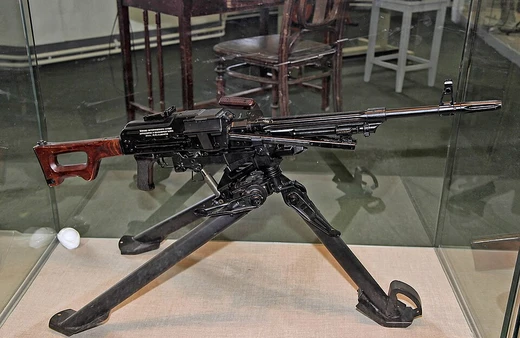
W85 heavy machine gun
Chinese heavy machine gun adopted as vehicle-mounted QJC-88.

The W85 heavy machine gun is a gas-operated weapon designed in the People's Republic of China to fire the Soviet-designed 12.7×108mm round. It was originally intended as a lightweight infantry support weapon but was never accepted into PLA service in that role. It was later adopted as a vehicle-mounted machine gun under the designation QJC-88.
Quick Facts
- Origin
- China
- Is Ranged
- yes
- Service
- 1980s-present
- Wars
- War in Darfur / Sri Lankan Civil War / Northern Mali conflict / Syrian Civil War / Libyan Civil War / Iraqi Civil War / Yemeni Civil War / Russo-Ukrainian War
- Manufacturer
- Norinco
- Production Date
- 1985-present
- Variants
- QJC-88
- Weight
- 18.5 kg (gun only) / 39 kg (with tripod)
- Cartridge
- 12.7×108mm
- Action
- Gas-operated, long stroke gas piston, open bolt
- Rate
- 550-600 rounds/min
- Velocity
- 850 m/s (2,788 ft/s)
Facts from the source article.
Lore & Background
The W85 was designed with a small receiver of generally rectangular cross-section and a thick gas tube below the barrel containing a conventional gas piston. It was built to be as light as possible for infantry use, and it features rails for optics or anti-aircraft sights in addition to iron sights. The weapon fires 12.7×108mm rounds from belts and is more accurate than the Type 54 heavy machine gun, but its thinner barrel overheats faster. In trials, the W85 lost out to the Type 85 as an infantry weapon and was not accepted into PLA service for this role.
The QJC-88 variant was introduced as a pintle-mounted machine gun for tanks and armored vehicles. It weighs the same as the W85, is solenoid fired, and is mounted on a special cradle allowing for elevation angles of -5 to +65°. It has been mounted on the Type 99, Type 96, Type 15, and Type 59 Durjoy tanks as a commander heavy machine gun, as well as on the Type 05 armored personnel carrier variant, various configurations of the Type 08 family (including ZSL-10 APC, ZTL-11 assault vehicle, and Type 08 Artillery Reconnaissance Vehicle), the PLL-05, and the Type 89 AFV.
During the Syrian civil war, some Syrian Democratic Forces technicals locally known as duşkas were equipped with W85 heavy machine guns. Users include the Libyan National Army, the Nepali Army, Rwandan peacekeepers in Darfur, the South Sudan Democratic Movement, and Ukrainian forces from 2022 (theorized to be taken from intercepted arms shipments to the Houthis in 2021). The weapon is also manufactured locally as Khawad. Non-state actors include the Free Syrian Army, People's Defense Units, and the Wagner Group (Khawad used by mercenaries in Mali).
Reader's Guide
The W85 heavy machine gun is notable primarily for its dual identity: a failed infantry weapon that succeeded as a vehicle-mounted system. Its design prioritized lightness and accuracy over sustained fire capability, which proved unsuitable for infantry use but acceptable for armored vehicle mounts where barrel overheating is less critical. The QJC-88 variant became standard on multiple Chinese armored platforms, including main battle tanks and armored personnel carriers, indicating the design's adaptability. The weapon's presence in conflicts such as the Syrian civil war and its use by various state and non-state actors—including Ukrainian forces—demonstrates its spread beyond China. The local manufacture as Khawad and its appearance in multiple theaters suggest the design has found a niche as a durable, exportable heavy machine gun despite its initial rejection by the PLA.
Did You Know?
- The W85 was designed to be as light as possible for infantry use but lost trials to the Type 85.
- The QJC-88 variant is solenoid fired and can elevate from -5 to +65°.
- During the Syrian civil war, Syrian Democratic Forces mounted W85s on technicals called duşkas.
- The weapon is manufactured locally as Khawad and has been used by Wagner Group mercenaries in Mali.
More in Machine Guns, Part 4 1-24
Spotted an error? Know more?
Reader corrections go straight into our review queue. Suggest an edit · How this site is sourced