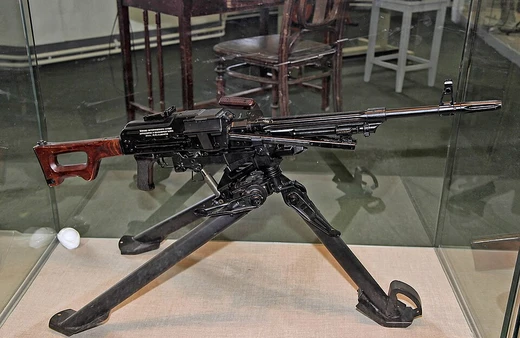
Vz.53 anti-aircraft gun
Czechoslovak quad 12.7 mm anti-aircraft gun, widely exported during the Cold War.

The Vz.53, often called the M53 in Western references, is a Czechoslovak anti-aircraft system from the 1950s. It mounts four Vz.38/46 machine guns—copies of the Soviet DShK—in a 12.7 mm caliber on a wheeled carriage that can rotate a full 360 degrees. Its official Czech name is 12.7 mm PL štvorguľomet vz.53.
After World War II, the Czechoslovak military had a jumble of anti-aircraft guns, including German weapons like the Flakvierling 38, which fired proprietary ammunition no longer in production. Since the army already manufactured the Vz.38/46, a clone of the Soviet DShKM, it built a light quad-mount carriage for these guns to defend against low-flying aircraft. The result, designated Vz.53, entered service in 1953. It worked alongside the towed 30 mm Vz.53/59 and its self-propelled variant, the M53/59 Praga, which struggled at very close ranges.
The Vz.53 resembled the Soviet ZPU-4 but used a lighter 12.7 mm round, giving it a shorter effective range and less punch than the Soviet 14.5 mm weapon. It was, however, about three times lighter than the ZPU-4. Both systems quickly became outdated as supersonic jet fighters appeared in NATO forces. Czechoslovakia mostly pulled the Vz.53 from service by the early 1960s, though it was not fully replaced until the 9K32 Strela-2 arrived in the early 1970s.
Many Vz.53s were sold or given as aid to Soviet-aligned states during the Cold War. Cuba was a major operator, using them during the Bay of Pigs invasion, where they reportedly shot down a Douglas A-26 Invader bomber. Cuba later brought the guns to Angola and supplied some to the MPLA during the Angolan Civil War, keeping M53s in use into the 1990s. Cuba also sent at least half a dozen M53s to Grenada, where they were used against U.S. forces in Operation Urgent Fury in 1983; one is suspected of downing a UH-60 Blackhawk, the first such loss of that helicopter. Some appeared in the Nicaraguan Revolution, provided by Cuba.
Egypt received M53s as part of the 1955 Egyptian–Czechoslovak arms deal and used them during the Suez Crisis. Others went to Iraq and Syria. Arab nations deployed large numbers in the Six-Day War and the Yom Kippur War, where Israel captured many. A small number were sent to North Vietnam and saw action in the Vietnam War. As of 2021, the Vz.53/M53 is not known to be in active service anywhere, though some may remain in Cuban storage.
Quick Facts
- Origin
- Czechoslovakia
- Is Ranged
- YES
- Service
- 1953 onwards
- Designer
- Vasiliy Gavrilovich Grabin
- Design Date
- 1953
- Production Date
- 1953 – late 1950s
- Weight
- 558 kg
- Crew
- 4
- Cartridge
- 12.7×108mm
- Action
- Gas operated, flapper locking
- Velocity
- 850 m/s
- Range
- 1,500 m
Facts from the source article.
Lore & Background
Following World War II, the Czechoslovak military was equipped with a wide mixture of anti-aircraft weapons, including many German weapons such as the Flakvierling 38, a quad-barreled 2 cm weapon. However, these weapons used proprietary ammunition, production of which had ceased after Germany's surrender. The Czechoslovak People's Army was already producing the Vz38/46, a copy of the Soviet DShKM 12.7 mm machine gun, and decided to create a light quad-mount anti-aircraft carriage mounting these guns to serve as a low-level air defense weapon. The resulting system was designated Vz.53 and entered service in 1953. The Vz.53 complemented the towed 30 mm Vz.53/59 and its self-propelled version, the M53/59 Praga, which were not effective at extremely close ranges.
The Vz.53 was similar to the Soviet ZPU-4, but the Vz.53's lighter 12.7 mm cartridge had a lower effective range and did less damage than the Soviet 14.5 mm weapon. However, the Vz.53 was approximately three times lighter than the ZPU-4. Regardless, both weapons were quickly rendered obsolescent as supersonic jet fighters began to enter service in NATO countries. The Vz.53 was mostly withdrawn from Czech service by the early 1960s, but was not fully replaced until the 9K32 Strela-2 became available in the early 1970s.
Reader's Guide
The Vz.53/M53 saw extensive combat use across multiple conflicts, largely due to its export to Soviet client states as part of the Cold War. Cuba was one of the largest operators, using several during the Bay of Pigs invasion where they were reportedly responsible for shooting down a Douglas A-26 Invader bomber. Cuba later brought these to Angola and provided some to the Angolan MPLA during the Angolan Civil War, and used M53s until the 1990s. Cuba also provided at least half a dozen M53s to Grenada, where they were used against US forces during Operation Urgent Fury in 1983; it is suspected that an M53 was responsible for shooting down a UH-60 Blackhawk during this operation, the first UH-60 ever to be shot down. Some were also used during the Nicaraguan Revolution, provided by Cuba.
M53s were sold to Egypt as part of the Egyptian–Czechoslovak arms deal in 1955 and were used during the Suez Crisis. Some were supplied to Iraq and Syria, and Arab nations used large numbers of M53s during the Six-Day War and Yom-Kippur War, where many were captured by Israel. A small number were provided to North Vietnam and used during the Vietnam War. As of 2021, the Vz.53/M53 is not known to be in service anywhere in the world, though some may be in storage in Cuba.
Did You Know?
- The Vz.53 is approximately three times lighter than the Soviet ZPU-4.
- It is suspected that an M53 shot down the first UH-60 Blackhawk ever lost in combat, during Operation Urgent Fury in 1983.
More in Machine Guns, Part 4 1-24
Spotted an error? Know more?
Reader corrections go straight into our review queue. Suggest an edit · How this site is sourced