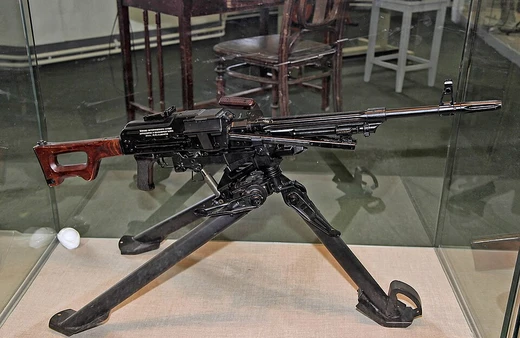
Vickers machine gun
A water-cooled .303 machine gun known for extreme reliability.

The Vickers machine gun, a water-cooled weapon chambered in .303 British (7.7 mm), was built by Vickers Limited for the British Army. It required a three-man crew to operate, though additional men were needed to transport the gun, ammunition, and spare parts. It saw service from before World War I into the 1960s, and air-cooled versions were mounted on many Allied fighter aircraft during World War I. The gun earned a strong reputation for toughness and dependability. In August 1916, the British 100th Company of the Machine Gun Corps used ten Vickers guns to fire continuously for twelve hours, using 100 barrels and expending a million rounds without any breakdowns.
The Vickers gun evolved from the Maxim gun of the late 19th century. After buying the Maxim company in 1896, Vickers improved the design by inverting the mechanism, reducing weight through a lighter, simpler action, using high-strength alloys, and adding a muzzle booster. The British Army officially adopted it as the Gun, Machine, Mark I, Vickers, .303-inch on 26 November 1912. When World War I began, shortages meant the British Expeditionary Force still used Maxims in 1914. Vickers faced potential prosecution for war profiteering over the high price of each gun, which was then significantly reduced. As production grew, it became the British Army’s primary machine gun, used on all fronts.
When the Lewis Gun was introduced as a light machine gun for infantry, Vickers guns were reclassified as heavy machine guns and grouped under the new Machine Gun Corps. Later, with the arrival of heavier .50-caliber machine guns, tripod-mounted rifle-caliber types like the Vickers were further reclassified as medium machine guns. After World War I, the Machine Gun Corps was disbanded, and the Vickers returned to infantry units. Before World War II, plans to replace it with a rimless-round weapon, such as the 7.92mm Besa machine gun, did not fully materialize; the Vickers remained in British Army service until 30 March 1968. Its last operational use was in the Radfan during the Aden Emergency, and it was succeeded by the British L7 variant of the FN MAG general-purpose machine gun.
In 1913, a Vickers gun was mounted on the experimental Vickers E.F.B.1 biplane, likely the world’s first purpose-built combat aircraft, though the production Vickers F.B.5 used a Lewis gun instead.
Quick Facts
- Origin
- United Kingdom
- Is Ranged
- yes
- Service
- 1912–1968
- Design Date
- 1912
- Manufacturer
- Vickers
- Unit Cost
- £175 in 1914 · £80 in 1918 · ~£50 in 1926
- Mass
- 33 - all-up
- Length
- 3 ft
- Part Length
- 28 in
- Crew
- 3
- Action
- Recoil with gas boost
Facts from the source article.
Lore & Background
The Vickers machine gun was based on the successful Maxim gun of the late 19th century. After purchasing the Maxim company outright in 1896, Vickers improved the design by inverting the mechanism, reducing weight, lightening and simplifying the action, and using high strength alloys. A muzzle booster was also added. The British Army formally adopted it as Gun, Machine, Mark I, Vickers, .303-inch on 26 November 1912. Shortages existed when the First World War began, and the British Expeditionary Force was still equipped with Maxims in 1914. Vickers was threatened with prosecution for war profiteering due to the exorbitant price, which was then reduced. As production increased, it became the British Army's primary machine gun on all fronts.
When the Lewis Gun was adopted as a light machine gun, Vickers guns were redefined as heavy machine guns and grouped in the new Machine Gun Corps. Later, with heavier 0.5 in calibre machine guns, the tripod-mounted rifle-calibre Vickers was reclassified as a medium machine gun. After the First World War, the Machine Gun Corps was disbanded and the Vickers returned to infantry units. Before the Second World War, plans to replace it with the 7.92mm Besa machine gun did not fully take effect; the Vickers remained in service until 30 March 1968. Its successor is the British L7 variant of the FN MAG general purpose machine gun.
In aircraft use, the Vickers gun became a standard weapon on British and French military aircraft after 1916. Its closed bolt firing cycle made it easier to synchronise to fire through propellers. The water-cooling system was rendered redundant in the air, but the barrel jacket was retained for boosted recoil; louvered slots were cut for air cooling. The Vickers was also chambered in 11mm Vickers round as an anti-balloon weapon, known as the 'Balloon Buster'. It was used on fighters such as the Sopwith Camel and SPAD XIII, and remained in RAF fighters until the Gloster Gladiator, after which it was replaced by Brownings.
Reader's Guide
The Vickers machine gun's significance lies in its exceptional reliability and longevity. The August 1916 action, where ten Vickers guns fired a million rounds without breakdowns using 100 barrels, epitomised its reputation as a foolproof weapon that never broke down. It served as the British Army's primary machine gun through both world wars and remained in service until 1968, with its last operational use in the Aden Emergency. Its design, based on the Maxim but improved with lighter construction and a muzzle booster, set a standard for sustained fire capability. The Vickers also played a crucial role in early military aviation, becoming a standard synchronised weapon on Allied fighters from 1916 onward. Although eventually replaced by the Browning Model 1919 in aircraft and the L7 GPMG in ground service, the Vickers left a legacy as one of the most reliable machine guns ever produced, influencing later designs and remaining in reserve use into the 1960s.
Did You Know?
- The Vickers machine gun was based on the Maxim gun, with Vickers purchasing the Maxim company outright in 1896.
- In August 1916, ten Vickers guns fired a million rounds over twelve hours without breakdowns.
- The Vickers was chambered in 11mm as an anti-balloon weapon, nicknamed the 'Balloon Buster'.
More in Machine Guns, Part 4 1-24
Spotted an error? Know more?
Reader corrections go straight into our review queue. Suggest an edit · How this site is sourced