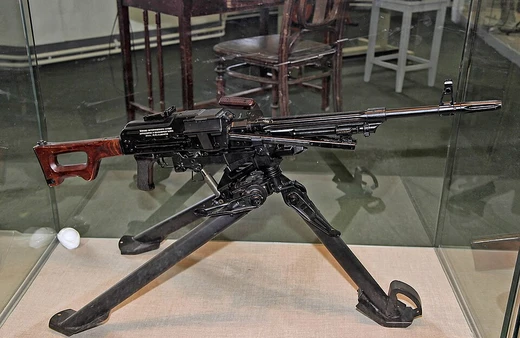
Vickers .50 machine gun
British large-calibre automatic weapon used for anti-aircraft and armoured vehicle defence.

The Vickers .50 machine gun, officially designated 'Gun, Machine, Vickers, .5-in', was a large-calibre British automatic weapon. It was commonly used as a close-in anti-aircraft weapon on Royal Navy and Allied ships, typically in four-gun or two-gun mountings, as well as on tanks and other armoured fighting vehicles. The gun was similar to the .303 Vickers machine gun but fired the shorter British Vickers 0.5 in ammunition, which was shorter than the American .50 BMG round.
Quick Facts
- Origin
- United Kingdom
- Is Ranged
- yes
- Service
- 1933–1954
- Used By
- United Kingdom / Ireland
- Wars
- World War II
- Manufacturer
- Vickers / Enfield
- Production Date
- 1933–1938
- Spec Label
- Vickers .5 Mk V
- Weight
- 63 lb, excluding 10 lb cooling water
- Length
- 52.4 in
- Part Length
- 31 in
- Cartridge
- 12.7×81mmSR
Facts from the source article.
Lore & Background
The Vickers .50 machine gun underwent development through several marks. The Mark I was the initial model, but the first to enter service was the Mark II in 1933, which was mounted in some British light tanks, often paired with a .303 Vickers. The Mark II featured a pistol grip instead of the spade grips of the infantry .303 machine gun. The Mark III was a naval anti-aircraft version used mostly by the Royal Navy and allied navies in the Second World War, typically in four-gun mountings but also as single and dual mounts. Its quad mounting had its guns adjusted to provide a spread of fire 60 ft wide and 50 ft high at 1000 yd. Vickers claimed it could fire all 800 rounds in 20 seconds and be reloaded in 30 seconds. The Mark III proved insufficiently powerful at short range against modern all-metal aircraft and was superseded during the war by the Oerlikon 20 mm cannon. The Mark IV, introduced in 1933 but not declared obsolete until 1944, had full auto only at 600 rounds per minute. The Mark V, introduced in 1935, was a strengthened variant and the main variant used, with a fire rate of 500-600 rounds per minute. Marks IV and V were also used on trucks in the North Africa Campaign, such as by the Long Range Desert Group. The Vickers .50 was superseded for use in British-built armoured fighting vehicles during the Second World War by the 15 mm Besa machine gun.
Reader's Guide
The Vickers .50 machine gun served as a significant close-in anti-aircraft weapon for the Royal Navy and Allied navies during the Second World War, particularly in its quad-mount Mark III configuration. Its design allowed for a concentrated spread of fire, and its high cyclic rate of 700 rounds per minute per gun made it a formidable short-range defensive weapon. However, as aircraft construction evolved to all-metal designs, the .50 calibre round proved insufficiently powerful, leading to its replacement by the Oerlikon 20 mm cannon. On land, the gun saw use in light tanks and armoured fighting vehicles, as well as on trucks in the North Africa Campaign by units like the Long Range Desert Group. The Mark V became the primary variant for these roles. The gun's development through multiple marks—from the Mark I through Mark V—reflects ongoing efforts to improve its performance and durability. Ultimately, it was superseded in British armoured vehicles by the 15 mm Besa machine gun, a Czech design adopted by the British for the Royal Armoured Corps. The Vickers .50 remains notable as a British adaptation of the heavy machine gun concept, distinct from the American .50 BMG in its ammunition and application.
Did You Know?
- The Vickers .50 fired a round shorter than the American .50 BMG (12.7×99mm).
- The Mark III naval quad mount had a 200-round magazine per barrel, wrapping the ammunition belt around the magazine drum.
- The Mark II entered service in 1933 and had a pistol grip instead of spade grips.
More in Machine Guns, Part 4 1-24
Spotted an error? Know more?
Reader corrections go straight into our review queue. Suggest an edit · How this site is sourced