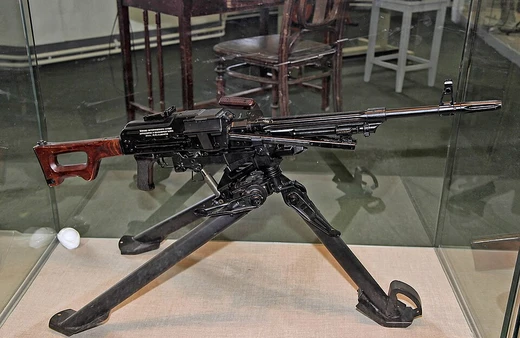
Type 97 heavy tank machine gun
The only magazine-fed general purpose machine gun, used in Japanese tanks and infantry.

The Type 97 heavy tank machine gun served as the primary machine gun inside Japanese tanks and armored vehicles throughout World War II, and infantry units also used it as a general purpose medium machine gun. It stands out as the only magazine-fed general purpose or medium machine gun ever produced.
Development began with the Type 11 light machine gun, which the Army Technical Bureau adapted for vehicle use as the Type 91 mobile machine gun. That weapon inherited the Type 11’s flaws: it jammed easily when exposed to even small amounts of grit or dirt, and its 6.5x50mm Arisaka rounds lacked stopping power. During the early Second Sino-Japanese War, Japanese forces captured Czechoslovak ZB vz. 26 light machine guns from China’s National Revolutionary Army. The ZB vz. 26’s many design strengths prompted the creation of the Type 97. A modified version was used in armored vehicles until 1940, when the Japanese Army adopted a rimless 7.7 mm cartridge.
Mechanically, the Type 97 resembled the ZB vz. 26, but with a different stock and pistol grip. It fed from a straight, vertical, 20-round box magazine and fired the same 7.7mm cartridges as the Type 99 rifle. Like all air-cooled automatic weapons, its barrel could overheat quickly, forcing the gunner to fire in bursts to avoid ruining the barrel. When mounted in a tank, it used a fixed-focus 1.5x telescopic sight with a 30° field of view, fitted with a rubber eye pad to protect the gunner. As an infantry weapon, it was used with a bipod and weighed 11.25 kg without it.
The Type 97 entered service in 1937 and equipped all Japanese tanks and armored vehicles until the war ended. The Imperial Japanese Navy also used it in vehicles like the Type 92 Jyu-Sokosha heavy armored car. It was rarely used as a standalone infantry gun because of its weight. That weight issue led to the development of the Type 99 light machine gun, which looked similar but had a different internal design and was issued in the same caliber. Communist forces used the Type 97 during the Korean War.
Quick Facts
- Origin
- Empire of Japan
- Is Ranged
- yes
- Service
- 1937–1945
- Used By
- Imperial Japanese Army
- Wars
- Second Sino-Japanese War / Soviet-Japanese Border Wars / World War II / Chinese Civil War / Korean War
- Design Date
- 1937
- Number
- 18,000
- Weight
- 12.4 kg
- Length
- 1145 mm
- Part Length
- 700 mm
- Cartridge
- 7.7×58mm Arisaka
- Action
- Gas-operated
Facts from the source article.
Lore & Background
The Type 97 was developed after Japanese forces captured Czechoslovak ZB vz. 26 light machine guns from China’s National Revolutionary Army during the early stages of the Second Sino-Japanese War. The ZB vz. 26's design advantages led to the Type 97, which was mechanically similar but had a different stock and pistol grip. It was used in a modified form for armored vehicles until 1940, when the Japanese Army switched to a rimless 7.7 mm cartridge.
When fitted in a tank, the Type 97 used a fixed focus 1.5x telescopic sight with a 30° field of view, and a rubber eye pad was attached to the rear of the sight to prevent injury to the gunner. As an infantry weapon, a bipod was employed. Like all air-cooled automatic weapons, the barrel could easily overheat, requiring the gunner to fire in bursts or risk shooting out the barrel.
The Type 97 came into service in 1937 and was used on all Japanese tanks and other armored vehicles until the end of the war. The Imperial Japanese Navy also used it in their combat vehicles, such as the Type 92 Jyu-Sokosha heavy armored car. It was much less common as a stand-alone infantry gun due to its weight, which led to the development of the similar-looking but internally different Type 99 light machine gun in the same caliber.
Reader's Guide
The Type 97 heavy tank machine gun represents a significant adaptation of a foreign design—the Czechoslovak ZB vz. 26—into Japanese service, reflecting the pragmatic wartime practice of reverse-engineering captured weapons. Its role as the standard tank machine gun for the Imperial Japanese Army throughout World War II underscores its importance in armored warfare, yet its weight limited its use as an infantry weapon, prompting the development of the Type 99 light machine gun. The Type 97's unique status as the only magazine-fed general purpose/medium machine gun distinguishes it from contemporaries. Its continued use by communist forces during the Korean War demonstrates its lasting presence beyond the conflict for which it was designed. The weapon's design lineage, from the Type 11 through the Type 91 and the captured ZB vz. 26, illustrates the iterative process of Japanese small arms development, though the Type 97 itself was not related to the Type 97 aircraft machine gun or the Type 97 automatic cannon.
More in Machine Guns, Part 4 1-24
Spotted an error? Know more?
Reader corrections go straight into our review queue. Suggest an edit · How this site is sourced