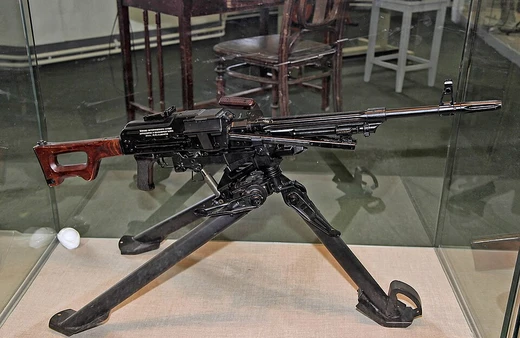
Type 92 heavy machine gun
Japanese heavy machine gun, standard in WWII, nicknamed 'the woodpecker'.

The Type 92 heavy machine gun is a Japanese design related to the Hotchkiss machine gun series. It entered service in 1932 and became the standard Japanese heavy machine gun used during World War II. Designed by Kijiro Nambu and built by Hino Motors and Hitachi, it was known for its reliability and was used after the war by various forces in East Asia.
Quick Facts
- Is Ranged
- yes
- Origin
- Empire of Japan
- Designer
- Kijiro Nambu
- Design Date
- 1932
- Production Date
- 1932–45
- Service
- 1932–1950s
- Wars
- Second Sino-Japanese War / World War II / Hukbalahap Rebellion / Chinese Civil War / Indonesian National Revolution / First Indochina War / Korean War / Vietnam War
- Part Length
- 721 mm
- Cartridge
- 7.7×58mm Type 92
- Feed
- 30-round Hotchkiss-type metal strip
- Action
- Gas-operated
- Rate
- 450–500 rounds per min
Facts from the source article.
Lore & Background
The Type 92 was essentially a scaled-up version of the Type 3 heavy machine gun, with its calibre increased to 7.7 mm. Like the Type 3, it was air cooled, ammo strip-fed, and based on the Hotchkiss M1914. It could use both a rimless and semi-rimmed 7.7×58mm Shiki round, and a 7.7mm Arisaka round could be used if necessary. The gun was intended to be fired on a tripod with a team of three men; the tripod had removable carry poles so the weapon could be transported fully assembled for quicker deployment.
An unusual characteristic was the placement of its iron sights, canted slightly to the right instead of the centre. A number of different sights were produced, including the Type 93 and Type 94 periscopic sights, the Type 96 telescopic sight, and a ring-type anti-aircraft sight. Problems included the use of 30-round feed strips, which did not allow for as high a volume of fire as a belt-fed gun, and the oiler, which enabled better extraction in clean conditions but could bring dirt inside the gun in the field. The gun has an internal oil pump mechanically activated by the bolt, dispensing oil onto a brush to lubricate each cartridge as it is fed.
The Type 92 was nicknamed 'the woodpecker' by Western Allied soldiers because of the characteristic sound it made when fired due to its relatively low rate of fire, and 'the chicken neck' by Chinese soldiers due to its appearance. It was sometimes used as a light anti-aircraft gun during the Pacific War.
Reader's Guide
The Type 92 heavy machine gun served as the standard Japanese heavy machine gun throughout World War II, with a total production of about 45,000 guns. Its design, based on the Hotchkiss M1914 and scaled up from the Type 3, chambered the improved 7.7mm round and was noted for reliability. After the war, captured weapons saw continued use by various forces in East Asia, including Chinese troops against the Japanese, the Korean People's Army during the Korean War, the Viet Minh during the First Indochina War, and the Indonesian Army during the Indonesian National Revolution. It was also used by Hukbalahap guerrillas, the Viet Minh and Viet Cong, and the West Papua National Liberation Army. The gun's distinctive low rate of fire produced a sound that earned it the nickname 'the woodpecker' from Western Allied soldiers, while its appearance led Chinese soldiers to call it 'the chicken neck'. Its legacy is that of a widely distributed and long-serving weapon that saw action in multiple conflicts across East and Southeast Asia.
Did You Know?
- Chinese soldiers called it 'the chicken neck' because of its appearance.
- It could use both rimless and semi-rimmed 7.7×58mm Shiki rounds, and a 7.7mm Arisaka round if necessary.
- The gun's iron sights were canted slightly to the right instead of the centre.
More in Machine Guns, Part 4 1-24
Spotted an error? Know more?
Reader corrections go straight into our review queue. Suggest an edit · How this site is sourced