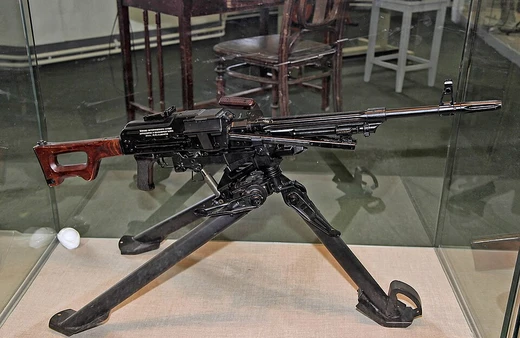
Type 3 heavy machine gun
Japanese air-cooled heavy machine gun, a Hotchkiss variant used from 1914.

The Type 3 heavy machine gun is a Japanese air-cooled heavy machine gun, also known as the Taishō 14 machine gun. It was part of a long line of Japanese Hotchkiss machine gun variants used by the Imperial Japanese Army from 1901 to 1945.
Quick Facts
- Origin
- Empire of Japan
- Is Ranged
- yes
- Service
- 1914–1945 (Japan)
- Designer
- Kijiro Nambu
- Design Date
- 1914
- Production Date
- 1914–1932
- Variants
- Modelo 1920
- Mass
- 55 kg
- Length
- 1198 mm
- Part Length
- 737 mm
- Cartridge
- 6.5×50mmSR Arisaka · 7×57mm Mauser
- Action
- Gas-actuated
Facts from the source article.
Lore & Background
The Type 3 heavy machine gun was developed by Japanese gun designer Kijirō Nambu as a further modification of the Type 38 heavy machine gun, which itself was a domestic version of the Hotchkiss M 1897. Nambu focused on improving heat dissipation and durability, leading to the Type 3's adoption in 1914. It first saw combat during the Japanese intervention in Siberia in 1919.
During the 1930s, the Type 3 saw wide-scale use in Manchuria and China during the Second Sino-Japanese War. The weapon's tripod could be used as an anti-aircraft mounting, and special anti-aircraft sights were provided. The Type 3 was also exported: Chile purchased several hundred in 7×57mm Mauser as the Modelo 1920, with barrels made in France by Hotchkiss and most of the weapon produced at the Koishikawa Arsenal. Guns were also purchased for Chang Tso-lin's Fengtian Army and later used by the Collaborationist Chinese Army. The Korean People's Army used the Type 3 during the Korean War.
Reader's Guide
The Type 3 heavy machine gun represents a key step in Japan's adaptation of the Hotchkiss design for its own military needs. Its lineage began with imported Hotchkiss M 1897 guns in 1901, followed by licensed domestic production and modifications by Kijirō Nambu. The Type 3's improvements in heat dissipation and durability made it a reliable support weapon for the Imperial Japanese Army from its introduction in 1914 through the end of World War II. Its service in Siberia, Manchuria, and China demonstrated its effectiveness in both ground and anti-aircraft roles. The weapon's export to Chile and use by Chinese forces, as well as its later employment by the Korean People's Army during the Korean War, show its lasting presence beyond Japan's own military. The Type 3 was succeeded by later Japanese heavy machine guns such as the Type 92 and Type 1, but it remained a significant part of Japan's machine gun development.
Did You Know?
- It was designed by Kijirō Nambu, who also modified the earlier Type 38 heavy machine gun.
- Chile purchased several hundred Type 3 machine guns in 7×57mm Mauser as the Modelo 1920.
- The Type 3 tripod could be used as an anti-aircraft mounting with special sights.
More in Machine Guns, Part 4 1-24
Spotted an error? Know more?
Reader corrections go straight into our review queue. Suggest an edit · How this site is sourced