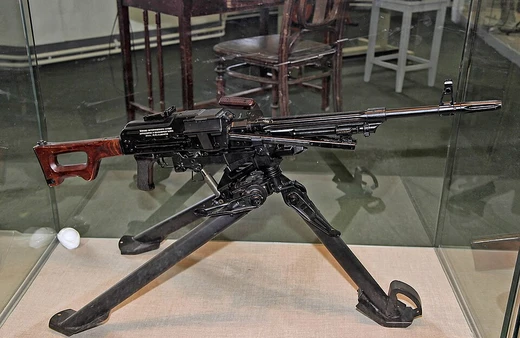
Type 3 aircraft machine gun
Japanese Navy aircraft machine gun derived from the M2 Browning.

The Type 3 was a 13 mm fixed machine gun for aircraft, operated by the Imperial Japanese Navy during World War II. Its design was adapted from the American M2 Browning, but it fired the 13.2×99mm Hotchkiss round—the same ammunition used by the Hotchkiss M1929 and the Japanese Type 93 heavy machine gun. Even with the slight caliber difference, M2 Browning cartridges could still be fired from the Type 3, a practice that reportedly took place during the war. Production ran from 1943 to 1945.
The fixed version armed later variants of the Mitsubishi A6M Zero fighter and prototypes of the Kawanishi N1K Shiden Kai. The Type 3 was also tested in a flexible defensive mount, which came with a longer barrel. However, it was judged too heavy for that role, weighing nearly 28 kg—more than the 20 mm Type 99-1 Mod.1 autocannon at 23 kg. The flexible version was ultimately turned down in favor of the lighter Type 2 machine gun.
Quick Facts
- Origin
- Empire of Japan
- Is Ranged
- yes
- Service
- 1943–1945
- Wars
- World War II
- Manufacturer
- Nihon Seikōjō KK / Suzuka Naval Arsenal / Toyokawa Naval Arsenal
- Weight
- 27.5 kg
- Length
- 1530 mm
- Part Length
- 910 mm
- Cartridge
- 13.2×99mm Hotchkiss (52 g)
- Action
- Short recoil-operated, rising block locked (Browning)
- Rate
- 800 RPM
- Velocity
- 790 m/s
Facts from the source article.
Lore & Background
The Type 3 was derived from the .50 in M2 Browning but chambered for the slightly larger 13.2×99mm Hotchkiss round, the same cartridge as the Hotchkiss M1929 machine gun and the Imperial Japanese military's licensed version, the Type 93 heavy machine gun. Despite the small difference in calibers, it was possible to use M2 Browning cartridges in the Japanese machine gun, which ostensibly occurred during World War II. The machine gun was produced from 1943 to 1945.
The fixed version was used on later models of the Mitsubishi A6M Zero fighter and prototypes of the Kawanishi N1K Shiden Kai. The Type 3 was trialled for flexible defensive fixtures as well as fixed offensive ones. The flexible version featured a longer barrel. It was ultimately determined to be unsuitable in a flexible defensive role due to its weight compared to existing alternatives; the 13.2mm Type 3 weighed almost 28 kg, heavier than the 20mm Type 99-1 Mod.1 autocannon at 23 kg. The flexible version was ultimately rejected in favour of the lighter Type 2 machine gun.
Reader's Guide
The Type 3 13 mm fixed aircraft machine gun represents a notable adaptation of a foreign design to meet Japanese naval aviation requirements during World War II. By basing the weapon on the American M2 Browning but rechambering it for the 13.2×99mm Hotchkiss cartridge, the Japanese Navy created a heavy machine gun that could use the same ammunition as the Type 93 heavy machine gun and the Hotchkiss M1929. The ability to fire M2 Browning cartridges, despite the slight caliber difference, provided logistical flexibility during combat. The weapon's primary significance lies in its deployment on later models of the Mitsubishi A6M Zero, one of the most famous fighters of the war, and on prototypes of the Kawanishi N1K Shiden Kai. However, its weight of nearly 28 kg proved a limitation; when trialled for flexible defensive mounts, it was found heavier than the 20mm Type 99-1 Mod.1 autocannon, leading to its rejection in that role in favor of the lighter Type 2 machine gun. Produced only from 1943 to 1945, the Type 3 saw limited service but illustrates the wartime efforts to upgrade aircraft armament using available technology.
Did You Know?
- The Type 3 was based on the American M2 Browning machine gun.
- It used the 13.2×99mm Hotchkiss cartridge, the same as the Type 93 heavy machine gun.
- Despite the caliber difference, M2 Browning cartridges could be used in the Type 3.
- The flexible version had a longer barrel but was rejected due to its weight.
More in Machine Guns, Part 4 1-24
Spotted an error? Know more?
Reader corrections go straight into our review queue. Suggest an edit · How this site is sourced