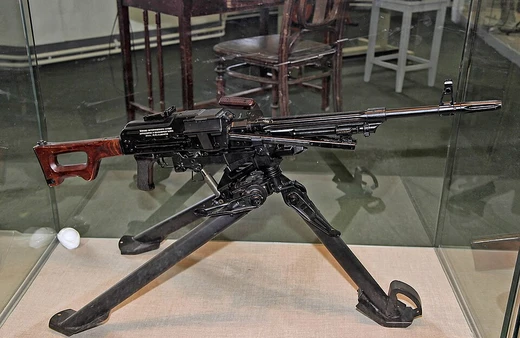
Nkm wz. 38 FK
Polish 20 mm heavy machine gun used in anti-air and anti-tank roles.

The nkm wz. 38 FK, a Polish military designation for a heavy machine gun from 1938, was a 20 mm weapon that modern terminology would classify as an autocannon. Developed in interwar Poland, it served in anti-aircraft and anti-tank roles, and was also mounted on certain TKS tankettes for armored use. Production began in 1938, and the gun was employed heavily during the 1939 Polish Defensive War.
The name was a code rather than a formal title. "nkm" stands for "najcięższy karabin maszynowy," meaning the heaviest machine gun, a class above standard heavy machine guns using rifle cartridges like the 7.92 Mauser. "wz. 38" indicates the 1938 pattern, the year it was submitted for testing or designed. The suffix "FK" distinguished it from other weapons designed that same year, referring to Fabryka Karabinów, the state-owned rifle factory in Warsaw.
In the early 1930s, the Polish Army sought a modern anti-tank and anti-aircraft weapon to replace outdated World War I equipment. Tests in 1931 of heavy machine guns from Hotchkiss, Solothurn, and Oerlikon found them unsuitable, as they could not effectively serve both roles. A 1937 commission tested newer 20 mm designs from Oerlikon, Madsen, and Hispano-Suiza, but all had flaws, prompting a domestic design effort led by engineer Bolesław Jurek of Fabryka Karabinów.
Four models, A through D, were considered. Model A, designed by Jurek and adopted in 1939, was an automatic, self-repeating weapon operating on short barrel recoil. It featured a quickly replaceable barrel with a muzzle brake and fed from a 5- or 10-round box magazine or a 15-round drum. For tank mounting, it used a spherical yoke with an armored cover by Napiórkowski and Miniewski. Model B, a prototype by W. Lewandowski, was gas-operated with a gas port, fed by cloth or metal belt or box magazine. Model C, by S. Rytwiński and W. Lewandowski, operated similarly and fed from a 200-round belt, a 5- or 10-round box, or a 100-round drum. It had a PL20A tripod base for anti-tank infantry use, designed by J. Skrzypiński and developed by L. Kowalewicz, with a lighter barrel and 5-round box. A heavier PC20A wheeled mount, weighing 400–500 kg and also by Kowalewicz, was intended for higher tactical levels, and the model was considered for aircraft armament.
Quick Facts
- Origin
- Poland
- Is Ranged
- yes
- Service
- 1938–1939
- Wars
- World War II
- Designer
- Wawrzyniec Lewandowski
- Design Date
- 1938
- Manufacturer
- Państwowa Fabryka Karabinów
- Unit Cost
- zl30,000 (tank version)
- Number
- 55
- Weight
- 57.6 kg
- Length
- 2015 mm
- Part Length
- 1476 mm
Facts from the source article.
Lore & Background
In the early 1930s, the Polish Army sought a modern anti-tank and anti-air weapon to replace outdated World War I equipment. Tests of Hotchkiss, Solothurn, and Oerlikon guns in 1931 were found unsuitable for both roles. A second commission in 1937 tested 20 mm designs by Oerlikon, Madsen, and Hispano-Suiza, but all had flaws, leading to an indigenous design led by engineer Bolesław Jurek of the Warsaw-based Fabryka Karabinów. Four models (A–D) were considered; only Model A was adopted. It was an automatic self-repeating weapon operating on short barrel recoil, with an easily replaceable barrel and muzzle brake, fed from box or drum magazines. For tank mounting, a spherical yoke with armored cover by Napiórkowski and Miniewski was used.
The first batch of 100 Model A guns was ordered on August 26, 1938, with production by Zieleniewski in Sanok and barrels from Pruszków. A second order for 140 pieces was placed in April 1939, 40 of which were stationary weapons. Initial costs were high: the design, factory equipment, and first batch cost roughly 2.2 million złotys, with budget plans for 1939/1940 amounting to almost 3.4 million. Production was slower than expected; by the outbreak of World War II, only 55 of the 896 pieces ordered for delivery by 1940 had been delivered. As a stop-gap, roughly 30 TK-3 and TKS tankettes were rearmed with this HMG. Overall production did not exceed 60 pieces by September 1, 1939.
Reader's Guide
The nkm wz. 38 FK was accepted by the Polish Army in 1939 and intended for extensive use: 8 pieces in anti-air configuration per infantry division. Its penetration capacity was sufficient to defeat any German tank of 1939 except possibly the Panzer IV; however, photographic evidence later indicated that a Panzer IV destroyed by Cadet Roman Orlik was indeed a Panzer IV, not a Panzer 35(t). Despite its promise, the weapon's impact was limited by low production numbers—fewer than 60 units delivered before the war—and high costs. The gun's legacy lies in its role as a domestically designed heavy machine gun that attempted to fill both anti-tank and anti-air needs, and in its use on Polish tankettes during the 1939 campaign. It represents a late interwar effort to modernize Polish armament, cut short by the German invasion.
Did You Know?
- The nkm wz. 38 FK was designed by Bolesław Jurek of the Warsaw-based Fabryka Karabinów.
- It was fed from a box magazine of 5 or 10 rounds or a drum magazine of 15 rounds.
- Only about 60 pieces were produced by the start of World War II.
More in Machine Guns, Part 4 1-24
Spotted an error? Know more?
Reader corrections go straight into our review queue. Suggest an edit · How this site is sourced