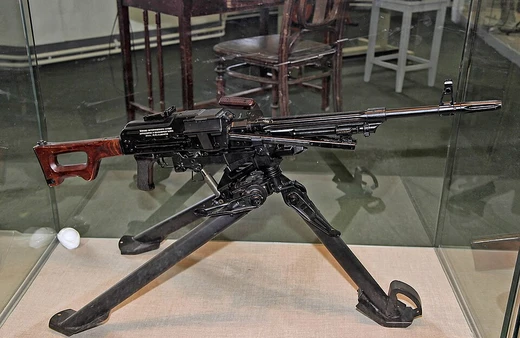
Mitrailleuse d'Avion Browning - F.N. Calibre 13,2 mm
A Belgian 13.2 mm aircraft machine gun exported to Romania and Sweden.

The Mitrailleuse d'Avion Browning - F.N. Calibre 13,2 mm, more commonly known as the 13.2 mm FN Browning, was a 13.2 mm caliber, shell-firing, heavy machine gun for aircraft use. Designed by Fabrique Nationale (FN) in Herstal, Belgium, as a private export venture during the final years prior to World War II, it drew great interest on the export market but was only exported to Romania and Sweden before the German invasion of Belgium in 1940.
Quick Facts
- Origin
- Belgium
- Is Ranged
- Yes
- Service
- 1939–1957 (Frontline with Swedish Air Force) / 1951–2007: practice
- Used By
- Sweden / Romania / Finland
- Wars
- World War II
- Design Date
- 1938
- Manufacturer
- FN Herstal / L. M. Ericsson
- Production Date
- 1939 – c. 1946
- Weight
- 24.3 kg
- Length
- 1415 mm / (1450 mm with flash hider)
- Part Length
- 816.5 mm excluding flash hider
- Cartridge
- 13.2×99mm Hotchkiss / 12.7×99mm Browning
Facts from the source article.
Lore & Background
The 13.2 mm FN Browning was developed by FN as an improved version of the .50 in air-cooled Browning MG53 aircraft machine gun. Improvements included making the weapon lighter, increasing the rate of fire, and offering it in 13.2×99mm Hotchkiss, a cartridge effectively being a 12.7×99mm Browning cartridge but with a caliber of 13.2 mm. FN developed a high-explosive shell against air targets for this cartridge, purpose built for the weapon. In period texts, the weapon is referred to as a 'shell firing gun' due to this high-explosive munition.
Interest in the weapon came from the Finnish Air Force, the Royal Romanian Air Force, the Swedish Air Force, the Royal Netherlands Army Aviation Brigade, and the Royal Belgian Military Aviation. The Dutch planned to use it in their Fokker D.XXIII fighter, and the Belgians in their Renard R.36 and its variants. However, with the start of World War II and the invasion of Belgium in the summer of 1940, the weapon was only exported to Romania and Sweden.
Romania used the few weapons sold on their SM.79 bombers and later on their IAR 80B fighter, where they were considered equal to 20 mm weapons. Sweden ordered the weapon in 1939 along with a license to produce it; delivery was rushed by ship due to the German invasion. Swedish license production was handled by LM Ericsson in a basement complex in central Stockholm, leading to the variant 13,2 mm automatkanon m/39A. Finland, through connections with Sweden, obtained the blueprints and produced an unlicensed version chambered in 12.7×99mm Browning, designated 12,70 LKk/42.
Reader's Guide
The 13.2 mm FN Browning is notable as a late pre-war private venture that, despite limited export, saw significant use in Sweden and Finland. In Sweden, the 13,2 mm akan m/39 became the main aircraft weapon of World War II, playing a role similar to the .50 in AN-M2 Browning for American forces. Although it never saw combat in Swedish service, it remained in use for an extended period. After the war, Sweden re-chambered the guns for 12.7×99mm Browning due to ammunition costs, requiring only a barrel swap. The 12.7 mm akan m/39 continued as a training weapon for jet fighters into the early 2000s, with its last training carrier, the Saab 37 Viggen, leaving service in 2007.
Finland used the unlicensed 12,70 LKk/42 to rearm many of its fighter aircraft, including the Curtiss 75 Hawk, Brewster B-239 Buffalo, and the indigenous VL Myrsky. After World War II, the Finnish variant served as training weaponry in aircraft such as the Saab 35 Draken and BAE Hawk. The weapon's legacy lies in its adaptation across multiple nations and its long service life, transitioning from a frontline aircraft gun to a training armament for decades.
Did You Know?
- Sweden designated the Belgian-produced weapons as 13,2 mm automatkanon m/39, meaning '13.2 mm autocannon m/39'.
- The last frontline military aircraft to use the 12.7 mm akan m/39 was the SAAB T 18B coastal attacker, which left service in 1959.
More in Machine Guns, Part 4 1-24
Spotted an error? Know more?
Reader corrections go straight into our review queue. Suggest an edit · How this site is sourced