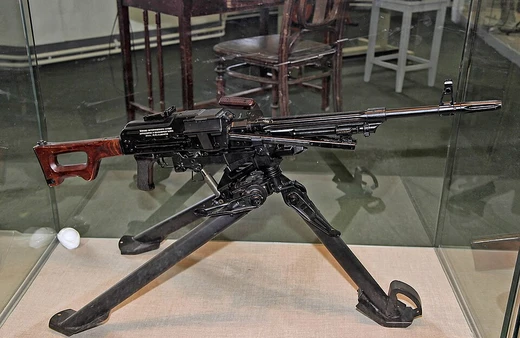
MG 131 machine gun
A compact 13 mm aircraft machine gun used by Luftwaffe from 1940.

The MG 131 (Maschinengewehr 131) is a German 13 mm caliber machine gun developed in 1938 by Rheinmetall-Borsig and produced from 1940 to 1945. Designed for use in fixed, flexible, or turreted single and twin mountings in Luftwaffe aircraft during World War II, it was notable for being one of the smallest and lightest heavy machine guns of its era, weighing 16.6 kg—less than 60% of comparable weapons like the M2 Browning or Breda-SAFAT. Its compact size allowed installation in the noses of fighters originally intended for lighter 7.92 mm guns, making it a key upgrade from 1943 onward as Allied aircraft armor increased.
Quick Facts
- Is Ranged
- yes
- Origin
- Nazi Germany
- Design Date
- 1938
- Production Date
- 1940–1945
- Manufacturer
- Rheinmetall-Borsig
- Used By
- Germany
- Wars
- World War II
- Variants
- MG 131E (prototype for ground use; never adopted)
- Caliber
- 13 mm
- Part Length
- 550 mm
- Cartridge
- 13×64mmB
- Feed
- Belt-fed
Facts from the source article.
Lore & Background
The MG 131 was developed by Rheinmetall-Borsig in 1938 and entered production in 1940, serving throughout World War II. It was designed for aircraft use in fixed, flexible, or turreted mountings, both single and twin. The weapon was also license-built in Japan for the Imperial Japanese Navy as the Type 2 machine gun. Its relatively small size and light weight—16.6 kg—allowed it to replace lighter 7.92 mm guns in the noses of fighters like the Messerschmitt Bf 109 and Fw 190, a common configuration from 1943 onwards as Allied aircraft armor made smaller-caliber guns obsolescent.
The MG 131 fired electrically primed 13×64 mm B ammunition to sustain a high rate of fire when shooting through a propeller disc. It could use armor-piercing, incendiary, high-explosive, and tracer rounds. The gun was accurate, with a 35 × 45 cm spread at 100 m, and had a barrel life of 17,000 rounds, meaning ballistic properties deteriorated slowly. It was installed in many aircraft, including the Bf 109, Me 410 Hornisse, Fw 190, Ju 88, Junkers Ju 388, and He 177 Greif bomber variants. The Fernbedienbare Drehlafette FDL 131Z remotely controlled turret used single or paired MG 131s for dorsal defense, while the quadmount Hecklafette HL 131V system for tail defense—with two guns per side carriage—was planned for late-war heavy bombers but only reached prototype mockups and kinetic test units.
A ground variant, sometimes called the MG 131E or MG 131E-1, was trialed with a shoulder stock and bipod, using a battery for its electric firing system, but was not operationally used or produced. The weapon's electrically primed ammunition was unique to the MG 131, though a mechanically primed variant was produced in small quantities in Spain for unknown purposes.
Reader's Guide
The MG 131's significance lies in its role as a compact, lightweight heavy machine gun that enabled Luftwaffe fighters to upgrade their firepower without major airframe redesign. Weighing 16.6 kg, it was less than 60% of the M2 Browning or Breda-SAFAT, yet offered a rate of fire up to 930 rpm and could fire armor-piercing, incendiary, high-explosive, and tracer ammunition. Its small size allowed it to fit in noses originally designed for 7.92 mm guns, making it the standard cowl armament on later Bf 109G and Fw 190 models from 1943 onward. This upgrade was driven by the increasing armor of Allied aircraft and the challenge of daylight raids by heavy American bombers, which rendered smaller-caliber guns obsolescent.
The MG 131's electrically primed ammunition was essential for synchronized firing through propeller discs, and its accuracy (35 × 45 cm spread at 100 m) and long barrel life (17,000 rounds) made it reliable in sustained engagements. It was widely installed across Luftwaffe aircraft, from fighters to bombers, and featured in remote turret systems like the FDL 131Z and the planned HL 131V tail defense system. The weapon was also license-built in Japan as the Type 2 machine gun. A ground variant was trialed but never fielded. The MG 131's legacy is as a practical, high-volume solution to the need for heavier aircraft armament in the later war years, balancing weight, firepower, and space constraints.
More in Machine Guns, Part 4 1-24
Spotted an error? Know more?
Reader corrections go straight into our review queue. Suggest an edit · How this site is sourced