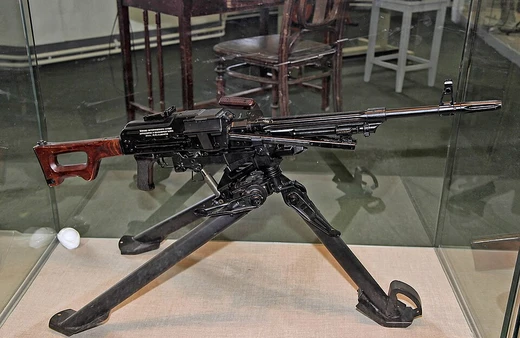
MG 11
Swiss heavy machine gun derived from the Maxim, related to the MG 08.

The MG 11 is a Swiss heavy machine gun that entered service shortly before and during World War I. It shares a close design relationship with the German MG 08 and represents the final Swiss adaptation of the Maxim machine gun.
The MG 11 was initially ordered from DWM in Berlin, where it was known as the Model 1909. When German deliveries stopped during World War I, production began in 1915 at the W+F factory in Bern. This water-cooled weapon used a tripod mount and fired the 7.5×55 mm GP 11 cartridge. It served with the army, cavalry, fortresses, tanks, and aircraft of the Swiss Army. The gun body was a lighter version of earlier Swiss Maxims, using a smaller receiver made from better steel rather than brass and lower-quality steel. The tripod was a new design, originally based on the naval mount for the MG 08. In fortress use, an optical sight and armored ball screen were added, the water cooling system connected to a tank, and a sealing rubber placed behind the muzzle to keep flamethrower oil out of the bunker.
During a modernization program in 1934 and 1935, the MG 11 was adapted to use modern metal ammunition belts, replacing the earlier canvas belts. A flash suppressor was added to the muzzle, along with a new trigger system that allowed one-handed firing so the gunner could also operate the sweeping fire control wheel on the tripod. Additional anti-aircraft equipment was introduced. Modernized guns were marked with a white stripe along the cooling sleeve.
The MG 11 began to be phased out in the early 1950s, replaced by the air-cooled 7.5 mm MG 51 general-purpose machine gun. This replacement was completed by the 1980s.
Quick Facts
- Origin
- Switzerland
- Is Ranged
- YES
- Service
- 1911–1980s
- Used By
- Swiss Army
- Designer
- Hiram Maxim / Waffenfabrik Bern
- Design Date
- 1911
- Manufacturer
- Waffenfabrik Bern
- Production Date
- 1911–1946
- Number
- 10,000 / +
- Variants
- MG 11 revisions 1934/1935
- Weight
- 18.7 kg (without tripod)
- Length
- 1100 mm
Facts from the source article.
Lore & Background
The MG 11 was originally procured from DWM Berlin, where it was designated the 1909. As German deliveries ceased during World War I, manufacturing was taken up in 1915 by the Eidgenössischen Waffenfabrik W+F Bern. The gun body was the same as the German DWM 1909, a slightly modified design that was lighter than previous Swiss versions due to a smaller receiver made of better steel instead of brass and lower-quality steel. The tripod was designed from scratch, originally as the naval mount for the MG 08.
When used in fortresses, an optical sight and ball armoured screen were applied, the water cooling was connected to a tank, and a sealing rubber was mounted behind the muzzle to prevent penetration of flamethrower oil into the bunker. In 1934 and 1935, the MG 11 was modernized: it was adapted for metal machine gun belts replacing canvas belts, a flash suppressor was added at the muzzle, a new trigger system allowed one-handed firing so the gunner could simultaneously operate the sweeping fire control wheel, and additional kit for anti-aircraft usage was introduced. Modernized guns were marked with a white stripe along the cooling sleeve.
The MG 11 served with the army, cavalry, and in fortresses, tanks, and airplanes of the Swiss Army. Beginning in the early 1950s, it was gradually replaced by the air-cooled 7.5 mm Maschinengewehr Modell 1957 (MG 51) general-purpose machine gun, with the replacement process finished in the 1980s.
Reader's Guide
The MG 11 represents the culmination of Swiss adaptation of the Maxim machine gun, being the last in a series of Swiss derivatives. Its close constructive relationship with the German MG 08 highlights the shared design lineage, while its independent production by W+F Bern during World War I demonstrates Swiss industrial self-sufficiency when foreign supply was cut off. The 1934/1935 modernization programme extended its service life significantly, adapting it to metal belts, flash suppression, and improved ergonomics for one-handed firing and anti-aircraft use. The MG 11 remained in Swiss service for decades, only gradually replaced from the early 1950s by the MG 51, with the replacement process not completed until the 1980s. This longevity underscores its robust design and the Swiss military's conservative approach to equipment replacement. The MG 11's use across multiple roles—infantry, cavalry, fortress, tank, and aircraft—demonstrates its versatility within the Swiss armed forces.
Did You Know?
- The MG 11 was originally procured from DWM Berlin under the designation DWM 1909.
- Manufacturing of the MG 11 was taken up in 1915 by the Eidgenössischen Waffenfabrik W+F Bern after German deliveries ceased during World War I.
- Modernized MG 11 machine guns were marked with a white stripe running along the length of the cooling sleeve.
More in Machine Guns, Part 4 1-24
Spotted an error? Know more?
Reader corrections go straight into our review queue. Suggest an edit · How this site is sourced