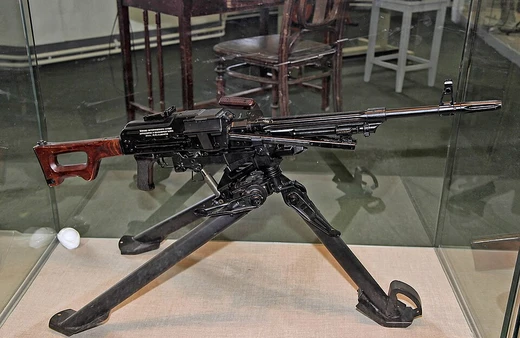
MG 01
Standard German machine gun from 1901 until replaced by the MG 08.

The Maschinengewehr 1901 (MG 01) served as the Imperial German Army’s standard machine gun from 1901 until the MG 08 replaced it in 1908. After that, it was largely issued to colonial troops.
Its development followed a 1892 order from Kaiser Wilhelm II approving an 8-mm Maxim gun for naval use, which led to the army’s MG 99. The MG 01 improved on the MG 99 by adding spoked wheels to some sled mounts, making the gun easier to push or pull. A patent for the sled carriage was filed in the UK by Deutsche Waffen- und Munitionsfabriken in 1900.
The MG 01 first saw combat during the Herero Wars against the Herero and Nama peoples. At least two were later exported to Bulgaria and used in the Balkan Wars. By the start of World War I, most MG 01s—along with other obsolete machine guns—had been moved to colonial machine gun detachments, where the MG 08 was gradually taking over. In East and South West Africa, the Schutztruppe mounted them on tripods and artillery carriages. In the Kiautschou Bay Leased Territory, the III. Seebataillon’s machine gun company used them during the Siege of Tsingtao. After the war, German soldiers employed the MG 01 in the Spartacist uprising.
Only two surviving examples are known. MG 01 No. 206, made in 1902, is at the Bayerisches Armeemuseum in Ingolstadt, Bavaria; it originally belonged to the III. Bataillon 3. Infanterie Regiment, 1. Maschinengewehr Abteilung in Augsburg. MG 01 No. 626, made in 1907 in Berlin, is at the Royal Museum of the Armed Forces and Military History in Brussels; it was likely a navy-issued gun captured by the British during World War I.
Users included the German Empire (Kaiserliche Marine and Deutsches Heer from 1901 until at least 1919), Chile (which adopted it as the ametralladora Maxim modello 1902 in 7x57 mm on the orders of Emil Körner, despite already having cheaper Hotchkiss guns), Bulgaria (via export), and the United Kingdom (from wartime captures).
Quick Facts
- Is Ranged
- yes
- Service
- 1901-1919
- Wars
- Herero Wars / World War I / Spartacist uprising / Balkan Wars
- Designer
- Deutsche Waffen und Munitionsfabriken
- Manufacturer
- DWM
- Number
- At least 400 (1914)
Facts from the source article.
Lore & Background
The MG 01 was developed from the MG 99, which itself was based on the M87 'World Standard' adopted by the army in 1899. An application for a UK patent on the sled carriage was filed by Deutsche Waffen- und Munitionsfabriken in 1900. The MG 01 added upon the MG 99 by introducing spoked wheels to the sled mount on some models, allowing it to be pushed and pulled.
The MG 01 was first used in the Herero Wars by the German Empire against the Herero and Nama peoples. At least two MG 01s were exported to Bulgaria, where they saw service in the Balkan Wars. By the start of World War I, almost all MG 01s and other obsolete machine guns had been relegated to machine gun detachments in Germany's colonial possessions, where they had started to be replaced by the MG 08. During World War I, it was used by the East and South West African Schutztruppe, commonly mounted on tripods and artillery carriages. In the Kiautschou Bay Leased Territory, it was used by the machine gun company of the III. Seebataillon and saw service during the Siege of Tsingtao. After World War I, the MG 01 was used by German soldiers during the Spartacist uprising.
Reader's Guide
The MG 01 served as the Imperial German Army's standard machine gun for only seven years before being superseded by the MG 08, but its significance extends beyond that brief frontline tenure. It was the first German-adapted Maxim design to see widespread colonial use, particularly in the Herero Wars and later in Africa during World War I. Its introduction of spoked wheels on the sled mount improved tactical mobility. The MG 01 also saw export to Bulgaria and was adopted by Chile as the ametralladora Maxim modello 1902. After World War I, it was used in internal German conflict during the Spartacist uprising. Only two known examples survive: one in the Bayerisches Armeemuseum in Ingolstadt, and another in the Royal Museum of the Armed Forces and Military History in Brussels, the latter captured by the British during World War I. The MG 01 thus represents a transitional step between early Maxim guns and the more famous MG 08, while remaining a key weapon in Germany's colonial and late-war arsenals.
Did You Know?
- At least two MG 01s were exported to Bulgaria and saw service in the Balkan Wars.
- Only two known surviving examples exist: No. 206 (1902) in Ingolstadt and No. 626 (1907) in Brussels.
- The Chilean M1902 Maxim was essentially identical to the MG 01 except for the caliber.
More in Machine Guns, Part 4 1-24
Spotted an error? Know more?
Reader corrections go straight into our review queue. Suggest an edit · How this site is sourced