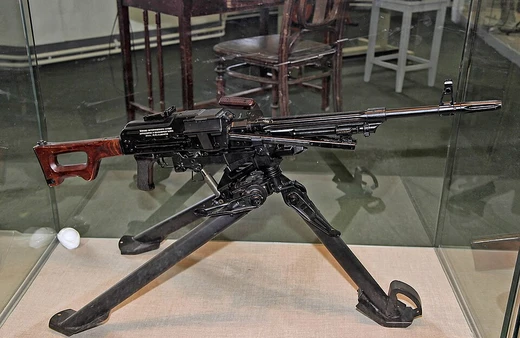
M45 quad mount
Four .50 caliber M2 Brownings on an electrically laid mount.

The M45 quad mount is a towed anti-aircraft weapon that paired four .50 caliber M2 Browning machine guns on either side of an armored, open-top gunner’s compartment, with electrical controls for aiming. It was built by the W. L. Maxson Corporation as a successor to their earlier M33 twin mount. Though meant for shooting down aircraft, it was frequently turned against ground targets, picking up the nicknames “meat chopper” and “Krautmower.” It entered service in 1944 and remained in use at least through the Vietnam War.
The M45 was developed by reworking the M33 twin mount to carry four machine guns instead of two. This came after earlier experiments with twin-gun mounts on M2 half-tracks, including designs from Bendix, Martin Aircraft Company, and Maxson. The Maxson M33 turret was chosen and, mounted on the larger M3 half-track (designated T1E2), was accepted for service in 1942 as the M13 Multiple Gun Motor Carriage. The same mount also went onto the M5 half-track as the M14. A 1942 test placed the quad mount on an M3 light tank in place of its turret, but that project was dropped.
During World War II, the M45 was the main weapon—alongside the 37 mm gun—of mobile anti-aircraft artillery battalions in Europe. These units provided critical air defense for larger formations, especially field artillery. The quad mount’s four heavy-barrel M2 Brownings could be adjusted so their fire converged on a single point at a chosen range, and this could be reset while in action. Multiple guns were needed because a single M2’s rate of fire (450–550 rounds per minute) was too slow for anti-aircraft work. The M45 saw heavy ground use during the Battle of the Bulge. Even after Allied air supremacy was established following the Normandy invasion in June 1944, German fighter-bombers could still make low-level attacks and quickly escape. The Luftwaffe also launched a large-scale attack, Operation Bodenplatte, on New Year’s Day 1945.
The U.S. Navy tested the M45 against kamikaze attacks late in 1944. Two Essex-class carriers each received six mounts for operational trials, starting with the USS Lexington (CV-16) in May 1945. The guns proved too light and ineffective against the high speeds of diving kamikaze aircraft.
After the war, the M45 was found ineffective against fast jet aircraft, but it was used against infantry targets.
Quick Facts
- Origin
- United States
- Is Ranged
- YES
- Weight
- 1087 kg
- Part Length
- 1.6 m L/50
- Cartridge
- .50 BMG (12.7×99mm NATO)
- Cartridge Weight
- .6 kg
- Caliber
- 12.7 mm
- Action
- Short recoil-operated
- Velocity
- 890 m/s
- Range
- 1.5 km (effective AA) / 4.5 km (maximum AA)
- Max Range
- 1.8 km (horizontal) / 2.5 km (maximum)
- Feed
- Belt-fed (M2 or M9 links)
Facts from the source article.
Lore & Background
The M45 quad mount was developed by re-working the earlier M33 twin mount to take four machine guns. It became the principal weapon, along with the 37 mm gun, of highly mobile anti-aircraft artillery battalions deployed in the European Theater during World War II. These battalions provided air defense to larger units, particularly field artillery. The mount's quartet of Browning M2HB heavy barrel .50 caliber guns could be tuned to converge upon a single point at distances that could be reset while in use. Multiple-gun mounts were developed for the M2 Browning because the single gun's rate of fire was too low for anti-aircraft use.
The M45 found use throughout the war as a land-based weapon, especially during the Battle of the Bulge. It was also tested by the US Navy as a solution for Kamikaze attacks starting in late 1944; two Essex class aircraft carriers received six mounts each for operational testing starting with CV-16 Lexington in May 1945, but the guns were too light and ineffective against the high speeds of diving Kamikaze aircraft. The M45 was ineffective against the fast-flying planes of the Jet Age, but was used against infantry targets in US post-war service. In Vietnam, it was pressed into service to defend bases and to ride escort convoys along Viet Cong roads. The French Army also used M45s in combat, placing them on trucks to deal with ambushes, and four M45s were used during the Battle of Dien Bien Phu.
Reader's Guide
The M45 quad mount's significance lies in its role as a mobile anti-aircraft platform that provided a strong deterrent against strafing runs during World War II, particularly in the European Theater. Its four .50 caliber M2 Brownings offered a combined rate of fire that addressed the single gun's low rate for anti-aircraft use. The mount's electrical laying and ability to converge fire on a single point made it effective against low-altitude attacks. Although it became obsolete against jet aircraft, it found continued use against ground targets in post-war conflicts, including the Korean War and Vietnam War, where it was mounted on halftracks, trailers, and gun trucks. The M45 also spawned the Israeli TCM-20, which replaced the machine guns with 20mm cannons. The mount's longevity—from its introduction in 1944 through the Vietnam War—demonstrates its adaptability, even as its original anti-aircraft role diminished. Its nicknames 'meat chopper' and 'Krautmower' reflect its effectiveness against ground targets.
Did You Know?
- The M45 quad mount was developed by the W. L. Maxson Corporation to replace the earlier M33 twin mount.
- Standard practice was to alternate firing between the upper and lower pair of guns to allow one pair to cool.
- The M45 was tested on two Essex class aircraft carriers in May 1945 as a counter to Kamikaze attacks.
- The Israeli TCM-20 was a postwar development that replaced the .50 caliber machine guns with two 20mm Hispano-Suiza HS.404 cannons.
More in Machine Guns, Part 4 1-24
Spotted an error? Know more?
Reader corrections go straight into our review queue. Suggest an edit · How this site is sourced