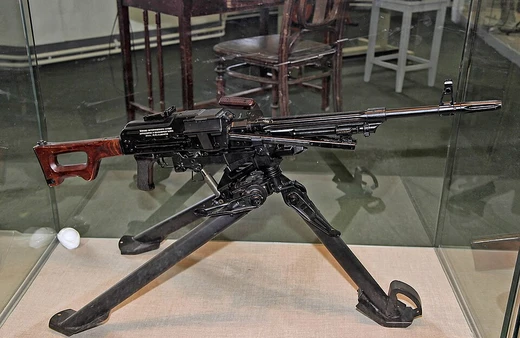
M2 Browning
A heavy machine gun designed by John Browning, serving since the 1930s.

The M2 machine gun, also known as the Browning .50-caliber machine gun and informally as 'Ma Deuce', is a heavy machine gun designed near the end of World War I by John Browning. It is a scaled-up version of Browning's M1919 .30-06 machine gun, chambered for the larger and more powerful .50 BMG (12.7 mm) cartridge. The M2 has been used extensively as a vehicle weapon and for aircraft armament by the United States since the 1930s and remains the primary heavy machine gun of NATO countries.
Quick Facts
- Origin
- United States
- Is Ranged
- yes
- Designer
- John Browning
- Design Date
- 1918
- Production Date
- 1921–present (M2HB/M2A1)
- Number
- 3 million
- Service
- 1933–present
- Weight
- 38 kg / 28 kg (AN/M2) / 58 kg with tripod and traverse and elevation mechanism (T&E) / 24 lb barrel weight
- Length
- 1654 mm / 1429 mm (AN/M2)
- Part Length
- 1143 mm / 910 mm (AN/M2)
- Cartridge
- .50 BMG (12.7×99mm NATO)
- Action
- Short recoil-operated
Facts from the source article.
Lore & Background
The M2 was developed in response to World War I demands for a larger-caliber machine gun to counter armored aircraft and ground armor. General John J. Pershing requested a .50-caliber gun with a muzzle velocity of at least 2700 ft/s. John Browning began redesigning his .30-06 M1917 around July 1917, while Winchester developed the cartridge. The first .50-caliber trials on 15 October 1918 showed a muzzle velocity of only 2300 ft/s and a rate under 500 rounds per minute. Captured German 13.2 mm anti-tank rifle ammunition helped Winchester improve the .50 round to achieve 2750 ft/s.
Browning and Fred T. Moore produced the water-cooled M1921, used experimentally from 1921 to 1937. After Browning's death in 1926, S. H. Green studied the M1921's design from 1927 to 1932, creating a single receiver that could be configured into seven types. Colt manufactured prototypes in 1933, and with Navy support began M2 production that year. The air-cooled M2 HB (heavy barrel) variant weighs 84 lb, compared to 121 lb for the water-cooled version. The AN/M2 light-barrel aircraft version weighs 60 lb and became standard for American military aircraft in World War II.
The M2 is an air-cooled, belt-fed, short-recoil-operated machine gun firing from a closed bolt. The M2HB has a cyclic rate of 450–575 rounds per minute, while the AN/M2 aircraft gun cycles at 750–850 rpm. It can be configured for left or right feed and left or right charging. The M2 has no safety, though a sliding safety switch has been fielded to USMC armorers and is standard for the U.S. Army; the upgraded M2A1 includes a manual trigger block safety.
Reader's Guide
The M2 Browning has been a cornerstone of U.S. and NATO heavy machine gun capability since the 1930s. It was heavily used in World War II, the Korean War, the Vietnam War, the Gulf War, the War in Afghanistan, and the Iraq War. Its .50 BMG cartridge provides long range, high accuracy, and immense stopping power, making it effective against infantry, light armored vehicles, watercraft, light fortifications, and low-flying aircraft. The M2 has been used longer by U.S. forces than any other firearm except the .45 ACP M1911 pistol, also designed by John Browning. Current manufacturers include General Dynamics, Ohio Ordnance Works, U.S. Ordnance, and FN Herstal. The M2HB remains in service with many nations, and its design has been adapted with quick-change barrel systems and other improvements while retaining the original operating principles.
Did You Know?
- The M2 is informally called 'Ma Deuce'.
- The M2HB weighs 84 lb, while the water-cooled version weighs 121 lb.
- The AN/M2 aircraft version has a cyclic rate of 750–850 rounds per minute.
- The M2 has been used by U.S. forces longer than any firearm except the M1911 pistol.
More in Machine Guns, Part 4 1-24
Spotted an error? Know more?
Reader corrections go straight into our review queue. Suggest an edit · How this site is sourced