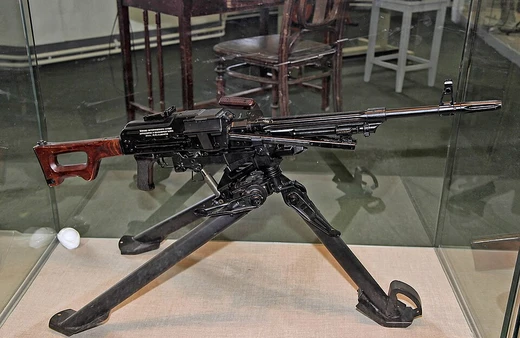
M1917 Browning machine gun
A water-cooled heavy machine gun serving from World War I to Vietnam.

The M1917 Browning is a heavy machine gun that served with U.S. forces in World War I, World War II, the Korean War, and the Vietnam War, and was also used by other countries. It was crew-served, belt-fed, and water-cooled, operating alongside the lighter air-cooled Browning M1919. It was used at the battalion level and often mounted on vehicles like jeeps. Two main versions existed: the M1917, used in World War I, and the M1917A1, used afterward. The M1917 had a cyclic rate of 450 rounds per minute and saw some aircraft use, while the M1917A1 had a rate of 450 to 600 rounds per minute.
John Moses Browning filed a patent for a recoil-powered automatic gun in 1900. He returned to the design in 1910, building a water-cooled prototype. After successful tests, Browning made minor improvements: replacing side ejection with bottom ejection, adding a buffer, swapping the hammer for a two-piece firing pin, and other tweaks. The core design remained from 1900. The M1917 was water-cooled, though some experimental versions lacked a water jacket; the air-cooled M1919 later emerged as a medium machine gun. Unlike many early machine guns, it did not use Maxim’s toggle lock. At 47 pounds, it was lighter than contemporary Maxim-type guns like the German Maschinengewehr 08 (137 pounds, with the 08/15 model at 43 pounds) and the British Vickers, while remaining highly reliable. Its only similarities to the Maxim or Vickers were recoil operation, a T-slot breechblock, pull-out belt feed, water cooling, and forward ejection. Its sliding-block locking mechanism saved weight and complexity, a feature used in earlier Browning designs. The belt fed left-to-right, and cartridges were stacked closer together than in Maxim/Vickers patterns, a layout later copied by many guns.
The Army Ordnance Department showed little interest in machine guns until the U.S. declared war in April 1917. At that time, the U.S. arsenal had only 1,100 machine guns, most outdated. The government asked several designers to submit weapons. Browning arranged a test at Springfield Armory in May 1917. The first gun fired 20,000 rounds with few malfunctions, mostly from poorly loaded cloth belts. Impressed, Browning fired another 20,000 rounds; one part broke—a sear at about 39,500 rounds. The Ordnance Board was impressed but doubted production models could match that performance.
Quick Facts
- Is Ranged
- yes
- Origin
- United States
- Designer
- John M. Browning
- Design Date
- 1917
- Production Date
- 1917–45
- Service
- 1917–1970s5
- Wars
- World War I / Mexican Revolution / Banana Wars / Chaco War / World War II / Chinese Civil War / Korean War / First Indochina War / Congo Crisis / Vietnam War / Cambodian Civil War
- Part Length
- 24 in (609 mm)
- Cartridge
- .30-06 Springfield
- Feed
- 250 round fabric belt
- Action
- Recoil-operated automatic
- Rate
- 450 round/min, 600 round/min for M1917A1
Facts from the source article.
Lore & Background
In 1900, John Moses Browning filed a patent for a recoil-powered automatic gun. Browning did not work on the gun again until 1910, when he built a water-cooled prototype of the 1900 design. Although the gun worked well, Browning improved the design slightly, replacing side ejection with bottom ejection, adding a buffer, replacing the hammer with a two-piece firing pin, and making other minor improvements. The basic design of the gun was still the 1900 design. Unlike many other early machine guns, the M1917 had nothing to do with Maxim's toggle lock design. At 47 lbs, it was much lighter than contemporary Maxim type guns such as the first 137 lb German Maschinengewehr 08 (08/15 model: 43 lbs) and the British Vickers machine gun, while still being highly reliable. Its sliding-block locking mechanism saved weight and complexity.
The Army Ordnance Department showed little interest in machine guns until war was declared in April 1917. Browning arranged a test at the Springfield Armory in May 1917. In the first test, the weapon fired 20,000 rounds with only a few malfunctions mostly related to poorly loaded cloth belts. Browning fired another 20,000 rounds through the weapon with one broken part: a broken sear at about 39,500. The Ordnance Board was impressed, but unconvinced; Browning used a second gun that not only duplicated the original trial, but also fired continuously for 48 minutes and 12 seconds (over 21,000 rounds). The Army adopted the weapon as its principal heavy machine gun, utilizing the M1906 .30-06 cartridge. Production was complex; by the time of the Armistice, Westinghouse had made 30,150, Remington 12,000, and Colt 600. The M1917 saw limited service in the later days of World War I, with only about 1,200 seeing combat.
The Model 1917A1 was again used in the Second World War, primarily with M2 ball, tracer, and armor-piercing ammunition. Some were supplied to the UK for use by the Home Guard. The M1917's weight and bulk meant it was generally employed as a fixed defense or as a battalion or regimental support weapon. The Model 1917 was called to service again in the Korean War. On at least one occasion, U.S. soldiers urinated on the gun when water-cooling had failed in frigid temperatures. The Model 1917 was slowly phased out of military service in the late-1960s in favor of the M60 machine gun. Many were given to South Vietnam. The last ones in regular US service were on the machine gun infiltration course at Fort Benning, Georgia.
Reader's Guide
The M1917 Browning machine gun was notable for its reliability and sustained-fire capability, demonstrated in trials where it fired tens of thousands of rounds with minimal malfunctions. Its water-cooled barrel allowed for long periods of continuous fire, an advantage that kept it in service through multiple major conflicts. The weapon's design influenced later Browning machine guns, and its sliding-block locking mechanism was used in many previous Browning designs. Although production delays limited its combat use in World War I, it became a standard heavy machine gun for the United States through World War II, the Korean War, and into the Vietnam War. The M1917 was also supplied to other nations, including the United Kingdom and South Vietnam. Its legacy includes continued use by irregular military forces into the latter half of the 20th century, owing to the water-cooled barrel's ability to sustain fire. The M1917A1 variant, with a higher cyclic rate, served as the primary iteration after World War I. The gun's wooden ammunition chests evolved over time, and later metal boxes were adopted. The M1917's role as a battalion-level support weapon, often vehicle-mounted, and its presence in training at Fort Benning until the late 1960s, underscore its long service life.
Did You Know?
- The M1917 weighed 47 lbs, much lighter than the 137 lb German Maschinengewehr 08.
- U.S. soldiers in the Korean War urinated on the gun when water-cooling failed in frigid temperatures.
More in Machine Guns, Part 4 1-24
Spotted an error? Know more?
Reader corrections go straight into our review queue. Suggest an edit · How this site is sourced