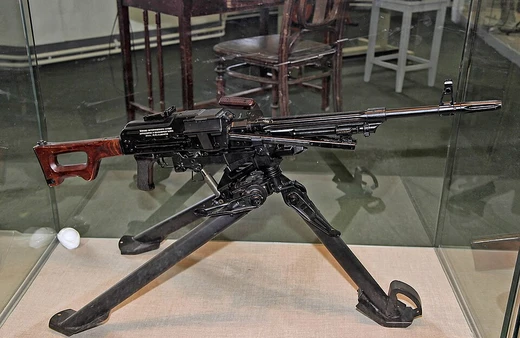
KPV heavy machine gun
Soviet 14.5mm heavy machine gun, powerful against armor and aircraft.

The KPV heavy machine gun is a Soviet weapon chambered in 14.5×114mm. It entered infantry service in 1949. Production of the infantry version ended in the 1960s due to its excessive size and weight. It was later adapted for anti-aircraft roles, proving effective against low-flying aircraft with a horizontal range of 3,000 meters and a vertical range of 2,000 meters. It was used in the ZPU series of anti-aircraft guns. Its size and power also made it useful as a light anti-armor weapon on BTR series vehicles and the BRDM-2 scout car.
Developed by S. V. Vladimirov starting in 1944 and adopted in 1949, the KPV combines the rate of fire of a heavy machine gun with the armor-piercing capability of an antitank rifle. It was designed to engage lightly armored targets, enemy personnel behind light cover, and aircraft. Its muzzle energy reaches 31 kJ, compared to 19 kJ for the 12.7mm Browning M2HB and about 28 kJ for the 20mm ShVAK aircraft gun. It is one of the most powerful machine guns used by Soviet and later Russian forces. The 14.5×114mm M41 cartridge can fire high explosive incendiary tracer (HEI-T) or armor-piercing incendiary (API) rounds. The KPV is air-cooled with a hard chrome plated bore. It operates via short recoil with gas assistance and a rotary bolt. It feeds from a 40-round metallic belt from either side. The barrel is removed by turning a latch on the forward receiver and pulling the barrel's carrying handle.
The armored vehicle version is the KPVT. It has a shorter receiver, a heavier barrel jacket, and uses a 50-round belt instead of 40. KPVTs arm the BTR-60PB/70/80 series, BRDM-2, boats, and stationary mounts. It engages lightly armored targets, weapons systems, and shelters up to 3,000 meters, and air targets up to 2,000 meters. The bullet retains lethal force to 8 km, with a maximum flight range of 9 km.
Naval mounts include the twin 2M-5 for motor torpedo boats, 2M-6 for armored gunboats, and 2M-7 for patrol and mine-sweeping boats. The single mount is the 14.5mm MTPU, intended for surface, coastal, and air targets, with the same horizontal and vertical ranges.
The ZPU is a towed anti-aircraft gun based on the KPV, entering service in 1949 and used by over 50 countries. Variants include the single-barreled ZPU-1, twin-barreled ZPU-2, and quadruple-barreled ZPU-4. The mountain version is the single-barreled ZGU-1 pack mount.
Quick Facts
- Origin
- Soviet Union
- Is Ranged
- yes
- Service
- 1949–present
- Designer
- Semyon Vladimirov
- Design Date
- 1944
- Manufacturer
- Degtyarev Plant
- Variants
- KPVT
- Weight
- 49 kg
- Length
- 1980 mm
- Part Length
- 1346 mm
- Height
- 225 mm
- Cartridge
- 14.5×114mm
Facts from the source article.
Lore & Background
The KPV was developed by S. V. Vladimirov starting in 1944 and was adopted in 1949. It was designed to combat lightly armored targets, enemy firepower and personnel behind light cover, and to serve as an anti-aircraft machine gun. The infantry version was taken out of production in the 1960s because it was too large and heavy. It was later redesigned for anti-aircraft use, showing excellent results against low-flying aircraft. The KPV is air-cooled with a hard chrome plated bore and uses a short recoil operation system with gas assistance and a rotary bolt. It can be fed with a 40-round metallic belt from either side. The barrel is removable by turning a latch on the forward end of the receiver and pulling the barrel's carrying handle. The 14.5×114mm M41 cartridge can be used with high explosive incendiary-tracer or armor-piercing incendiary bullets.
Reader's Guide
The KPV heavy machine gun was notable for its power, with a muzzle energy of 31 kJ, exceeding that of the 12.7mm Browning M2HB (up to 19 kJ) and the 20mm ShVAK aircraft gun (about 28 kJ). It was used in the ZPU series of towed anti-aircraft guns, which entered service in 1949 and were adopted by over 50 countries. The KPV also served as a light anti-armour weapon on the BTR series of vehicles and the BRDM-2 scout car. The armored vehicle version, the KPVT, featured a shorter receiver, heavier barrel jacket, and a 50-round belt. KPVTs were the primary armament of BTR-60PB/70/80 series armored personnel carriers and BRDM-2 armored reconnaissance vehicles. The weapon was also mounted on naval vessels in twin mounts (2M-5, 2M-6, 2M-7) and a single mount (MTPU). The bullet retains lethal force at 8 km, with a maximum flight range of 9 km. Ammunition types include B-32 armor-piercing incendiary (penetrating 32 mm of RHA at 500 m), BZT armor-piercing incendiary tracer, and MDZ high-explosive incendiary. The KPV and KPVT were produced under license in several countries, including China (Type 56 and Type 58), Poland, and India.
Did You Know?
- The KPV's muzzle energy of 31 kJ exceeds that of the 12.7mm Browning M2HB (up to 19 kJ) and the 20mm ShVAK (about 28 kJ).
- The infantry version was taken out of production in the 1960s due to being too large and heavy.
- The KPVT uses a 50-round belt instead of the original 40-round belt.
More in Machine Guns, Part 4 1-24
Spotted an error? Know more?
Reader corrections go straight into our review queue. Suggest an edit · How this site is sourced