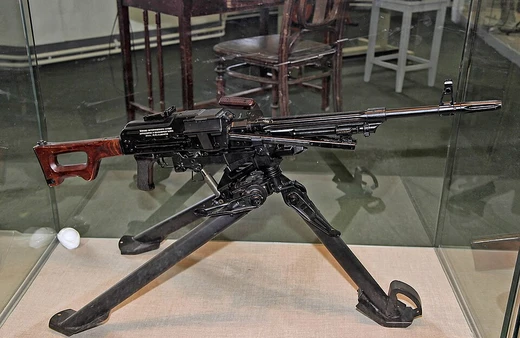
Hotchkiss 13.2 mm machine gun
French heavy machine gun for anti-aircraft, naval, and ground use.

The Hotchkiss 13.2 mm machine gun, also known as the Hotchkiss M1929 machine gun (Mle 1929, Mle 1930, etc.), was a heavy machine gun primarily intended for anti-aircraft use. Designed and manufactured by French arms manufacturer Hotchkiss et Cie from the late 1920s until World War II, it saw service with various nations' forces, including Italy and Japan where the gun was built under license.
Quick Facts
- Origin
- France
- Is Ranged
- YES
- Wars
- World War II
- Design Date
- 1929
- Manufacturer
- Hotchkiss et Cie
- Weight
- 37.5 kg (83 lbs) / single gun, stripped
- Length
- 1.67 m
- Part Length
- 1 m
- Cartridge
- 13.2×99mm Hotchkiss Long (intr. 1929) · 13.2×96mm Hotchkiss Short (intr. 1935)
- Caliber
- 13.2 mm
- Action
- Gas operated
- Rate
- 450 rpm (cyclic) / 200-250 rpm (sustained)
Facts from the source article.
Lore & Background
Development of the Hotchkiss 13.2 mm machine gun began in 1922 as an aircraft machine gun, but the French government classified the belt-fed version while only allowing export of the magazine version from around 1927. The gun was based on a gas-operated action similar to the reliable 8 mm Hotchkiss Mle 1914 machine gun. The initial cartridge, the 13.2 × 99 mm Hotchkiss 'Long', was essentially a .50 BMG cartridge necked up to 13.2 mm, but it caused excessive barrel wear. In 1935, Hotchkiss introduced the 13.2 × 96 mm Hotchkiss 'Short' cartridge with a slightly shorter case and reworked projectile, which fixed the barrel wear issue without requiring modifications to existing weapons.
The M1929 came in single, double, and quadruple barreled configurations for anti-aircraft use on high-angle pedestal and tripod mounts, as well as low-angle bipod mounts for anti-tank and heavy machine gun roles. French infantry commanders refused to accept the 13.2 mm, arguing that heavy falling bullets could endanger friendly troops and preferring larger calibers with self-destructing shells. However, the gun saw extensive use as a naval weapon and was chosen by the French cavalry for some armored vehicles. The French Air Force used it for airfield defense in two versions: a dual-purpose anti-aircraft/anti-armor mounting on a two-wheeled carriage, and a fixed tripod mount with a seat and anti-aircraft sight.
Naval use included twin and quadruple mountings on French, Italian, and Japanese warships early in World War II. French warships refitted in the United States in 1943 had their 13.2 mm guns replaced by Oerlikon 20 mm cannons. In Italy, Breda produced the gun under license as the Breda Mod.31 from 1931, used aboard ships, submarines, and armored trains. The Spanish Navy bought the weapon in December 1935 and used it during the Civil War. The Greek version was fed by a rigid metal band (feed strip) and used an articulated tripod for dual anti-aircraft and anti-tank roles.
Reader's Guide
The Hotchkiss 13.2 mm machine gun's significance lies in its widespread adoption and license production by multiple nations, including Italy and Japan, making it a notable example of interwar French arms export. Its design, based on the reliable gas-operated action of the earlier Hotchkiss Mle 1914, provided a foundation for a family of anti-aircraft weapons in 13.2, 25, and 37 mm calibers. The gun's primary limitation was its magazine feed—a 30-round curved box that emptied in four seconds, restricting sustained fire to 200-250 rounds per minute despite a cyclic rate of 450 rounds per minute. This made it less effective in sustained anti-aircraft engagements compared to belt-fed contemporaries.
Its legacy includes service in the French, Italian, Japanese, Spanish, and Greek armed forces, as well as use by the Free French in North-East Africa in 1942. The gun was mounted on various armored vehicles, including the Belgian T15, French AMR 35 light tank, and Japanese Type 92 Heavy Armored Cars. The introduction of the 13.2 × 96 mm 'Short' cartridge in 1935 to address barrel wear demonstrates a practical engineering solution that maintained compatibility with existing weapons. The gun's replacement by Oerlikon 20 mm cannons on refitted French warships in 1943 reflects the shift toward more powerful anti-aircraft weapons during World War II.
Did You Know?
- The Hotchkiss M1929 was initially developed in 1922 as an aircraft machine gun, but the French government classified the belt-fed version and only allowed export of the magazine version.
- The Greek version of the gun was fed by a rigid metal band (feed strip) rather than a box magazine.
More in Machine Guns, Part 4 1-24
Spotted an error? Know more?
Reader corrections go straight into our review queue. Suggest an edit · How this site is sourced