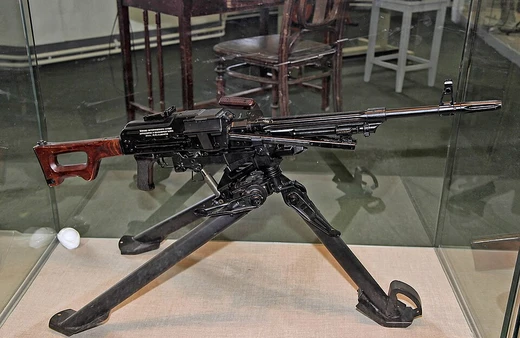
DShK
Soviet heavy machine gun used from World War II to present.

The DShK M1938 is a Soviet heavy machine gun designed by Vasily Degtyaryov and later improved by Georgi Shpagin, who revised the cartridge feed mechanism. It is sometimes nicknamed Dushka or Dochka in Slavic-speaking regions and in countries that use the weapon. The DShK may be vehicle mounted or used on a tripod or wheeled carriage as a heavy infantry machine gun.
Quick Facts
- Origin
- Soviet Union
- Is Ranged
- yes
- Service
- 1938–present
- Designer
- Vasily Degtyaryov / Georgi Shpagin
- Design Date
- 1938
- Manufacturer
- Tula Arms Plant
- Unit Cost
- US$2,250 (2012)
- Production Date
- 1938–1980 (Soviet Union)
- Number
- 1,000,000
- Variants
- DShK 38/46 / Type 54
- Weight
- 34 kg (gun only) / 157 kg on wheeled mounting
- Length
- 1625 mm
Facts from the source article.
Lore & Background
Development of the DShK began in the Soviet Union in 1929, requiring a heavy machine gun similar to the M2 Browning. The first design was finalized by Vasily Degtyaryov in 1931, using the same gas operation as the Degtyaryov machine gun and a 30-round drum magazine, but it had a poor rate of fire. Georgy Shpagin revised the design by changing it to a belt-fed system with a rotary-feed cylinder, and production began in 1938 as the DShK 1938. During World War II, 9,000 were produced and used by the Red Army, mostly in anti-aircraft roles on vehicles such as the GAZ-AA truck, IS-2 tank, ISU-152 self-propelled artillery, and the T-40 amphibious tank. When deployed against infantry, the DShK was used with a two-wheeled trolley, with which the machine gun weighed a total of 346 lb. In 1944, a much cheaper muzzle brake patterned after the Polish Wz. 35 anti-tank rifle was introduced. After 1945, the DShK was exported widely to other countries in the Eastern Bloc.
In 1946, an improved variant called the DShK 38/46 or DShK-M was produced, with a revised muzzle and feeding system. Over a million were produced from 1946 to 1980. The gun was revised to become more reliable and easier to manufacture. It was produced under license in Pakistan, Iran, Yugoslavia, Romania, Poland, and Czechoslovakia. The Czechoslovak variant is visually distinguishable by a rectangular muzzle brake. China produced its own variant, the Type 54. After World War II, DShKs were used widely by communist forces in Vietnam, starting with the Battle of Dien Bien Phu in 1954. They were a major threat to American aircraft in the Vietnam War, and of the 7,500 helicopters and fixed-wing aircraft lost during the war, most were shot down and destroyed by anti-aircraft guns including the DShK.
Reader's Guide
The DShK and the American M2 Browning are the only .50 caliber machine guns designed prior to World War II that remain in service to the present day. The DShK began to be partially replaced in the Soviet Union by the NSV machine gun in 1971 and the Kord machine gun in 1998, but it remains in service, although it is no longer produced. In June 1988, during The Troubles, a British Army Westland Lynx helicopter was hit 15 times by two Provisional IRA DShKs smuggled from Libya and forced to crash-land near Cashel Lough Upper, south County Armagh. Rebel forces utilized DShKs in the Syrian civil war, often mounting the gun on cars. In 2012, the Syrian government claimed to have destroyed 40 such technicals on a highway in Aleppo and six in Dael. The weapon was used by Ukrainian forces in the 2022 Russian invasion of Ukraine to shoot down Iranian-made Shahed-136 drones. The DShKs are fitted with a searchlight when defending against drones, which MANPADS have been unable to destroy. As many of the DShKs have been left over from the Soviet Union, they have been both cost-effective and one of the most reliable methods of destroying drones.
Did You Know?
- The DShK's name is derived from its original designer Vasily Degtyaryov and Georgi Shpagin, who improved the cartridge feed mechanism.
- During the Vietnam War, most of the 7,500 helicopters and fixed-wing aircraft lost were shot down by anti-aircraft guns including the DShK.
- In 2022, Ukrainian forces used DShKs fitted with searchlights to shoot down Iranian-made Shahed-136 drones.
Frequently Asked Questions
Who designed the DShK?
Vasily Degtyaryov originally created the DShK M1938, and Georgi Shpagin later refined its cartridge feed mechanism.
What are the DShK's key specs?
It fires 12.7×108mm rounds from a belt feed at 600 rounds per minute, with an effective range of roughly 1.5 miles. At 500 meters it can punch through up to 20 mm of armor.
How is the DShK typically deployed?
The gun can be mounted on a vehicle, set on a tripod, or carried on a wheeled carriage for heavy infantry use. Its butterfly trigger lets the operator control fire from either side of the weapon.
What does the nickname 'Dushka' mean?
In Slavic-speaking countries and other regions where the weapon is common, the DShK is affectionately called Dushka or Dochka, which roughly translates to 'little daughter.'
How long has the DShK been in service?
The DShK has seen continuous use from World War II all the way to the present day, making it one of the longest-serving heavy machine gun designs in military history.
More in Machine Guns, Part 4 1-24
Spotted an error? Know more?
Reader corrections go straight into our review queue. Suggest an edit · How this site is sourced