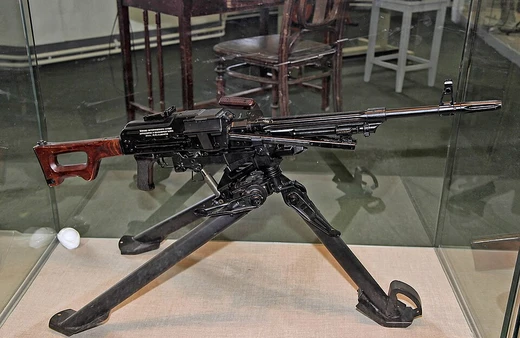
Fiat–Revelli Modello 1935
Italian air-cooled belt-fed machine gun, modified from the Fiat Mod.1914.

The Fiat–Revelli Modello 1935, also known as the Fiat Modello 14/35 or simply Fiat Mod.35, was an Italian machine gun developed as a modified version of the World War I-era Fiat Mod.1914. It was notable for its adoption of belt-fed 8×59mm ammunition, a quick-change barrel, and the removal of the water jacket and water pump, offering superior penetration power compared to its predecessor. Despite these improvements, the gun remained prone to jamming and dust-related issues during its service life, yet saw extensive action in World War II.
Quick Facts
- Origin
- Italy
- Is Ranged
- yes
- Service
- 1935–1945
- Used By
- Kingdom of Italy
- Design Date
- 1934
- Developed From
- Fiat Mod.14
- Production Date
- 1935–1943
- Cartridge
- 8×59mm Rb Breda
Facts from the source article.
Lore & Background
The Fiat Mod.1914 had seen widespread use during World War I, but its flaws became increasingly apparent over time. Since 1926 the Italian Army felt the need for a machine gun with a caliber larger than 6.5 mm, and from 1928 began experimenting with modified Fiat Mod.14 guns in various calibers: 8 mm, 7.92 mm, and 7.65 mm. In 1931 the Army also started a competition for a completely new machine gun in 8–7.92 mm caliber. After the adoption of the new 8 mm cartridge in 1933, the Regio Esercito pursued both the modification of the Fiat Mod.14 and the competition for a new gun, which ended in 1935 with the adoption of the Fiat Mod.35 and in 1937 with the Breda Mod.37.
The Mod.35 opted for a more conventional belt feed, air-cooling, and rechambering for the 8×59mm RB Breda cartridge. The gun was prone to cook-off of chambered rounds during pauses in firing. Like the Mod.14, it was a complete weapon system comprising the machine gun unit, tripod mounting assembly, and ammunition supply, requiring a multi-person crew to operate. The rechambering and belt feed improved stopping power and rate of fire, but the gun reportedly suffered from jammings rather often.
There is unsubstantiated data frequently reported in English-language texts and websites about the Mod.35 using an integrated oil pump to lubricate ammunition, inherited from the Fiat Mod.14. Such a device was never implemented in either machine gun, but the manuals recommended slightly lubricating each round before insertion into the Mod.14 box magazine or Mod.35 belts to facilitate extraction and cycling.
Reader's Guide
The Fiat Mod.35 represented a significant attempt by the Italian Army to modernize its machine gun inventory between the world wars, addressing the limitations of the earlier Fiat Mod.1914 by adopting a larger caliber and belt feed. Its quick-change barrel and air-cooling were practical improvements over the water-jacketed predecessor, yet the gun retained a reputation for jamming and dust sensitivity that limited its effectiveness. The weapon saw extensive combat during World War II, and after the Italian Armistice, captured examples were redesignated by the Germans as the 8 mm Schweres Maschinengewehr 255(i). The Mod.35 also saw use on various Italian armored vehicles, including the Lancia 1ZM, Fiat-Terni Tripoli, Fiat 3000, CV 33, CV 35, and Fiat 1100 C.M., as well as on the T17E1 Staghound used by Italian Police, where it replaced the hull-mounted Browning M1919. Its legacy is that of a flawed but widely deployed weapon that bridged the gap between World War I designs and the later Breda Mod.37, though it never fully overcame its reliability issues.
Did You Know?
- The Fiat Mod.35 was also designated as the Fiat Modello 14/35, reflecting its origin as a modification of the World War I-era Fiat Mod.1914.
- After the Italian Armistice, captured Fiat Mod.35s were renamed by the Germans as the 8 mm Schweres Maschinengewehr 255(i).
- The Mod.35 was installed in twin mounts on the CV 33 and CV 35 light tanks.
More in Machine Guns, Part 4 1-24
Spotted an error? Know more?
Reader corrections go straight into our review queue. Suggest an edit · How this site is sourced