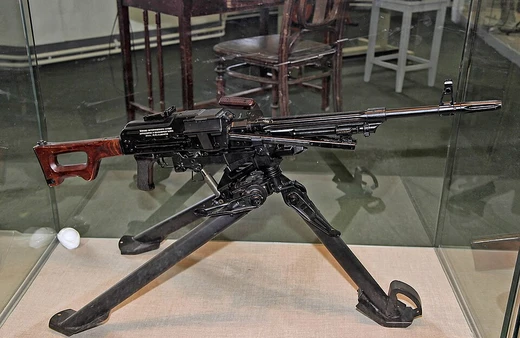
AA-52 machine gun
French general-purpose machine gun using lever-delayed blowback operation.

The AA-52 (Arme Automatique Transformable Modèle 1952) is a French general-purpose machine gun developed after World War II and manufactured by the state-owned Manufacture d'armes de Saint-Étienne (MAS). It was one of the first French-produced guns of the post-war era, conceived for ease of production using welded stamped sheet steel. The AA-52 remains in service as a vehicle-mounted weapon due to large quantities in inventory, though it has been largely phased out for infantry use in favor of the lighter FN Minimi.
Quick Facts
- Is Ranged
- yes
- Origin
- French Fourth Republic
- Design Date
- 1952
- Manufacturer
- Manufacture d'armes de Saint-Étienne (MAS)
- Service
- 1952–present
- Weight
- 9.97 kg
- Caliber
- 7.5 mm / 7.62 mm
- Part Length
- 600 mm
- Cartridge
- 7.5×54mm French / 7.62×51mm NATO
- Feed
- 50-round non-disintegrating belt
- Sights
- Iron / Removable APX (SOM) telescopic sights / IR scope
- Action
- Lever-delayed blowback
Facts from the source article.
Lore & Background
The AA-52 was conceived and developed following French military experiences in the First Indochina War during the early 1950s. At that time, the French army was equipped with an assortment of weapons from British, American, and German sources, making supply of ammunition and replacement parts nearly impossible. The army decided to adopt a standard machine gun, resulting in the AA-52, designed for simplified production with welded stamped sheet steel construction.
The AA-52 uses lever-delayed blowback operation, also seen in the FAMAS rifle made at the same factory. When firing, gas pressure on the case head initiates an impulse on a cam that sends the bolt carrier rearward; after a certain distance, a link (the firing pin) pulls the bolt head to extract the spent case. Because there is no primary extraction, the chamber is fluted to allow powder gases to flow back and unstick the case, similar to Heckler & Koch roller-delayed blowback weapons. The feed and trigger mechanisms are derived from the MG 42.
The weapon can be used as a light machine gun with a bipod or as a heavy machine gun with a tripod; when used with a tripod for continuous fire, a heavier barrel is fitted. The barrel is changed by pressing a latch and rotating it a quarter turn. The APX(SOM) telescopic sight used on the MAS-49 and FR-F1 sniper rifle can be mounted, as well as an infrared night sight.
Reader's Guide
The AA-52 was partially withdrawn from French army service in 2008 and replaced in the 2010s by 10,881 FN MAG general-purpose machine guns. It has been replaced in the helicopter role by the Belgian FN MAG, starting with the EC 725 Caracal of special operations units and Air Force search and rescue teams. Despite these replacements, the AA-52 remains in use as a vehicle-mounted weapon due to the large quantities still in service. The original 7.5×54mm French cartridge limited export potential, so the gun was adapted for 7.62×51mm NATO as the AANF-1 (also ANF-1 or NF-1). A version chambered in .50 BMG, the MAC-58, was prototyped and one preserial example retained, but it never reached production because the French armed forces already had large quantities of US M2 Browning machine guns. The AA-52 has been used by multiple nations, including Bolivia, Cameroon, the Comoros, the Dominican Republic, Indonesia, Ireland, Madagascar, Mali, Senegal, and Somalia, and was fitted on vehicles such as the Irish Panhard AML 60-7 CS and the Indonesian Korps Marinir AMX-10 PAC 90.
Did You Know?
- The AA-52 uses lever-delayed blowback operation, also found in the FAMAS rifle from the same factory.
- The feed and trigger mechanisms of the AA-52 are derived from the German MG 42.
- A .50 BMG version called the MAC-58 was prototyped but never entered production due to existing stocks of M2 Brownings.
More in Machine Guns, Part 4 1-24
Spotted an error? Know more?
Reader corrections go straight into our review queue. Suggest an edit · How this site is sourced