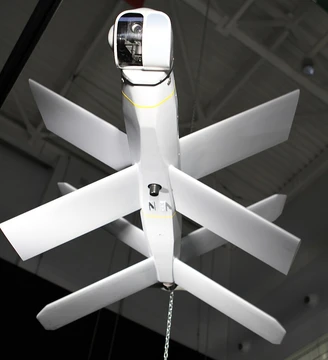
Temco XKDT Teal
American rocket-propelled target drone evaluated by the Navy in the late 1950s.

The Temco XKDT Teal was a rocket-powered target drone developed by Temco Aircraft for the U.S. Navy in the late 1950s. It was designed as a low-cost, expendable air-launched drone capable of high performance, with a top speed near Mach 0.95. The aircraft featured a low-set swept wing and an inverted cruciform tail, with aluminum honeycomb wing construction and a fuselage that made extensive use of magnesium and fiberglass. After evaluation, no production order was placed.
The Teal could be launched from altitudes up to 50,000 feet at speeds between 163 and 248 knots. A dual-thrust solid-fuel rocket motor ignited after launch, providing 150 pounds of thrust for the first four seconds, then 50 pounds for about 500 seconds. A three-axis autopilot controlled the drone, while radar reflectors and infrared flares aided tracking. After nine minutes of flight, a self-destruct device activated.
The first XKDT-1 flight occurred in September 1957, with most launches conducted from a McDonnell F3H Demon carrier aircraft. The evaluation program ended without a production contract, as supersonic targets had become preferred.
Quick Facts
- Aircraft Type
- Target drone
- National Origin
- United States
- Manufacturer
- Temco Aircraft
- Primary User
- United States Navy
- First Flight
- September 1957
Facts from the source article.
Lore & Background
The XKDT Teal was designed for use as an inexpensive and expendable air-launched, high-performance target drone. Its design utilized a low-set swept wing and an inverted cruciform tail; the structure included aluminum honeycomb wing construction and extensive use of magnesium and fiberglass in the fuselage. It was intended to reach speeds of up to Mach 0.95.
The Teal could be launched at any altitude of up to 50,000 ft; speed at launch was between 163 kn and 248 kn. Following launch, a dual-thrust solid fuel rocket motor ignited, providing 150 lbf of thrust for the first four seconds of powered flight, followed by 50 lbf for approximately 500 seconds of propulsive time. Control was provided by a three-axis autopilot; radar reflectors and infrared flares assisted in tracking the drone, and at the end of nine minutes' flight time a self-destruct device would be activated.
The first flight of an XKDT-1 took place in September 1957; most flights utilized a McDonnell F3H Demon carrier aircraft. Following the conclusion of the evaluation program, no production contract was placed, as supersonic targets had become preferred.
Reader's Guide
The Temco XKDT Teal represents a transitional point in target drone development during the late 1950s, when the United States Navy sought an inexpensive, expendable, high-performance air-launched target. Its design incorporated advanced materials for the era, including aluminum honeycomb wing construction and extensive use of magnesium and fiberglass in the fuselage. The dual-thrust solid fuel rocket motor provided a sustained flight time of approximately nine minutes, with a self-destruct device ensuring the drone's disposal after its mission. Despite successful evaluation flights beginning in September 1957, primarily launched from McDonnell F3H Demon carrier aircraft, the program did not proceed to production. The shift in preference toward supersonic targets rendered the subsonic Teal obsolete for its intended role. Its legacy lies in demonstrating the feasibility of a low-cost, rocket-propelled target drone with a sophisticated autopilot and tracking aids, even as the rapid pace of aviation technology soon outpaced its capabilities.
Did You Know?
- The XKDT Teal was built by Temco Aircraft for evaluation by the United States Navy.
- The drone's dual-thrust rocket motor provided 150 lbf for the first four seconds, then 50 lbf for about 500 seconds.
- Most test flights were launched from a McDonnell F3H Demon carrier aircraft.
More in Loitering Munitions and Target Drones 1-24
Spotted an error? Know more?
Reader corrections go straight into our review queue. Suggest an edit · How this site is sourced