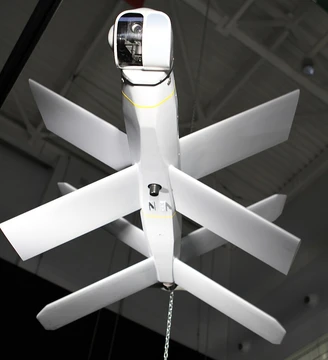
FPV loitering munition
Modified commercial racing drones with explosives for one-way attack.

An FPV loitering munition is a type of loitering munition created by modifying common commercial racing drones with the attachment of a small explosive, named for the first-person view (FPV) they provide the operator. These munitions allow direct reconnaissance during the strike mission and have been used by both conventional armies and non-state militants.
- Type
- Loitering munition
- Construction
- Modified commercial racing drone with attached explosive (IED, grenade, mortar round, or RPG warhead)
- Operator perspective
- First-person view (FPV) via onboard camera
- Notable users
- Russian and Ukrainian forces (since 2022 escalation of Russo-Ukrainian war)
- Production rate by october 2023
- Thousands per month by both Russian and Ukrainian forces
- Example models
- Escadrone Pegasus, Vyriy Drone Molfar
- Cost effectiveness example
- A Tor missile system ($24 million) could buy 14,000 FPV drones
Lore & Background
During the 2010s and 2020s, both regular militaries and non-state groups began adapting off-the-shelf racing drones into what are called "FPV loitering munitions," named for the first-person view they give the pilot. These drones are fitted with small explosives—such as IEDs, grenades, mortar rounds, or RPG warheads—and used to dive-bomb tactical targets. The same FPV feed also allows the operator to conduct reconnaissance during the attack.
After the 2022 escalation of the Russo-Ukrainian war, both Russian and Ukrainian forces were each producing thousands of FPV drones per month by October 2023, many supplied by volunteer organizations. Examples of these low-cost, rapidly evolving designs from 2022–23 include the Escadrone Pegasus and the Vyriy Drone Molfar. In 2022, the UK government announced it was sending "hundreds of loitering munitions" to Ukraine. On 9 November 2023, Ukrainian soldiers reported using a civilian-donated FPV drone to destroy a Russian Tor missile system on the Kupiansk front, highlighting the extreme cost-effectiveness of such weapons: a single Tor system costs about $24 million, equivalent to roughly 14,000 FPV drones.
Reader's Guide
FPV loitering munitions represent a significant evolution in loitering munition technology, emerging from the modification of commercial racing drones rather than purpose-built military systems. Their significance lies in their low cost and rapid proliferation, enabling both state and non-state actors to field precision strike capabilities. The Russo-Ukrainian war demonstrated their cost-effectiveness, as a single $24 million Tor missile system was claimed destroyed by a civilian-donated FPV drone, with the same sum capable of purchasing 14,000 such drones. By October 2023, both Russian and Ukrainian forces were producing thousands per month, many donated by volunteer groups. Their legacy includes blurring the line between military and civilian drone technology, as well as demonstrating that loitering munitions can be rapidly adapted from commercial off-the-shelf components. The FPV format provides operators with direct reconnaissance during the strike mission, enhancing situational awareness. These munitions have also been used by non-state militants, indicating their accessibility beyond conventional military forces.
Did You Know?
- FPV loitering munitions are named for the first-person view they provide the operator.
- A Ukrainian soldier claimed to have used a civilian-donated FPV drone to destroy a Russian Tor missile system on 9 November 2023.
- The cost of one Tor missile system ($24 million) could buy 14,000 FPV drones.
From SEAD Doctrine to a New Weapon Category
The concept of a loitering munition traces its roots to the 1980s, when militaries sought a way to neutralize the growing threat posed by fixed surface-to-air missile systems like the Soviet S-75 and S-125. The U.S. had already developed Wild Weasel tactics and anti-radiation missiles such as the AGM-45 Shrike, but the Soviet shift to mobile batteries like the 2K12 Kub and intermittent radar operation demanded a new approach. Israel's 1982 Operation Mole Cricket 19 demonstrated the value of using unmanned aircraft and air-launched decoys to bait enemy radars into revealing themselves before striking with dedicated missiles. Building on that logic, programs like Northrop's AGM-136 Tacit Rainbow and Israel's IAI Harpy integrated anti-radiation seekers into loitering airframes, allowing operators to hold cheap munitions over suspected SAM sites and release them only when a radar was detected. Early developers did not call these systems loitering munitions; a 1988 article described the Tacit Rainbow variously as a UAV, a cruise missile, or a standoff weapon. The term itself emerged much later, and the category was deployed operationally for SEAD by several forces during the 1990s.
Expanding the Mission Set
By the 2000s, loitering weapons had moved well beyond their original anti-radar niche. Manufacturers began tailoring them for long-range strikes, close fire support, and ultra-short-range tactical employment. The AeroVironment Switchblade, for instance, is small enough to fit in a soldier's backpack and is issued at the platoon level, while the ZALA Lancet and HESA Shahed 136 saw extensive use by Russian forces in the Russo-Ukrainian war. Ukraine countered with the UJ-25 Skyline and the same Switchblade system. In the 2016 Nagorno-Karabakh conflict, an IAI Harop struck a bus being used to transport Armenian troops, illustrating the weapon's flexibility against soft targets. In the Gaza Strip, Rafael's Spike Firefly was employed for its precision and capacity to hit targets sheltered behind cover, a use the manufacturer confirmed in 2024. Turkish firm Roketsan developed the Eren, a multirole loitering munition capable of intercepting enemy aerial platforms while retaining ground-attack capability; in February 2026, a Bayraktar Akinci UCAV used an Eren to destroy a target drone in flight. This broadening of roles—from SEAD to air-to-air interception—shows how the category has become a versatile tool across the full spectrum of combat.
The FPV Drone Revolution
A dramatic shift arrived when conventional armies and non-state fighters began attaching small explosives—IEDs, grenades, mortar rounds, or RPG warheads—to ordinary commercial racing quadcopters, creating what became known as FPV loitering munitions, named for the first-person-view camera feed that guides the operator. These improvised weapons also provide real-time reconnaissance during the strike itself. The escalation of the Russo-Ukrainian war in 2022 turned this idea into an industrial-scale phenomenon. By October 2023, both Russian and Ukrainian forces were producing thousands of FPV drones each month, with many units donated by volunteer groups. Low-cost designs such as the Escadrone Pegasus and the Vyriy Drone Molfar evolved rapidly during 2022–23. The British government announced in 2022 that it would supply hundreds of loitering munitions to Ukraine. The cost asymmetry is staggering: on 9 November 2023, Ukrainian soldiers reported using a civilian-donated FPV drone to destroy a Russian Tor missile system on the Kupiansk front. A single Tor system costs roughly twenty-four million dollars to build—enough to purchase approximately fourteen thousand FPV drones.
A Spectrum of Complexity
Loitering munitions span an enormous range of engineering sophistication. At one extreme, a weapon can be nothing more than a commercially available quadcopter with a strapped-on explosive, sent on a one-way kamikaze run. Purpose-built quadcopter variants like the STM Kargu represent a step up. At the other end, dedicated systems such as the IAI Harop feature elaborate flight-control systems, purpose-designed warheads, and onboard electro-optical sensor suites that allow a human operator to identify and designate targets through a data link before the vehicle crashes into the target and detonates. Anti-radiation variants like the IAI Harpy can operate fully autonomously, searching for and attacking enemy radar without any human in the loop. A defining operational advantage across the spectrum is flexibility: unlike most other munitions, a loitering munition's mission can be retargeted or aborted mid-flight. While the vast majority are aerial platforms, the category also encompasses certain autonomous undersea vehicles with similar loiter-and-strike characteristics. Their ability to engage hidden targets that appear only briefly—without committing high-value platforms near the threat area—remains their core strategic value.
Frequently Asked Questions
What is an FPV loitering munition?
It is a one-way attack drone built by bolting a small explosive payload onto a consumer racing quadcopter, with the pilot seeing the world through a live camera feed. The name comes from that first-person-view camera, which is the defining feature that separates it from other drone categories.
How is an FPV loitering munition constructed?
The airframe is essentially a stock hobby racing drone, and the warhead is a repurposed explosive—ranging from a hand grenade or IED to a mortar round or RPG warhead—mounted to the frame. This keeps the build cheap, simple, and fast to assemble in the field.
Who has been flying FPV loitering munitions in combat?
Russian and Ukrainian forces have both deployed them heavily since the 2022 escalation of their war, and non-state militant groups have adopted the same concept. They are among the most widely fielded loitering-munition types in modern conflict.
How fast are FPV loitering munitions being produced?
By October 2023, both the Russian and Ukrainian sides were manufacturing thousands of these drones every month. That industrial-scale output turned a hobbyist quadcopter into a mass-produced battlefield tool within roughly a year.
What makes FPV loitering munitions tactically significant compared to other drones?
Because the operator watches the target through the onboard camera in real time, the same vehicle handles both reconnaissance and the final strike in a single pass. That dual role, combined with the extremely low cost of the parts, makes it a force multiplier for both state militaries and insurgent groups.
More in Loitering Munitions and Target Drones 1-24
Spotted an error? Know more?
Reader corrections go straight into our review queue. Suggest an edit · How this site is sourced