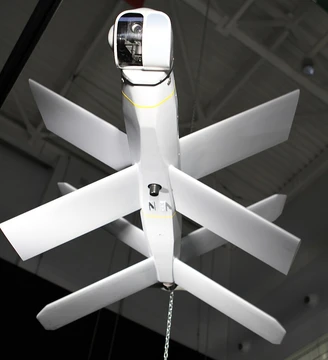
TAI Şimşek
Turkish high-speed target drone simulating enemy aircraft and missiles.

TAI Şimşek is a turbojet-powered, radio-controlled target drone built by Turkish Aerospace Industries for the Turkish Armed Forces. Its name means "lightning" in Turkish. Development began in 2009, and a prototype was shown at that year's International Defence Industry Fair. The drone first flew on August 4, 2012.
Şimşek is used to simulate enemy aircraft and missiles during training for air-to-air, surface-to-air, and anti-aircraft gunnery and missile systems. It looks similar to tactical air-launched decoys (TALDs). The drone is launched from a catapult and recovered by parachute, and it can also operate from navy vessels.
Its payloads include a passive radar cross-section augmenter (Luneburg lens), a passive infrared signature system, a miss distance indicator, a countermeasures dispensing system, and a tracking smoke generator. TAI plans to develop the drone into a cruise missile with "Human-in-the-Loop" guidance for use against mobile or fixed soft targets.
In July 2020, TAI launched Şimşek from an integrated arm on its Anka drone, marking the first time a target drone was launched from a UAV.
**Şimşek-K** The Şimşek-K is the next-generation version, introduced at IDEF 2025. It serves two roles: a fast-moving enemy aircraft for training and a kamikaze (suicide) drone. On August 22, 2025, it completed its first rocket-assisted (RATO) ground launch and struck a ground target with a warhead.
**Süper Şimşek** Süper Şimşek is a high-subsonic tactical UAV, an advanced evolution of the original drone redeveloped into a multi-role, modular platform. Depending on its configuration, it can perform air defense training, electronic warfare, radar jamming and deception, suppression of enemy air defenses (SEAD/DEAD), intelligence, surveillance and reconnaissance (ISR), and loitering munition strikes.
It has a modular payload architecture and can be launched from ground-based rocket-assisted systems or air-launched from platforms like the ANKA, AKSUNGUR, and ANKA-3. It is designed for fully autonomous operation and supports AI-assisted swarm missions.
The Süper Şimşek variant was developed as a larger, more capable platform with increased payload, range, endurance, and mission flexibility. It first flew in December 2023.
Quick Facts
- Aircraft Type
- Unmanned target drone
- Manufacturer
- Turkish Aerospace Industries (TAI)
- Primary User
- Turkish Armed Forces
- First Flight
- August 4, 2012
Facts from the source article.
Lore & Background
Development of the Şimşek began in 2009, and a prototype was presented to the public at the International Defence Industry Fair the same year. The UAV made its maiden flight on August 4, 2012. It is designed to simulate enemy aircraft and missiles for training with air-to-air, surface-to-air, anti-aircraft gunnery and missile systems, and its appearance is similar to tactical air-launched decoys (TALDs).
The drone is launched from a catapult and recovered by parachute, and it can take off from and be controlled from navy vessels. In July 2020, TAI launched Şimşek from a TAI Anka integrated arm, making history by launching a target drone from a UAV for the first time. TAI intends to further develop the drone into a cruise missile with 'Human-in-the-Loop' (HITL) guidance capability for use against mobile or fixed soft targets.
Payloads include a Passive Radar Cross-Section Augmenter (Luneburg lens), Passive IR Signature, Miss Distance Indicator (MDI), Counter-measures Dispensing System, and a Tracking Smoke Generator. Later variants include the Şimşek-K, introduced at IDEF 2025 as a next-generation target and kamikaze drone, and the Süper Şimşek, a larger multi-role platform that first flew in December 2023 and entered limited service in early 2026.
Reader's Guide
The TAI Şimşek represents a foundational step in Turkish unmanned aerial target systems, providing realistic high-speed simulation of enemy aircraft and missiles for training and weapons testing. Its development between 2009 and 2012 addressed the Turkish Armed Forces' need for a dedicated, turbojet-powered target drone. The platform's notable achievement in July 2020—being launched from a TAI Anka UAV—marked the first time a target drone was air-launched from another UAV, demonstrating integration capabilities. The Şimşek's modular payload architecture, including radar and infrared signature augmentation, miss-distance indicators, and countermeasures, made it suitable for a range of training scenarios. Its evolution into the Şimşek-K and Süper Şimşek variants expanded its role from pure target simulation to include loitering munition strikes, electronic warfare, and AI-assisted swarm operations, reflecting a broader trend of converting training platforms into multi-role combat systems. The Süper Şimşek's integration with carrier aircraft such as the ANKA, AKSUNGUR, and ANKA-3, and its entry into limited service in early 2026, underscore its transition from a training tool to an operational asset.
Did You Know?
- Şimşek is the Turkish word for 'lightning'.
- In July 2020, it became the first target drone launched from a UAV (TAI Anka).
- TAI intends to develop the Şimşek into a cruise missile with Human-in-the-Loop guidance.
A Proliferation Beyond the Traditional Powers
The global UAV landscape, as catalogued across dozens of nations, reveals that unmanned aerial capability is no longer the exclusive domain of a handful of aerospace superpowers. From Algeria's AL fajer L-10 and Amel platform to Argentina's Nostromo family of four distinct airframes, from Armenia's Krunk and X-55 to Azerbaijan's AZAD and Orbiter-2M, a remarkable breadth of smaller and mid-sized states have invested in indigenous or locally adapted drone programs. Even nations with modest defense budgets, such as Costa Rica with its SA-SkyHunter aerial mapping system or Croatia with the BL M-99 Bojnik, have entered the field. Brazil alone lists well over thirty distinct UAV projects spanning the Air Force, Navy, and Marine Corps, while Australia fields everything from weather-data Aerosonde variants to the Boeing MQ-28 Ghost Bat. This geographic and institutional spread underscores that unmanned aviation has become a near-universal strategic and commercial priority, with each country tailoring its fleet to local operational needs and industrial capacity.
A Spectrum of Mission Profiles
The sheer variety of operational roles assigned to unmanned aircraft across the documented programs illustrates how deeply the technology has penetrated into both military and civilian life. Reconnaissance and surveillance dominate, appearing in entries from Argentina's Lipán M3 and ARA Guardian to Canada's Aeryon SkyRanger series and France's EADS Harfang. Yet the mission set extends far beyond eyes-in-the-sky. Australia's Aerosonde family is explicitly tasked with weather data collection, while Argentina's AeroVision Arcangel and Brazil's AGPlane serve agricultural and civilian surveillance. Belgium's Gatewing X-100 is oriented toward surveying and mapping, and France's Donecle drone performs autonomous aircraft inspection. At the other extreme, combat and target-drone roles are represented by Dassault nEUROn, Brazil's Aeromot K1AM, and the Aérospatiale C.22. Research and electronic-systems development, as seen in France's AVE-D Petit Duc and Brazil's Acauã, complete a picture in which a single airframe category serves an almost unlimited range of purposes.
Airframe Diversity and the Scale of Ambition
The physical forms and performance envelopes represented in the global UAV inventory span an extraordinary range. At one end sit compact multirotor platforms such as Brazil's Gyro 200 ED and Gyro 500 quadcopters, Colombia's Araknos V2 and Koleopteros, and Australia's V-TOL i-copter Phantom, all designed for short-range, low-altitude tasks. At the opposite extreme, Austria's Schiebel Camcopter S-300 is classified as a heavy-lift multi-role system, and Brazil's 14-X project envisions a Mach 10 scramjet capable of hypersonic flight. Between these poles lie fixed-wing tactical platforms like France's Dassault LOGIDUC and Canada's CL-227 Sentinel, soft-wing designs such as France's Flying-Robots FR102, and soldier-portable mini-UAVs including Brazil's Flight Technologies FT-100 Horus and the 4-kilogram Tiriba. This breadth of airframe architecture, from sub-five-kilogram hand-launched craft to heavy autonomous helicopters, demonstrates that no single design philosophy has dominated the field.
Decades of Iterative Development
The timeline embedded in the country-by-country listings traces more than half a century of continuous experimentation and refinement. Canada's Canadair CL-89, a reconnaissance platform from 1964 jointly funded with the United Kingdom and later West Germany, sits at the earliest point, followed closely by Belgium's MBLE Épervier of 1969 and Argentina's FMA IA X 59 Dronner of 1972. The 1990s and 2000s brought a wave of tactical and mini-UAVs, including Canada's CL-289 (1990), Australia's BAE STRIX, and France's Dassault AVE-D Petit Duc research aircraft (2000). The 2010s saw programs like Australia's Boeing MQ-28 Ghost Bat, Argentina's AeroVision Arcangel (2010), and Brazil's stalled Harpia medium tactical UAV, halted in January 2016. Several entries are explicitly marked as still in development or testing, such as Argentina's Lipán XM4 and Brazil's Flight Technologies VT-15, confirming that the field remains in active, ongoing evolution rather than a settled technology.
Frequently Asked Questions
What is TAI Şimşek?
Şimşek is a turbojet-powered target drone built by Turkish Aerospace Industries for the Turkish Armed Forces. The name means 'lightning' in Turkish. It is designed to mimic hostile aircraft and missiles so that air and ground defense units can rehearse their engagements.
What is the TAI Şimşek's role in military training?
The drone acts as a high-speed aerial target that simulates enemy aircraft and missile threats during live-fire exercises. It supports training for air-to-air combat, surface-to-air missile batteries, and anti-aircraft gunnery crews. Its airframe resembles tactical air-launched decoys, giving operators a realistic practice profile.
How is the TAI Şimşek launched and recovered?
The drone is deployed from a catapult system and brought back to the ground using parachute recovery. This reusable launch-and-recover cycle lets units run repeated training passes without expending a one-shot target.
When was the TAI Şimşek developed and first flown?
Development began in 2009, and a prototype was showcased at that year's International Defence Industry Fair. The drone achieved its maiden flight on August 4, 2012, after roughly three years of development work.
Why is the TAI Şimşek significant for Turkey's defense industry?
It demonstrates Turkey's ability to produce a high-speed, turbojet-powered training target domestically rather than depending on foreign suppliers. By giving the Turkish Armed Forces a homegrown, reusable aerial target, Şimşek bolsters the operational readiness of both air and ground defense units.
More in Loitering Munitions and Target Drones 1-24
Spotted an error? Know more?
Reader corrections go straight into our review queue. Suggest an edit · How this site is sourced