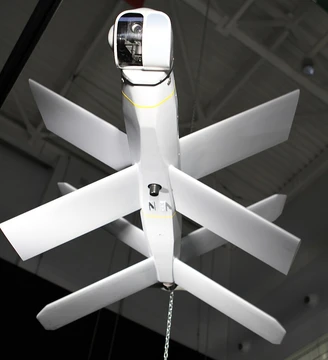
CM-501
Chinese precision-guided missile and loitering munition series by CASIC.

The CM-501 is a series of Chinese precision-guided missiles and loitering munitions developed by China Aerospace Science and Industry Corporation (CASIC). First revealed during the 9th Zhuhai Airshow held in November 2012, the CM-501 can be launched from ground, surface ship, and air platforms upon customers' requests. The series includes non-line-of-sight anti-tank missiles, lightweight variants, and loitering munitions, with modular designs allowing for simplified seeker and datalink options for export customers.
Quick Facts
- Is Missile
- yes
- Origin
- China
- Used By
- People's Liberation Army
- Manufacturer
- China Aerospace Science and Industry Corporation (CASIC)
- Unit Cost
- depends on models
- Propellant
- solid fuel
- Production Date
- 2010s-present
- Service
- 2019-present
- Engine
- CM-501G/GA/CM-502: solid-fuel rocket / CM-501X/XA: turbojet with rocket booster
- Weight
- CM-501G: 150 kg / CM-501GA: 100 kg / CM-501X: 170 kg / CM-501XA: 100 kg / CM-502: 45 kg
- Length
- CM-501GA: 2 m / CM-501X: 3.2 m / CM-501XA: 2 m
- Speed
- CM-502: Mach 1.1
Facts from the source article.
Lore & Background
The CM-501 series was first revealed during the 9th Zhuhai Airshow held in November 2012, developed by China Aerospace Science and Industry Corporation (CASIC). The series encompasses multiple variants: the CM-501G non-line-of-sight missile system, the lightweight CM-501GA, the loitering munitions CM-501X and CM-501XA, and the lightweight CM-502 and CM-502KG. The CM-501G is mounted on a Shaanxi SX2190 truck with two launcher boxes each containing nine missiles in a 3x3 configuration, totaling 18 missiles. The command vehicle can use other chassis such as the Dongfeng EQ2050. The CM-501GA is mounted on a lightweight CTL-181A Mengshi 6x6 MRAP truck chassis, with one radar command vehicle and one launcher vehicle carrying a 12-cell box-shaped launcher unit.
The CM-501G features a combined imaging infrared (IIR) and semi-active laser homing (SAL) seeker head for terminal guidance, supported by satellite navigation and inertial guidance system (INS) for flight navigation. A two-way data link allows in-flight route update and re-targeting. The system supports 'networked engagement', enabling retasking by command posts, forward observers, and friendly units within the data network. For export customers, the modular design allows simplification of the seeker (e.g., replacing IIR with simple satellite targeting or SAL only) and removal of the datalink to lower cost. The CM-501GA uses a combined TV/IIR terminal seeker with INS/satellite guidance and a two-way datalink, capable of targeting fixed structures and slow-moving tanks, ships, and air targets, with a reported CEP of ≤1 m for fixed targets.
The loitering munitions CM-501X and CM-501XA have a cylindrical seeker head and square prism body. The CM-501X weighs 170 kg with a 20 kg warhead, range of 70 km, and endurance of 50 minutes, powered by a turbojet with a rocket booster. The CM-501XA weighs 100 kg with an 8.5 kg warhead, range of 70 km, and endurance of 30 minutes. Both use combined INS and satellite navigation with modular seeker options including TV, infrared, passive radar, and combined IIR with millimeter-wave seeker. The CM-502KG, a lightweight variant, has a mass of 45 kg, warhead of 11 kg, top-attack trajectory, penetration value of 1000 mm, maximum speed of Mach 1.1, and range up to 25 km. It features four chopped control fins, an imaging seeker, two-way data-links, and fire-and-forget capability; up to 16 can be mounted on the Z-10 helicopter.
Reader's Guide
The CM-501 series represents a significant development in Chinese precision-guided munitions and loitering drones, offering a modular family of weapons adaptable to multiple platforms and mission profiles. Its debut at the 9th Zhuhai Airshow in November 2012 highlighted China's growing capability in networked, non-line-of-sight engagement systems. The series' modular design—allowing substitution of seeker heads and optional datalink removal—makes it attractive for export customers seeking cost-effective solutions. The CM-501G's integration with the Shaanxi SX2190 truck and support for networked engagement via two-way datalink enables flexible battlefield coordination. The lightweight CM-501GA and CM-502 variants extend the system's utility to light vehicles, small ships, and helicopters, as demonstrated by the CM-502KG's compatibility with the Z-10 helicopter. The loitering munitions CM-501X and CM-501XA provide persistent surveillance and strike capability with turbojet propulsion and modular seekers. Operators include the People's Liberation Army Ground Force (using CM-501GA, CM-501XA, CM-501X, and CM-502 on helicopters), the Pakistan Army (CM-502KG), the Pakistan Navy, and the Turkmen Ground Forces (CM-502KG). The series' emphasis on modularity, network integration, and multi-platform launch reflects a trend toward versatile, cost-adjustable precision strike systems.
Did You Know?
- The CM-501G has a range of more than 70 km and a warhead of 40 kg.
- The CM-501X loitering munition has an endurance of 50 minutes and a range of 70 km.
- Up to 16 CM-502KG missiles can be mounted on the Z-10 helicopter at once.
Guidance Architecture & Variant Spectrum
The CM-501 family, developed by China Aerospace Science and Industry Corporation and first unveiled at the 9th Zhuhai Airshow in November 2012, spans a broad spectrum of precision munitions unified by a common design philosophy. At the heavy end sits the CM-501G, a 150-kilogram missile with a 40-kilogram warhead and a range exceeding 70 kilometers, steered by two sets of cruciform control fins. Its terminal guidance relies on a combined imaging infrared and semi-active laser seeker, while mid-course navigation is handled by inertial and satellite systems. A two-way data link permits in-flight route changes and re-targeting. The lighter CM-501GA drops to 100 kilograms with a 20-kilogram warhead and a 5-to-40-kilometer envelope, using a television and imaging infrared seeker. At the opposite extreme, the CM-502KG weighs just 45 kilograms, carries an 11-kilogram warhead, and reaches Mach 1.1 with a 25-kilometer reach. Across all variants, CASIC's modular approach lets customers swap seeker packages or drop the datalink entirely to reduce unit cost.
Multi-Platform Integration & Networked Engagement
One of the CM-501 family's defining traits is its platform flexibility. CASIC designed the series to launch from ground vehicles, surface ships, and aircraft, tailored to each customer's operational needs. The CM-501G ground system rides on a Shaanxi SX2190 truck carrying two launcher boxes, each holding nine missiles in a three-by-three arrangement for eighteen rounds total. Elevation and traverse mechanics echo those of the Type 89 rocket system, while the command vehicle—mounted on a chassis such as the Dongfeng EQ2050—houses the operator who handles targeting, engagement, and re-targeting through the two-way data link. The CM-501GA shrinks the footprint further, fitting onto a lightweight CTL-181A Mengshi 6x6 MRAP chassis with a single 12-cell launcher. In the air domain, the CM-502KG can be carried sixteen at a time on a Z-10 attack helicopter. Crucially, the family supports networked engagement, meaning any friendly unit, forward observer, or command post within the data network can retask a missile already in flight.
Export Strategy & International Operators
CASIC built the CM-501 with a clear eye toward the international arms market, and the modular architecture makes that intent visible. For buyers seeking a lower-cost configuration, the imaging infrared seeker head can be swapped for a simpler satellite targeting system or a semi-active laser homing package alone. The two-way datalink, a key feature for in-flight re-targeting, is likewise optional and can be stripped out to bring the unit price down. The family's debut at the 9th Zhuhai Airshow in November 2012 signaled CASIC's push to showcase these systems to foreign delegations. That strategy has borne fruit: Pakistan's Army and Navy have both adopted CM-502KG missiles, and Turkmenistan's ground forces operate the same variant. Domestically, China's People's Liberation Army Ground Force fields CM-501GA and CM-501XA on vertical launch systems built around the CSK-181 chassis, while its helicopter fleet carries CM-501GA, CM-501X, and CM-502 munitions. The breadth of the customer base, from heavy truck-mounted batteries to light helicopter loads, demonstrates how the family's scalability serves very different operational doctrines.
Loitering Munitions & the Extended Family
Beyond its cruise-missile and anti-tank roles, the CM-501 family stretches into the loitering-munition niche with the CM-501X and CM-501XA. Both share a distinctive cylindrical seeker head atop a square-prism body and are powered by a turbojet with a rocket booster. The larger CM-501X weighs 170 kilograms, carries a 20-kilogram high-explosive warhead, and can loiter for 50 minutes within a 70-kilometer control radius. The smaller CM-501XA, at 100 kilograms and a 2-meter length with a 230-by-230-millimeter cross-section, offers 30 minutes of endurance over the same 70-kilometer range. Both feature modular seeker options spanning television, infrared, passive radar, and a combined imaging infrared with millimeter-wave package. The CM-501XA is noted for its ability to stand by after launch and autonomously engage multiple targets. The family's reach extends further still with the CM-506KG, a 150-kilogram air-launched guided bomb with a 130-kilometer maximum range, comparable in concept to the American GBU-53/B StormBreaker.
Frequently Asked Questions
What is the CM-501?
The CM-501 is a family of Chinese precision-guided missiles and loitering munitions produced by CASIC. The series spans anti-tank roles, lightweight variants, and loitering-munition configurations, all built around a modular seeker and datalink architecture tailored for export customers.
Who developed the CM-501?
China Aerospace Science and Industry Corporation (CASIC) is the developer behind the entire CM-501 missile and loitering-munition family.
What launch platforms can the CM-501 be fired from?
Depending on the customer's requirements, the CM-501 can be launched from ground vehicles, surface ships, or aircraft.
What are the CM-501G variant's weight, range, and warhead specs?
The CM-501G weighs 150 kg, carries a 40 kg warhead, and is rated for a range exceeding 70 km.
When and where was the CM-501 first shown to the public?
The CM-501 made its public debut at the 9th Zhuhai Airshow in November 2012.
More in Loitering Munitions and Target Drones 1-24
Spotted an error? Know more?
Reader corrections go straight into our review queue. Suggest an edit · How this site is sourced