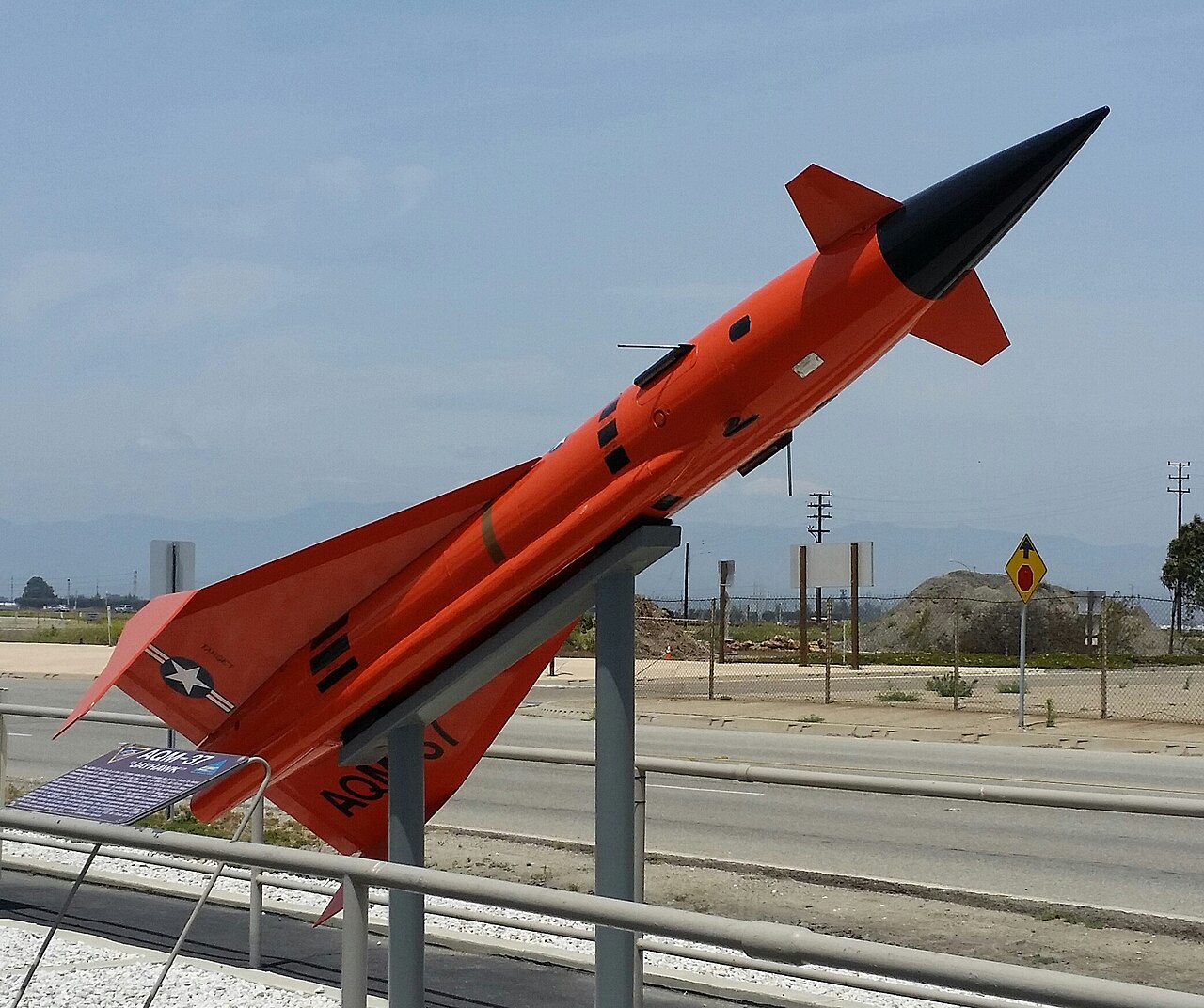
Beechcraft AQM-37 Jayhawk
Supersonic target drone simulating ICBM warhead packages for fleet exercises.

Mts6789 · CC BY-SA 4.0
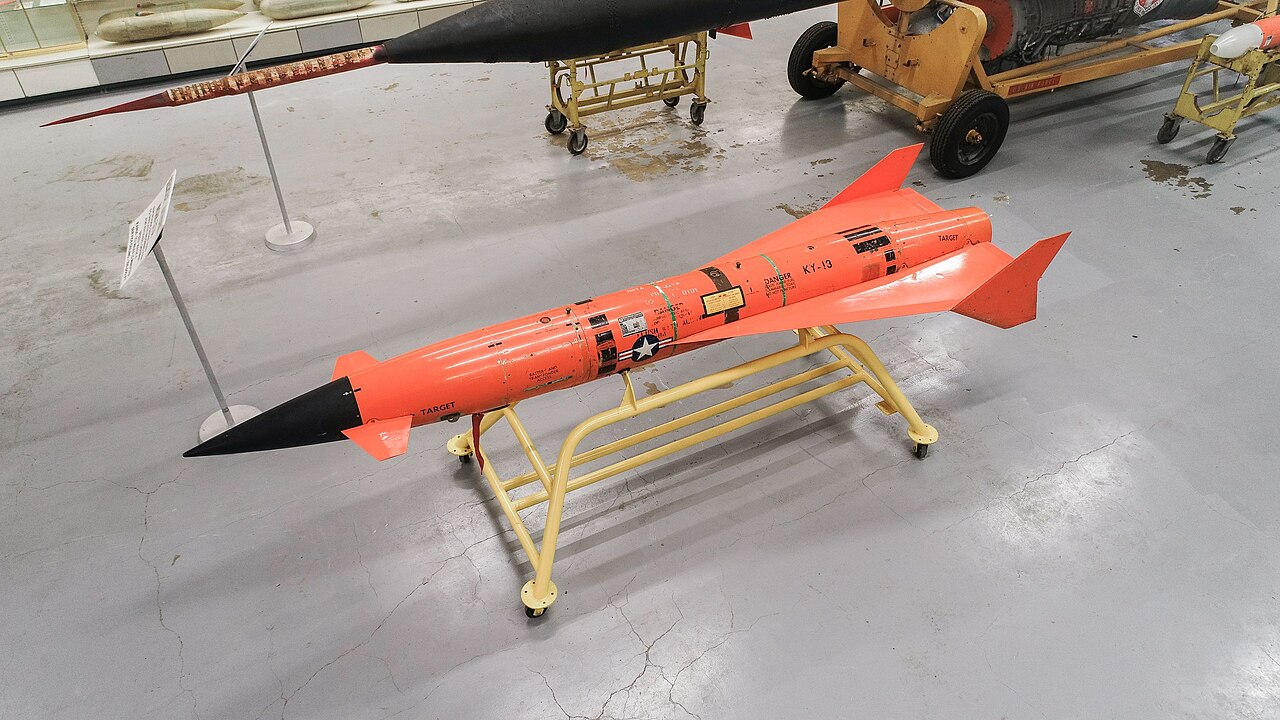
The Beechcraft AQM-37 Jayhawk is an air-launched supersonic target drone originally developed to simulate inbound ICBM warhead packages for fleet shoot-down exercises. Originally designated KD2B and Q-12, it entered service with the US Navy in 1963 and was launched for the final time in September 2022.
Quick Facts
- Manufacturer
- Beechcraft
- First Flight
- May 1961
- Primary User
- US Navy
- More Users
- United Kingdom
- Number Built
- 5,000+
Facts from the source article.
Lore & Background
The AQM-37 was developed in response to a 1959 joint US Navy and US Air Force request for a high-speed expendable target. Beechcraft won the competition, producing a small delta-winged drone with wingtip fins and a liquid rocket motor. The original version, the AQM-37A or Beech Model 1019, was followed by numerous subvariants intended to simulate different threats, such as sea-skimming antiship missiles or high-altitude naval attack missiles. One high-performance variant achieved Mach 4.7 and over 112,000 ft on a ballistic trajectory.
The US Army evaluated the AQM-37A in the late 1960s and bought a small initial batch of recoverable Model 1100/1101 variants fitted with parachute systems, some for low-altitude operation with radar altimeters and others for high-altitude operation with barometric altimeters. The Army later ordered over 400 improved non-recoverable Model 1102 variants. The USAF evaluated the AQM-37 in the early 1970s but was slow to adopt it; records of USAF procurement are sketchy, though it appears to be currently part of the Air Force target inventory. Small quantities were sold to Italy, Israel, and France, while Shorts in Britain built several hundred under licence as the Shorts SD.2 Stiletto. Meteor of Italy also built a number under license.
All variants are air-launched, with the US Navy traditionally using the F-4 Phantom and the British using the Canberra. The engine uses storable hypergolic liquid propellants: inhibited red fuming nitric acid (IRFNA) as oxidizer and MAF-4 (hydyne) as fuel, a mixture of 60% unsymmetrical dimethylhydrazine (UDMH) and 40% diethylenetriamine.
Reader's Guide
The AQM-37 Jayhawk served as a primary target drone for the US Navy for nearly six decades, with more than 5,000 units delivered since the early 1960s. Its ability to simulate a variety of threats—from sea-skimming antiship missiles to high-altitude naval attack missiles and ICBM warhead packages—made it a versatile tool for fleet shoot-down exercises. The final US Navy variant was the AQM-37C, and the last two remaining targets were launched on 22 September 2022, marking the end of its operational service.
The AQM-37 also influenced later development efforts. The US Air Force investigated an alternate propulsion scheme under project 'Sandpiper' in the late 1960s, fitting a few AQM-37As with hybrid rocket engines. This led to the High Altitude Supersonic Target (HAST) program and eventually the Teledyne Ryan AQM-81A Firebolt, which first flew in 1983 but never entered production. The AQM-37's legacy includes its long production run, international sales and licensed production, and its role as a benchmark for supersonic target drones.
Did You Know?
- The AQM-37 was originally designated KD2B by the US Navy and Q-12 by the US Air Force before the joint designation scheme.
- The engine is sometimes credited to Harley Davidson due to a sequence of company buyouts.
- The final US Navy launch of the AQM-37 occurred on 22 September 2022.
Gallery
Frequently Asked Questions
What is the Beechcraft AQM-37 Jayhawk?
It is an air-launched supersonic target drone built to replicate the reentry profile of an ICBM warhead package during fleet defense exercises. The platform carried the earlier designations KD2B and Q-12 before settling on the Jayhawk name.
What role does the Jayhawk serve in Navy operations?
The drone acts as a high-speed aerial target that mimics an incoming ballistic-missile warhead, giving fleet units a realistic threat to practice intercept and shoot-down procedures against.
What are the Jayhawk's top speed and ceiling?
The AQM-37 cruises at up to Mach 4.7 and climbs to altitudes exceeding 112,000 feet, closely matching the flight envelope of a reentering warhead.
When did the Jayhawk first fly and when was it retired?
Its maiden flight took place in May 1961, it entered US Navy service in 1963, and its final launch occurred on 22 September 2022, ending a career of nearly six decades.
Why is the Jayhawk considered a landmark in target-drone history?
With more than 5,000 airframes delivered, it became the longest-serving supersonic target drone in US Navy history, providing a consistent training threat from the Cold War era through the 2020s.
More in Loitering Munitions and Target Drones 1-24
Spotted an error? Know more?
Reader corrections go straight into our review queue. Suggest an edit · How this site is sourced