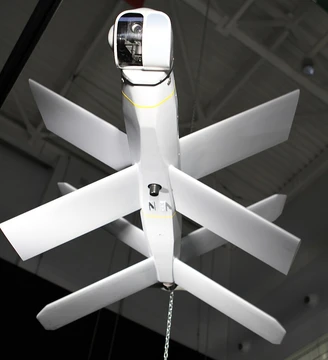
TAI Turna
Turkish target drone used for missile and gunnery training.

The TAI Turna is a turboprop-powered radio-controlled target drone developed by Turkish Aerospace Industries (TAI) for use by the Turkish Armed Forces in target tracking and gunnery firing exercises. Introduced in 2001, it is notable for its role in training with surface-to-air missiles and anti-aircraft guns, and for its evolution from the initial Turna/S version to the advanced Turna/G variant with beyond-visual-range capability.
Quick Facts
- Aircraft Type
- Unmanned drone target drone
- Manufacturer
- Turkish Aerospace Industries (TAI)
- Primary User
- Turkish Armed Forces
- Introduction
- 2001
- First Flight
- September 1996
Facts from the source article.
Lore & Background
The Research and Development Department of the Turkish Ministry of National Defence awarded a contract to TAI in August 1995 for a drone to serve the Turkish Air Force and Army in target tracking and gunnery exercises. The initial version, Turna/S, first launched in September 1996, with prototype testing completed in 1997 and trials by the Turkish Army and Navy ending in 1998. Between 2001 and 2003, new versions (Turna-101A, -111B, -201C) introduced roll-damping avionics, aerodynamic packages, improved stability and greater reliability.
Based on experience from frigate launches and bad-weather sorties, the Turna/G generation was evaluated, with intermediate versions (303C, 401C, 411C, 501D, 502D) improving autonomy, reliability, aerodynamics, stability and modular payload volume. Turna/G gained beyond-visual-range operational capability, which its predecessor lacked, and was introduced in 2003, entering production in late 2004. It was initially powered by a UK-made AR741 rotary engine (38 HP), later fitted with a TEI-TP-1X turboprop manufactured by TAI's subsidiary TEI, first test-flown on April 4, 2008.
The delta-winged UAV with V-tail has an all-composite airframe. Payloads include a passive radar cross-section enhancer (Luneburg lens), acoustic miss distance indicator, infrared flares and smoke. Data link uses encrypted real-time telemetry, with fully autonomous GPS waypoint navigation. The drone launches from a catapult on land or naval vessel and recovers by parachute or skid landing on water.
Reader's Guide
The TAI Turna has served as a dedicated target drone for the Turkish Armed Forces since its introduction in 2001, providing realistic training for Rapier and Stinger surface-to-air missiles as well as anti-aircraft guns ranging from 7.62 mm to 76 mm caliber. Its ability to tow a sleeve or banner for firing practice, or to be fired upon directly, made it a versatile training asset. The evolution from the Turna/S to the Turna/G marked a significant leap, adding beyond-visual-range capability and improved autonomy, reliability and payload flexibility. The integration of a domestically produced TEI-TP-1X turboprop engine reflected a move toward national self-sufficiency in drone propulsion. The drone's operational use from both land-based catapults and naval vessels, combined with its parachute or water-landing recovery, demonstrated adaptability across environments. While primarily a target drone, its development path—spanning multiple variants and incremental upgrades over more than a decade—illustrates the iterative refinement typical of military UAV programs. The Turna remains in service for training exercises, contributing to the readiness of Turkish air defense and naval gunnery crews.
Did You Know?
- The name 'Turna' is the Turkish word for the crane bird.
- The Turna/G variant introduced beyond-visual-range capability, which the Turna/S lacked.
- The drone can be recovered by parachute or by landing on skid in water.
- Firing exercises can take place directly at the drone, not only at a towed sleeve or banner.
More in Loitering Munitions and Target Drones 1-24
Spotted an error? Know more?
Reader corrections go straight into our review queue. Suggest an edit · How this site is sourced