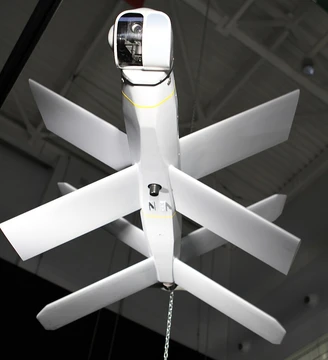
Spike Firefly
Miniature loitering munition for urban warfare against enemies behind cover.

The Spike Firefly is a miniature loitering munition developed by Rafael Advanced Defense Systems. It was designed to provide infantry forces with the capability to engage enemies behind cover during urban warfare. Although it is not an anti-tank guided missile (ATGM) like the rest of the Spike missile family, it is considered part of it from using components developed for them.
Quick Facts
- Origin
- Israel
- Is Ranged
- Yes
- Service
- 2020-present
- Used By
- Israel Defense Forces
- Wars
- Gaza War
- Design Date
- 2018
- Manufacturer
- Rafael Advanced Defense Systems
- Production Date
- 2018–present
- Weight
- 2.2 kg
- Height
- 400 mm
- Filling
- 420 g
- Engine
- Electric motor
Facts from the source article.
Lore & Background
The Spike Firefly, now known as the L-Spike 1x, is a small loitering munition made by Rafael Advanced Defense Systems. It was designed to help infantry hit enemies hiding behind cover in cities. Unlike other Spike missiles, it is not an anti-tank guided missile, but it shares many of their parts.
The munition has three main sections. The top holds sensors: an uncooled thermal imager, a daytime electro-optical camera, and a proximity sensor that can lock onto and chase fast-moving targets. The middle section is a battery that gives 15 minutes of flight time. The bottom can carry either a 350-gram blast fragmentation warhead for attacks or a second battery that doubles endurance to 30 minutes for reconnaissance. It can fly itself along waypoints or be steered by an operator to find and strike targets out of direct sight. The operator can cancel an attack mid-flight, and the munition can fly back to be used again.
Power comes from a battery running two electric motors, each spinning a pair of counter-rotating blades. This lets it take off and land vertically, hover, and stay quiet. The body is 400 mm tall, 80 mm wide, and weighs 3 kg. It can be controlled up to 1,500 meters in open areas or 500 meters in a city. Its top speed is 60 km/h, rising to 70 km/h when diving on a target, and it can handle winds up to 36 km/h. A full system includes three munitions stored in tubes and a 1 kg control unit, all carried in a backpack by one soldier, totaling 15 kg. It is meant for use at the company level.
Rafael first showed the Spike Firefly in June 2018. In May 2020, the Israel Defense Forces said they were buying it and named it Maoz. It saw its first combat use during the July 2023 Jenin incursion. After the October 7 attacks, it was used in the Gaza Strip during the Gaza War. In 2025, Rafael renamed the upgraded version the L-Spike 1x. That version weighs 2.2 kg, carries a 420 g warhead, and has a control range of 5,000 meters.
Reader's Guide
The Spike Firefly represents a notable development in loitering munitions, specifically tailored for infantry units in urban combat. Its ability to hover, perform vertical takeoff and landing, and engage targets behind cover addresses a tactical gap in close-quarters fighting. The munition's design, borrowing components from the Spike missile family, allowed it to leverage existing technology while serving a distinct role. Its operational debut during the July 2023 Jenin incursion and subsequent use in the Gaza War demonstrated its practical application in real-world conflicts. The later upgrade to the L-Spike 1x, with reduced weight, a larger warhead, and extended range, indicates ongoing refinement. The system's operator-in-the-loop capability, allowing abort and reuse, distinguishes it from expendable munitions and emphasizes flexibility. Its integration at the company level and carriage by a single operator highlight its intended accessibility for frontline forces. The Spike Firefly's presence in the IDF as the Maoz and its continued evolution underscore its role in modern urban warfare tactics.
Did You Know?
- The Spike Firefly can be reused if a strike is aborted, thanks to its operator-in-the-loop function.
- It was first used in combat during the July 2023 Jenin incursion.
- The munition can operate in wind speeds up to 36 km/h.
- An upgraded version was renamed the L-Spike 1x in 2025.
More in Loitering Munitions and Target Drones 1-24
Spotted an error? Know more?
Reader corrections go straight into our review queue. Suggest an edit · How this site is sourced