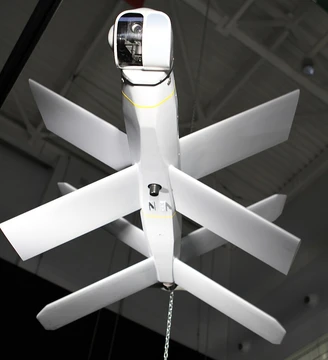
Rheinmetall FV-014
German fixed-wing loitering munition for contested electronic warfare environments.

The Rheinmetall FV-014 is a fixed-wing loitering munition—commonly called a kamikaze drone—built by the German defense firm Rheinmetall. It is intended for use in environments where electronic warfare is intense, merging surveillance and reconnaissance with the ability to deliver precision strikes. Its targets include heavy armor, artillery emplacements, and command posts, with an operational reach of up to 100 kilometers.
The drone launches from a rectangular transport-and-launch container using a solid-fuel booster rocket. After launch, it extends folding wings and shifts to aerodynamic flight, driven by a rear-mounted electric pusher propeller. This electric motor is designed to keep acoustic and thermal signatures low during the final approach. The airframe uses faceted geometric shapes to reduce its radar cross-section. The total launch weight is about 20 kilograms.
Flight endurance reaches 70 minutes, with a maximum range of 100 kilometers, supported by a secure data link that functions up to 60 kilometers away. The warhead is a 5-kilogram high-explosive dual-purpose shaped-charge fragmentation type, which Rheinmetall says can penetrate over 600 millimeters of rolled homogeneous armor. Control is human-in-the-loop via a portable ground station, allowing an operator to confirm targets, abort strikes, or coordinate swarms. The system is specifically built to work where Global Navigation Satellite Systems are jammed or unavailable.
On February 18, 2026, Rheinmetall demonstrated the FV-014 in a live-fire event for an unnamed prospective NATO customer. The test occurred at the National Test Centre for Unmanned Aerial Systems, run by the German Aerospace Centre in Cochstedt, Saxony-Anhalt. The munition performed several attack profiles, including hitting a simulated armored vehicle.
Defense analysts and outlets like Defense Express have noted that Rheinmetall claimed the FV-014 had gained "combat experience" before its public test. Observers have speculated that early prototypes were secretly field-tested by Ukrainian forces during the Russo-Ukrainian War, given that conflict is the main modern proving ground for unmanned systems in contested electronic warfare conditions. Rheinmetall has not officially confirmed any specific deployments in Ukraine.
Quick Facts
- Origin
- Germany
- Is Missile
- Yes
- Designer
- Rheinmetall
Facts from the source article.
Lore & Background
The FV-014 is launched from a rectangular transport-and-launch container using a solid-fuel booster rocket. Once airborne, it deploys folding wings and transitions to aerodynamic flight powered by a rear-mounted electric pusher propeller, designed to minimize acoustic and thermal signatures during the terminal approach. The airframe features faceted geometric structures intended to reduce the drone's radar cross-section. The system uses a human-in-the-loop control architecture via a portable ground station, allowing an operator to validate targets, abort strikes, or coordinate swarm attacks, and is specifically engineered to operate where Global Navigation Satellite Systems are jammed or denied.
On February 18, 2026, Rheinmetall conducted a live-fire demonstration for an undisclosed prospective NATO customer at the National Test Centre for Unmanned Aerial Systems, operated by the German Aerospace Centre in Cochstedt, Saxony-Anhalt. During the demonstration, the munition successfully executed various attack profiles, including striking a simulated armored vehicle target. Defense analysts and media outlets, including Defense Express, have noted that Rheinmetall previously claimed the FV-014 system had acquired combat experience prior to its official public testing. Observers have speculated that early prototypes were secretly field-tested by Ukrainian forces during the Russo-Ukrainian War, though Rheinmetall has not officially confirmed specific deployments in Ukraine.
Reader's Guide
The Rheinmetall FV-014 represents a notable entry in the class of loitering munitions designed for high-threat electronic warfare environments. Its combination of a 100 km range, 70-minute endurance, and a 5 kg HEDP warhead capable of penetrating over 600 mm of armor positions it as a system intended for engaging heavy armor and fortified positions. The use of a human-in-the-loop control architecture and resistance to GNSS jamming reflect a design philosophy prioritizing operator oversight and resilience against electronic countermeasures. The live-fire demonstration in February 2026 for a prospective NATO customer indicates ongoing interest from allied forces. The unconfirmed speculation regarding early field testing in Ukraine, if accurate, would place the FV-014 among a small number of loitering munitions to have seen combat in a major conflict characterized by intense electronic warfare. The system's faceted airframe and electric propulsion suggest an emphasis on low observability during the terminal phase. Its significance lies in its integration of ISR and strike capabilities in a compact, container-launched package, tailored for contested battlespaces where satellite navigation may be unreliable.
Did You Know?
- The warhead is claimed to penetrate more than 600 mm of rolled homogeneous armour.
- Rheinmetall has not officially confirmed specific deployments of the FV-014 in Ukraine.
More in Loitering Munitions and Target Drones 1-24
Spotted an error? Know more?
Reader corrections go straight into our review queue. Suggest an edit · How this site is sourced