Qods Saeghe
Iranian recoverable target drone with two guidance variants.

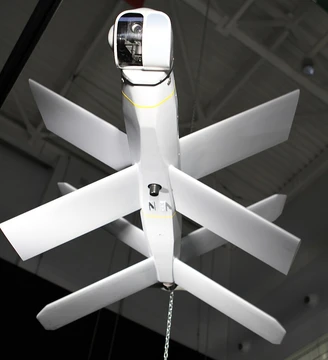
The Qods Saeghe, meaning "lightning bolt," is a straightforward Iranian target drone designed for recovery and reuse. Its airframe features low-mounted delta wings, a bullet-shaped fuselage, and a sweptback wing rudder, with control surfaces on the horizontal stabilizers. The entire structure is made of composite materials. Power comes from a single 18.6 kW (25 hp) WAE-342 pusher engine. The drone launches via a small rocket from a short metal rail, a JATO system, and is recovered by parachute over land or water—its plastic construction allows it to float—or by belly-landing on flat terrain.
Two versions exist. The Saeghe-1, also called the N-Q-A 100, relies solely on radio command guidance for its flight path and maneuvers. The Saeghe-2 shares the same airframe but features more advanced avionics, including tele-command and telemetry uplinks and downlinks with a ground control station that can fit in a small van. It also has GPS navigation for autonomous waypoint following beyond the operator’s line of sight. The Saeghe-2 carries a gyrostabilized radar reflector and three infrared flares, and it first flew in 2002. Both versions use a booster for launch and a parachute for recovery. Operators include the Islamic Republic of Iran Armed Forces and the Syrian Armed Forces.
Quick Facts
- Aircraft Type
- Target drone
- National Origin
- Iran
- Manufacturer
- Qods Aviation, Tehran / SSRC, Damascus
- Design Group
- Qods Aviation
- Primary User
- Iranian Armed Forces
Facts from the source article.
Lore & Background
The Saeghe has low-mounted delta wings and a bullet-shaped fuselage, with a sweptback wing rudder and no landing gear. Control surfaces are located on the horizontal stabilizers. The drone is constructed entirely of composite material and is powered by a single 18.6 kW (25 hp) WAE-342 pusher engine in a pusher configuration. It is launched via a small rocket from a short metal rail (JATO launch) and recovered by parachute over land or water—as a plastic drone, it floats—or by skidding on its belly over flat terrain.
The Saeghe comes in two versions. The Saeghe-1 (also known as the N-Q-A 100) uses simple radio command guidance for flight path and maneuvers. The Saeghe-2 shares the same airframe but has more advanced avionics, including tele-command and telemetry uplinks and downlinks between the drone and the ground control station, as well as GPS navigation for following navigational points on autopilot beyond line-of-sight. The Saeghe-2 carries a gyrostabilized radar reflector and three IR flares, and is controlled from a ground control station that can be carried in a small van. The Saeghe-2 first flew in 2002.
Reader's Guide
The Qods Saeghe represents a straightforward, cost-effective approach to target drone design, emphasizing simplicity and recoverability. Its composite construction and JATO launch allow for rapid deployment from austere locations, while parachute recovery—over water or land—enables reuse. The two variants illustrate a progression from basic radio command to GPS-based autonomous navigation, reflecting incremental upgrades in guidance technology. The Saeghe-2's inclusion of a gyrostabilized radar reflector and IR flares indicates its role in simulating larger aircraft for training or testing air defense systems. Operated by Iran and Syria, the Saeghe demonstrates how a basic airframe can be adapted to different levels of control sophistication without major structural changes. Its first flight in 2002 places it within a period of expanding Iranian unmanned systems development.
More in Loitering Munitions and Target Drones 1-24
Spotted an error? Know more?
Reader corrections go straight into our review queue. Suggest an edit · How this site is sourced