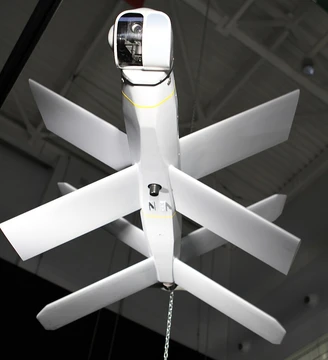
North American MQM-42
Supersonic target drone used for Hawk missile training.

The North American MQM-42 was a supersonic target drone built for the U.S. Army by North American Aviation (later North American Rockwell). It came in two versions: the Redhead, designed for high-altitude flight up to 60,000 feet, and the Roadrunner, meant for low-altitude operation as low as 300 feet. Both could fly between Mach 0.9 and Mach 2. The drone had a conventional design with small delta wings, a downswept tailplane, and a vertical stabilizer that also served as a mount for its ramjet engine. A solid-propellant rocket boosted it to ramjet operating speed, and it launched from the same launcher used for the MGR-3 Little John rocket. An autopilot maintained a preset altitude, but a ground control station could override it via radio command. If not shot down, the drone could be recovered by a retrorocket that slowed it for parachute deployment, triggered either by ground command or automatically if fuel ran out or control was lost. First flown in 1961, the drone received the designation MQM-42A in 1963 for both variants. It was mainly used to train soldiers in tracking and engaging targets for the MIM-23 Hawk missile system, remaining in Army service through the mid-1970s.
Quick Facts
- Aircraft Type
- Target drone
- National Origin
- United States
- Manufacturer
- North American Aviation
- Primary User
- United States Army
- First Flight
- 1961
Facts from the source article.
Lore & Background
The MQM-42, given the company designation NA-273, was a small aircraft of largely conventional design featuring small delta wings and a downswept tailplane. Its vertical stabilizer doubled as a pylon for the aircraft's ramjet engine, and a solid-propellant rocket provided thrust until the ramjet reached operating speed. Launch was from the same launcher used by the MGR-3 Little John battlefield rocket. Two minor variants were produced: 'Redhead' optimized for high-altitude flight up to 60,000 ft, and 'Roadrunner' for low-altitude operation as low as 300 ft above the ground. Both could reach speeds between Mach 0.9 and Mach 2. An autopilot set to maintain a preset altitude provided control, with radio command guidance from a ground control station able to override the autopilot. At the end of a flight, if not shot down, recovery could be either on command from the ground station or automatic in case of fuel exhaustion or loss of control; a retrorocket would decelerate the drone to allow deployment of a recovery parachute.
Reader's Guide
The MQM-42's significance lies in its role as a realistic supersonic target for training United States Army personnel in tracking and engaging targets with the MIM-23 Hawk surface-to-air missile. Its two specialized variants—Redhead for high-altitude and Roadrunner for low-altitude profiles—allowed the Army to simulate a range of threat scenarios. The drone's design, using a ramjet engine boosted by a solid-propellant rocket and launched from a Little John rocket launcher, demonstrated a practical approach to achieving sustained supersonic speeds in a recoverable target drone. The MQM-42 remained in service through the mid-1970s, providing a critical training tool during a period of evolving air defense needs. Its recovery system, using a retrorocket and parachute, enabled reuse of the drone, which was important for cost-effective training. The program's legacy is that of a dedicated, purpose-built target drone that directly supported the operational readiness of Hawk missile batteries.
Did You Know?
- The MQM-42 was developed under the company designation NA-273.
- It was launched from the same launcher as the MGR-3 Little John battlefield rocket.
- The 'Redhead' variant was optimized for altitudes up to 60,000 ft, while 'Roadrunner' could operate as low as 300 ft.
- Recovery was achieved by a retrorocket that decelerated the drone before a parachute deployed.
More in Loitering Munitions and Target Drones 1-24
Spotted an error? Know more?
Reader corrections go straight into our review queue. Suggest an edit · How this site is sourced