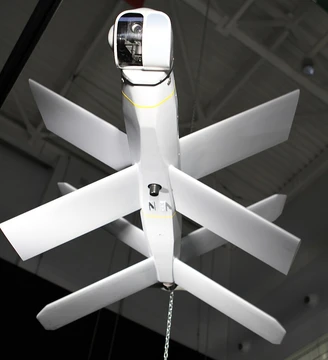
Nord CT41
French supersonic target drone for interceptor training.

The Nord CT.41 Narwhal was a French target drone developed by Nord Aviation starting in 1957. It was built to help train pilots in intercepting supersonic bombers. The drone had a canard layout, with a short, straight wing mounted at the middle of the fuselage and ramjet engines on the wingtips. It launched from an elevating ramp, using two solid rocket boosters to get airborne; the ramjets ignited once the drone reached Mach 1.7. Operators controlled it via command guidance, and it could be fitted with electronic enhancers or flares to make it a more visible target. Two versions existed: the CT.41A for high-altitude missions and the CT.41B for low-altitude work. If not shot down, the drone was recovered by parachute.
Test flights began in 1959, and production started that same year. The French Air Force received 62 units, but they were retired after a short service life because they were too fast for practical interceptor training. In November 1960, Hawker Siddeley obtained a manufacturing license for the type. Bell Aircraft also acquired six drones for evaluation by the United States Navy and secured a production license; the U.S. designated it the PQM-56A in 1962. The PQM-56A was withdrawn from service by the early 1970s.
Quick Facts
- Aircraft Type
- Target drone
- National Origin
- France
- Manufacturer
- Nord Aviation
- Primary User
- French Air Force
- More Users
- United States Navy
- Number Built
- 62
- Introduction
- 1960
- Retired
- 1971 (U.S. Navy)
- First Flight
- c.1959
Facts from the source article.
Lore & Background
Development of the CT.41 began in 1957. The drone featured a short, straight wing at mid-fuselage with ramjet engines mounted on the wingtips. Launch was assisted by two solid rocket boosters that provided initial thrust; the ramjets ignited at Mach 1.7. Command guidance controlled the aircraft, and it could be fitted with electronic enhancers and flares to increase its target signature. Recovery, if the drone was not shot down, was via parachute.
Two variants were produced: the CT.41A for high-altitude use and the CT.41B for low-altitude training. Test flights began in 1959, with production starting later that year. A total of 62 aircraft were built for the French Air Force. Their service life was brief, as the drone proved too fast to provide practical training for interceptor pilots.
In November 1960, Hawker Siddeley acquired a manufacturing license for the type. Bell Aircraft acquired six examples for evaluation by the United States Navy and also obtained a production license; the type received the U.S. designation PQM-56A in 1962. The PQM-56A was out of service by the early 1970s.
Reader's Guide
The Nord CT.41 Narwhal is notable as a dedicated supersonic target drone developed during the late 1950s to meet the training needs of intercepting fast bomber aircraft. Its canard configuration and wingtip-mounted ramjet engines were distinctive design choices aimed at achieving and sustaining supersonic speeds. The drone's operational history reveals a paradox: while it successfully reached high speeds, it was ultimately too fast for the very training it was designed to support, leading to a short service life with the French Air Force. The type's international reach, through licensing to Hawker Siddeley and Bell Aircraft, and its evaluation by the United States Navy under the designation PQM-56A, indicate that the concept of a supersonic target drone was of interest beyond France. However, the PQM-56A also saw limited service, being retired by the early 1970s. The CT.41 thus represents an early attempt to create a realistic high-speed target for air defense training, but one whose performance exceeded the practical requirements of the era's interceptor pilots.
Did You Know?
- The CT.41 used a canard configuration with wingtip-mounted ramjet engines.
- Its ramjets ignited at a speed of Mach 1.7 after launch by solid rocket boosters.
- The U.S. Navy evaluated six examples under the designation PQM-56A.
More in Loitering Munitions and Target Drones 1-24
Spotted an error? Know more?
Reader corrections go straight into our review queue. Suggest an edit · How this site is sourced